Why Operational Visibility Matters in Virtual Learning
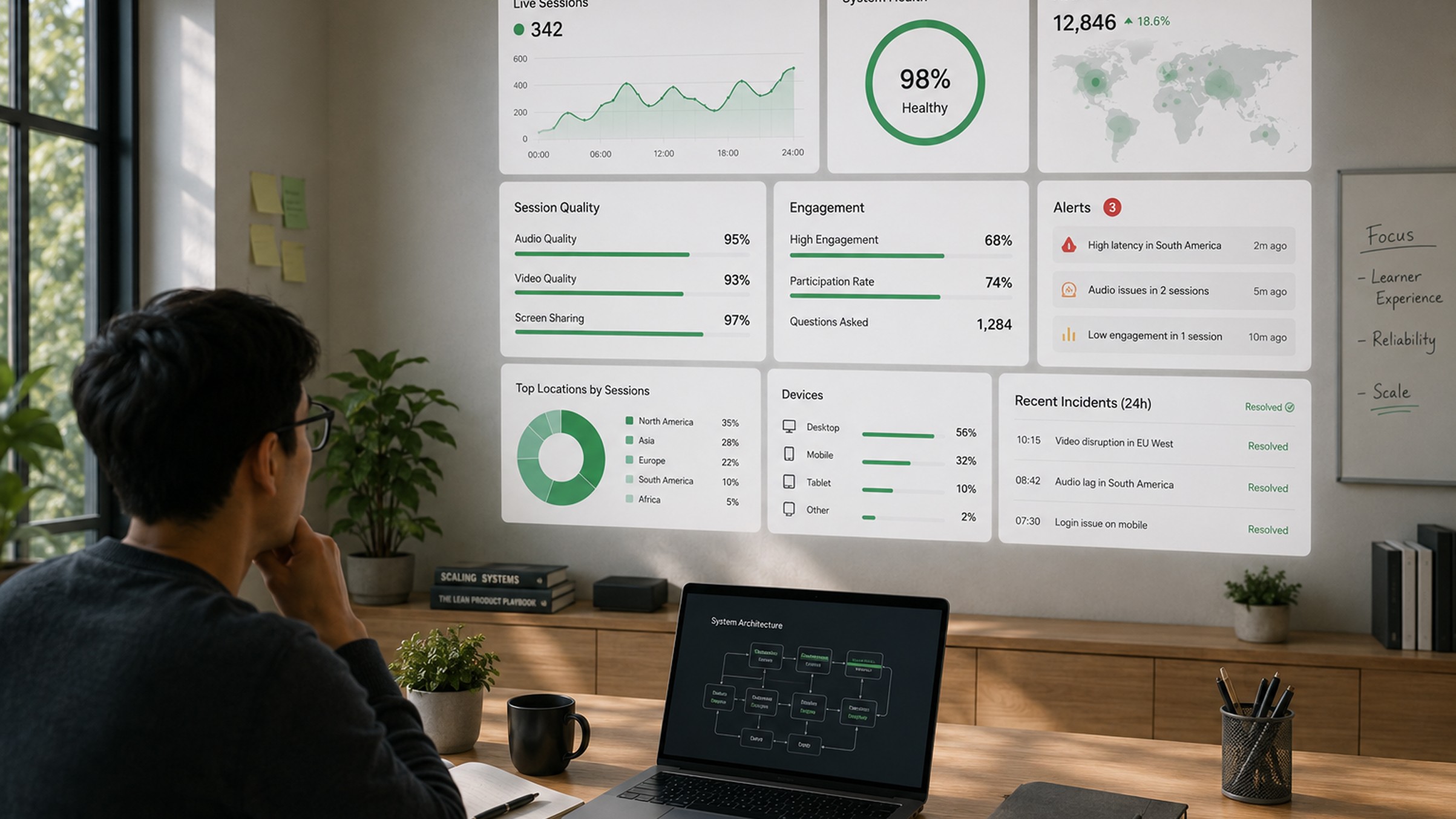
Most education organizations know when something has gone badly wrong. A student cancels. A parent complains. An instructor reports a difficult session. These signals are impossible to miss.
What's harder -- and more important -- is knowing what's going wrong before it becomes a visible problem.
A student whose engagement has been declining for three weeks. An instructor whose sessions consistently run short. A time slot that produces lower participation across all the students assigned to it. A pattern in comprehension check results that suggests a curriculum gap. These are the signals that operational visibility in virtual learning is designed to surface.
Without systematic visibility, education organizations manage reactively. Problems appear when they're already serious. Interventions happen after the damage is done. The only feedback mechanisms are complaints and cancellations -- both of which come too late.
With operational visibility built into the learning infrastructure, organizations can manage proactively. Patterns emerge from data before they become crises. Instructors have the context to teach more responsively. Operations teams can allocate attention where it's actually needed. Quality becomes something the organization manages systematically rather than something it hopes for and discovers after the fact.
The Hidden Operational Layer of Online Learning
Virtual learning looks like a session between a teacher and a student. That session is visible. Evaluable. Concrete.
What surrounds it is less visible: a dense operational layer that determines whether the session happens correctly, whether it's documented, whether the right people know what happened, and whether it connects meaningfully to the sessions before and after it.
This operational layer includes scheduling and coordination -- the workflows that get the right instructor and student into the right session at the right time, and handle the inevitable exceptions without requiring manual intervention for every edge case. It includes session setup and provisioning -- the technical configuration that makes sessions work without instructor or student effort. It includes documentation -- the records that maintain continuity, inform parent communication, and provide the raw material for quality monitoring. It includes communication workflows -- the pre-session reminders, post-session summaries, and progress updates that keep students and parents informed. And it includes the reporting and analytics layer that makes the accumulated data from all of these functions visible in a form that operations teams can act on.
Each of these components generates information. Scheduling systems know when sessions are booked, changed, and cancelled. Session platforms know who attended, for how long, and with what engagement. Documentation systems know what was covered and how students performed. Communication systems know whether messages were sent and when.
The problem in most online learning operations isn't that this information doesn't exist. It's that it's fragmented across systems that don't share data, or captured inconsistently, or only accessible in formats that require significant manual effort to make useful. Information that can't be seen in time to act on isn't operational visibility. It's historical record.
Operational visibility in virtual learning means having the information generated by the learning operation visible, timely, and connected -- so that the people who need to act on it can do so before problems compound.
Why Visibility Impacts Learning Outcomes
The connection between operational visibility and learning outcomes is indirect but real.
Operational visibility doesn't teach. What it does is surface the conditions under which teaching is or isn't working -- early enough that those conditions can be addressed.
A student who misses two sessions in a row and hasn't received a follow-up from the organization is a student whose likelihood of continuing to decline just increased. An instructor who walks into a session with no context about the student's previous performance is an instructor whose ability to teach responsively has been undermined. An operations team that has no visibility into engagement patterns across its student population is an operations team that can't distinguish between students who are thriving and students who are quietly falling behind until the latter group disappears.
The relationship is asymmetric. Good visibility doesn't guarantee good outcomes, because visibility is an operational capability, not a teaching capability. But poor visibility almost guarantees some proportion of bad outcomes that could have been prevented -- because problems that could have been caught early are instead caught late, and late interventions are less effective than early ones.
Outcome data from physical education bears this out. Schools with systematic attendance monitoring, structured parent communication, and regular progress reporting consistently produce better retention and completion rates than those without -- not because the teaching is better, but because the support systems around the teaching are better designed to catch and respond to problems. The principle transfers directly to virtual learning environments.
Operational visibility is how virtual learning organizations build those support systems at scale. Not by hiring more coordinators to manually track every student, but by building infrastructure that surfaces the right signals automatically and directs human attention to where it's needed.
Engagement and Attendance Systems
Attendance is the simplest form of operational visibility in virtual learning, and it's where many organizations stop.
Attendance tells you whether a student showed up. It tells you nothing about what happened after they did. An organization that tracks attendance but not engagement is collecting a necessary but insufficient dataset.
Engagement data adds the dimension that attendance lacks: what was happening during the session. Participation rates on comprehension checks. Whiteboard activity. Hand-raise patterns. Response latency on interactive exercises. Periods of inactivity in tools that should be producing interaction. Taken together, these signals give instructors and operations teams a picture of cognitive presence rather than just physical presence.
The operational requirements for useful engagement tracking are specific. Data has to be captured automatically, without depending on instructor configuration for each session. It has to be available in a form that enables comparison -- across sessions for the same student, across students for the same instructor, across time periods for the same organization. And it has to be surfaced through mechanisms that direct attention efficiently, because an operations team that has to manually review engagement data for every student isn't using the data effectively.
Exception-based surfacing is the model that works at scale. Define what normal engagement looks like. Surface the students and sessions that fall outside it. Let the operations team investigate those rather than reviewing everything.
The combination of attendance and engagement data is what enables the specific kind of proactive intervention that operational visibility is for. A student who missed last week's session and whose engagement scores have been declining for a month is a student who needs outreach now, not after they cancel. Attendance alone doesn't tell you that. Engagement alone doesn't tell you that. Both together, surfaced by a system designed to connect and analyze them, do.
Session Analytics and Reporting
Session analytics are the organizational layer of operational visibility -- the view that sits above individual sessions and reveals patterns that no single session shows.
Individual session data is informative for the instructor in that session. Aggregate session data is what makes quality management possible at scale.
A few examples of what becomes visible at the organizational level with consistent session analytics:
Instructor performance patterns. An instructor whose sessions consistently produce lower engagement scores than peers isn't necessarily a bad instructor -- the cause might be a difficult student cohort, an unsuitable subject assignment, or a scheduling issue. But the pattern is worth investigating, and it won't be investigated if it isn't visible. Session analytics make it visible.
Curriculum coverage gaps. When session data is connected to planned curriculum, analytics can show which topics are consistently covered and which are consistently skipped or abbreviated. If multiple instructors are spending less time on a particular concept than the curriculum plan specifies, that's a curriculum design signal or a training gap -- and it's invisible without coverage data.
Session timing and quality correlation. Some time slots consistently produce lower engagement than others. Some session lengths consistently produce better outcomes. These correlations are invisible at the individual session level and only emerge at the aggregate level.
Retention risk patterns. Students who show a specific combination of declining attendance and declining engagement in the same period cancel at higher rates than those who don't. Surfacing that combination early is the difference between proactive retention work and retroactive churn analysis.
For organizations that take reporting seriously, session analytics are not a reporting feature -- they're a management tool. The questions they answer directly inform operational decisions: which instructors need support, which students need intervention, which scheduling assumptions need revising, which curriculum elements need redesign.
AI-Powered Operational Intelligence
AI extends the reach of operational visibility by making pattern detection systematic and scalable.
Human reviewers can identify patterns in small datasets. As session volume grows, the dataset grows faster than review capacity. An operations team can manually review engagement trends for twenty students. It cannot do the same for five hundred without a system that preselects where to look.
AI-powered operational intelligence automates the pattern detection and directs human attention to the cases that warrant it. A student whose engagement has declined over the last six sessions. An instructor whose comprehension check completion rates have dropped relative to their baseline. A group of students with the same instructor whose progress has stalled while comparable groups with other instructors are advancing. These patterns exist in the data. AI surfaces them. Humans decide what to do about them.
The AI layer also adds value in session documentation. When every session generates a structured recap from AI processing of the transcript, the documentation dataset becomes both complete and consistent -- two properties that manual documentation doesn't reliably achieve. Complete means every session has a record. Consistent means the records are in a comparable format that supports aggregate analysis.
Documentation that's complete and consistent is the foundation for reporting that's actually useful. An organization that has accurate, structured session notes for every session over the past six months has a dataset that can answer real operational questions. An organization whose documentation is patchy and variable has noise.
The combination of automated pattern detection and systematic documentation is what gives AI-powered operational intelligence its operational value. Neither is sufficient alone. Together, they create an organizational picture of live learning that informal systems simply cannot produce.
Scaling Learning Operations Effectively
Operational visibility becomes critical at scale for a simple reason: the things that were visible through direct personal contact at small scale become invisible without systems as volume grows.
At twenty active students, an operations manager knows every student personally. They notice when someone's been quiet. They follow up on missed sessions by instinct. They hear from instructors about struggling students through informal channels. Visibility is maintained through relationship.
At two hundred active students, none of that holds. Informal relationship-based visibility has a ceiling, and it's well below two hundred students. Above that ceiling, the operations team is either overwhelmed trying to maintain the same personal approach at scale, or they're operating in the dark -- unaware of problems until they become visible through complaints and cancellations.
Scaling learning operations effectively means building systems that maintain visibility as volume grows, so that the quality of attention a student receives doesn't depend on whether they happen to be in the operations manager's mental top twenty.
The practical infrastructure for scalable visibility: session data capture that is automatic and consistent, not dependent on instructor compliance. Engagement monitoring that surfaces exceptions rather than requiring full-dataset review. Reporting that gives operations teams a real-time organizational view, not a weekly summary compiled from manual reports. Communication workflows that trigger automatically on session events, ensuring every student and parent receives timely information without requiring per-session manual effort.
Platforms like HiLink are built with this operational visibility layer as core infrastructure, not an add-on. Session management, real-time engagement data, automated documentation workflows, and AI-powered pattern detection are integrated components of the platform -- designed to give education operators and platform builders the organizational visibility that makes managing live learning at scale actually tractable.
The sessions are visible. The teaching is visible. What operational visibility in virtual learning makes possible is seeing the full picture of what's happening across the operation, in time to act on it.
That's the difference between managing reactively and managing well.