Why Modern Education Platforms Need More Than Video Calls
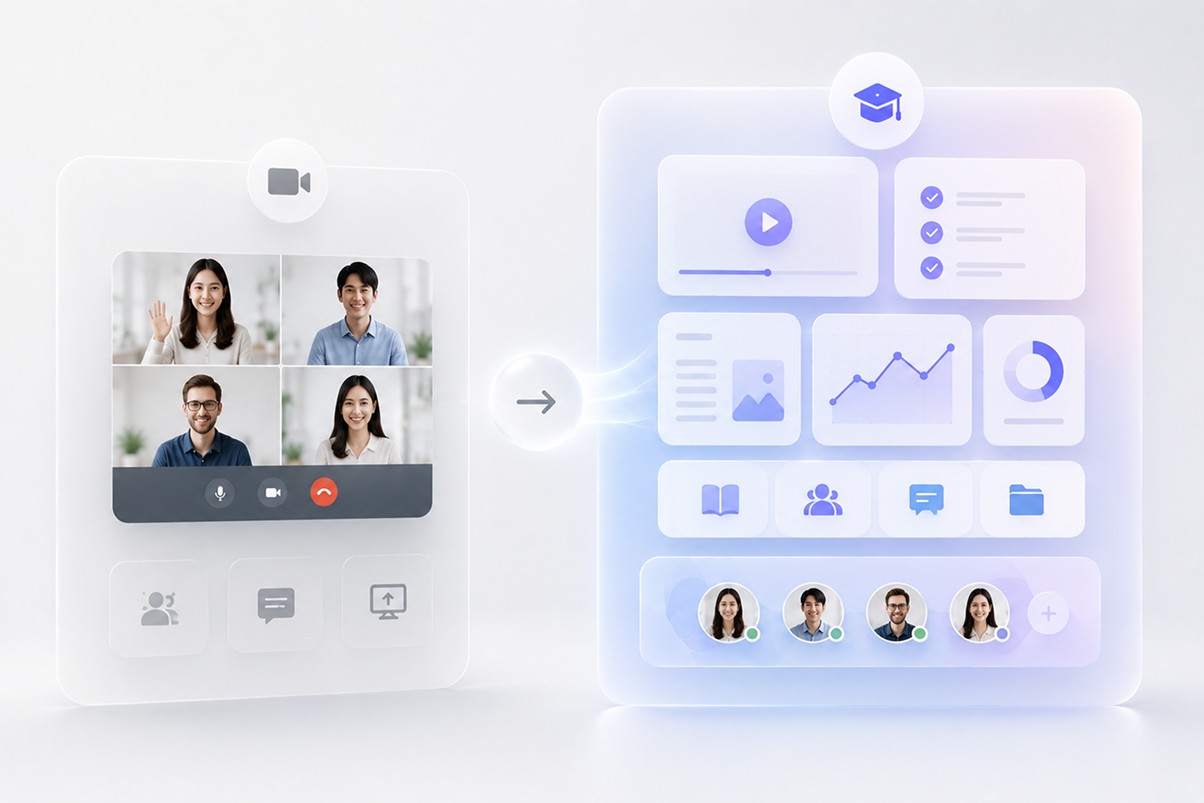
When online learning went mainstream, video calls became the default solution. Schools adopted them overnight. Tutoring companies built their entire operations on top of them. And for a while, that felt like enough.
It wasn't.
The cracks appeared slowly. Instructors managed their own attendance sheets. Session notes lived in personal inboxes. There was no reliable way to know whether students were actually learning -- or just showing up and zoning out. Scaling from 50 sessions a week to 500 meant hiring more coordinators, not getting better infrastructure.
Modern education platforms are built around a different premise: that running online learning well is an operational problem, not just a technology problem. Video is one small piece of a much larger puzzle.
Video Communication Is Not the Same as Learning Infrastructure
This is the distinction that gets glossed over most often.
Video conferencing tools are designed to put people in the same digital room. They optimize for connection quality, screen sharing, and the mechanics of conversation. That's a valid problem to solve. It's just not the education problem.
Teaching is fundamentally different from talking. A lesson has a structure. There are stages -- instruction, practice, feedback, review. Students need to be managed differently depending on where they are in the material and what kind of learners they are. Progress has to be measured, reported back to students or parents, and used to inform the next session.
None of that is built into a video call.
When tutoring companies and online schools try to use general communication tools as their core platform, they end up building an awkward layer of workarounds on top. Attendance is tracked in a spreadsheet. Post-session notes are sent via email. Homework is assigned through a messaging app. The instructor has to mentally hold together the entire operational picture during the session, while also teaching.
This works at small scale because human effort can patch the gaps. But it doesn't scale. And more importantly, it doesn't work as well as it should even when it technically functions. The administrative overhead takes cognitive space that should be going toward the student.
The Hidden Operational Layer of Education
Here's what most conversation about online learning tools misses: education is, at its core, a service delivery operation.
Think about what it actually takes to run a tutoring company or online school. You need to schedule sessions across instructors, students, and time zones. You need to match the right instructor to the right student. You need parents to receive timely updates without your operations team manually sending every message. You need to know instantly when an instructor no-shows, and have a recovery process that doesn't require a human to be watching a dashboard at all times.
You need to manage curriculum coverage across hundreds of sessions happening simultaneously. You need quality control. You need billing, enrollment, and communication to connect to what happens inside the classroom -- not sit in separate systems that no one has time to sync.
This operational layer is invisible when it's working. It becomes very visible when it breaks.
Generic communication tools don't address any of this. They provide a room. What happens before the room opens, inside the room in terms of structure and data, and after the room closes -- all of that is someone else's problem.
Modern education platforms treat that operational layer as the core product. The session is not a conversation. It's a managed event with roles, workflows, data capture, and downstream actions built in from the start.
Why Engagement Tools Matter
There's a common assumption that if you can see your students on camera, you can tell whether they're learning. You can't, really.
Engagement in a virtual environment is genuinely hard to measure, and easy to fake. A student can have their camera on and be completely elsewhere. Conversely, a student who looks distracted might be processing the material intensely.
Good engagement tools don't solve this problem entirely, but they create structured opportunities to surface what's actually happening.
Polls give instructors an instant, low-friction read on comprehension. If you ask three quick questions after explaining a concept and half the class gets it wrong, you know to slow down before moving on. Without a built-in polling tool, most instructors just ask "does everyone understand?" and assume the silence means yes.
Whiteboards and annotation tools let students show their thinking, not just state their answers. This matters because the way a student works through a problem reveals more than whether they got it right. An instructor watching a student annotate a diagram in real time learns things that a verbal answer would never surface.
Breakout rooms -- when used with structure -- allow small-group practice that mirrors what happens in the best physical classrooms. Done poorly, they're just unmonitored chat rooms. Done well, they're one of the most effective tools for active learning in a virtual setting.
Hand-raising mechanics, participation tracking, real-time attention signals -- these are not luxury features. They're the virtual equivalents of the ambient awareness a teacher has naturally when everyone is in the same room.
The point is not to gamify learning or surveil students. The point is to give instructors real information to work with, in real time.
The Importance of Structure and Workflows
A lesson is not a conversation that happens to have an educational topic. It has architecture.
Good instructors follow a structure even if they don't explicitly name it: a warm-up or review, an introduction of new material, guided practice, independent practice, and some form of wrap-up or preview of what comes next. That structure exists because it works. Research on learning consistently shows that how content is delivered matters as much as the content itself.
Generic video tools provide no support for this structure. The session starts, people talk, the session ends. Whatever happened in between is unrecorded, unstructured, and unreplicable.
Modern education platforms build structure into the session itself. Instructors can define session flows with distinct phases. Students can see where they are in the lesson. The system can prompt specific actions -- sharing a resource, opening a poll, moving to breakout mode -- at defined points in the session.
This isn't about removing instructor autonomy. A skilled teacher will adapt in the moment and should. But having a structured scaffold means that even less experienced instructors deliver more consistent sessions. It means a substitute instructor can pick up a session without starting from zero. It means quality is a system property, not a personal one.
Workflows extend beyond the session itself. What happens when a student misses a class? The system should trigger a notification, offer the recording, and flag the absence for the instructor's next session. What happens when a student consistently struggles with a particular concept? That pattern should be visible in the data, not buried in instructor memory.
Education organizations that build this kind of workflow into their platform deliver a better experience and spend far less time on manual coordination.
Session Data, Reporting, and Analytics
One of the clearest gaps between generic video tools and purpose-built education infrastructure is data.
Standard video conferencing might tell you who joined a call and for how long. That's about it. It won't tell you which parts of the session had the highest engagement. It won't tell you how many students answered a comprehension check correctly. It won't surface patterns across dozens of sessions with the same student. It won't give an instructor a pre-session brief on where a student left off last time.
Modern education platforms capture session data systematically. Attendance, engagement signals, comprehension check results, session duration, curriculum coverage, instructor performance -- all of it is recorded and made available in a form that operators can actually use.
This matters at three levels.
For instructors, session data means going into every lesson with context. What did we cover last time? What did this student struggle with? What should we focus on today? That information can be surfaced automatically, rather than relying on the instructor to remember or dig through notes.
For operations teams, analytics mean visibility at scale. If you're running 500 sessions a week, you can't personally monitor quality in each one. But you can look at aggregate engagement data, flag sessions that fall below a threshold, and identify instructors who might need support. That's quality management without requiring a human to be in every room.
For students and parents, reporting means accountability and transparency. A parent who can see session attendance, homework completion, and progress notes is a more engaged and more satisfied customer. That's not a small thing for a tutoring business.
The data layer is also what makes AI useful in an education context. AI can help summarize sessions, flag at-risk students, and generate post-session notes -- but only if the underlying session data is being captured in the first place. Without structured data, AI has nothing meaningful to work with.
The Future of Online Learning Systems
The online education market is not going to get simpler. More providers, more competition, more student expectations, and more demand for demonstrable outcomes. The organizations that build on real infrastructure will have a significant operational advantage over those still patching together video calls and spreadsheets.
What that infrastructure looks like is becoming clearer. It's API-first, so it can integrate with existing systems rather than requiring a rip-and-replace. It captures session data from the start, rather than treating data as an afterthought. It supports workflows across the full lifecycle of a session -- before, during, and after. It gives instructors tools that reduce cognitive overhead rather than adding to it. And it gives operators the visibility they need to manage quality at scale without managing every session individually.
Platforms like HiLink are built around this model. Rather than bolting educational features onto a communication tool, HiLink is designed as learning infrastructure from the ground up -- giving education operators and platform builders the session management, engagement data, and workflow capabilities they need without having to build that layer themselves.
The video call isn't going away. It's just not the product anymore.
For modern education platforms, the real product is everything around it: the structure, the data, the workflows, and the operational visibility that turns a collection of lessons into a learning system that actually scales.