What Makes a Virtual Classroom Effective?
Two students take the same subject online. Same curriculum. Similar backgrounds. Roughly equal motivation. One consistently makes progress. The other stagnates, loses interest, and eventually drops out.
The difference is rarely the teacher. It's the environment.
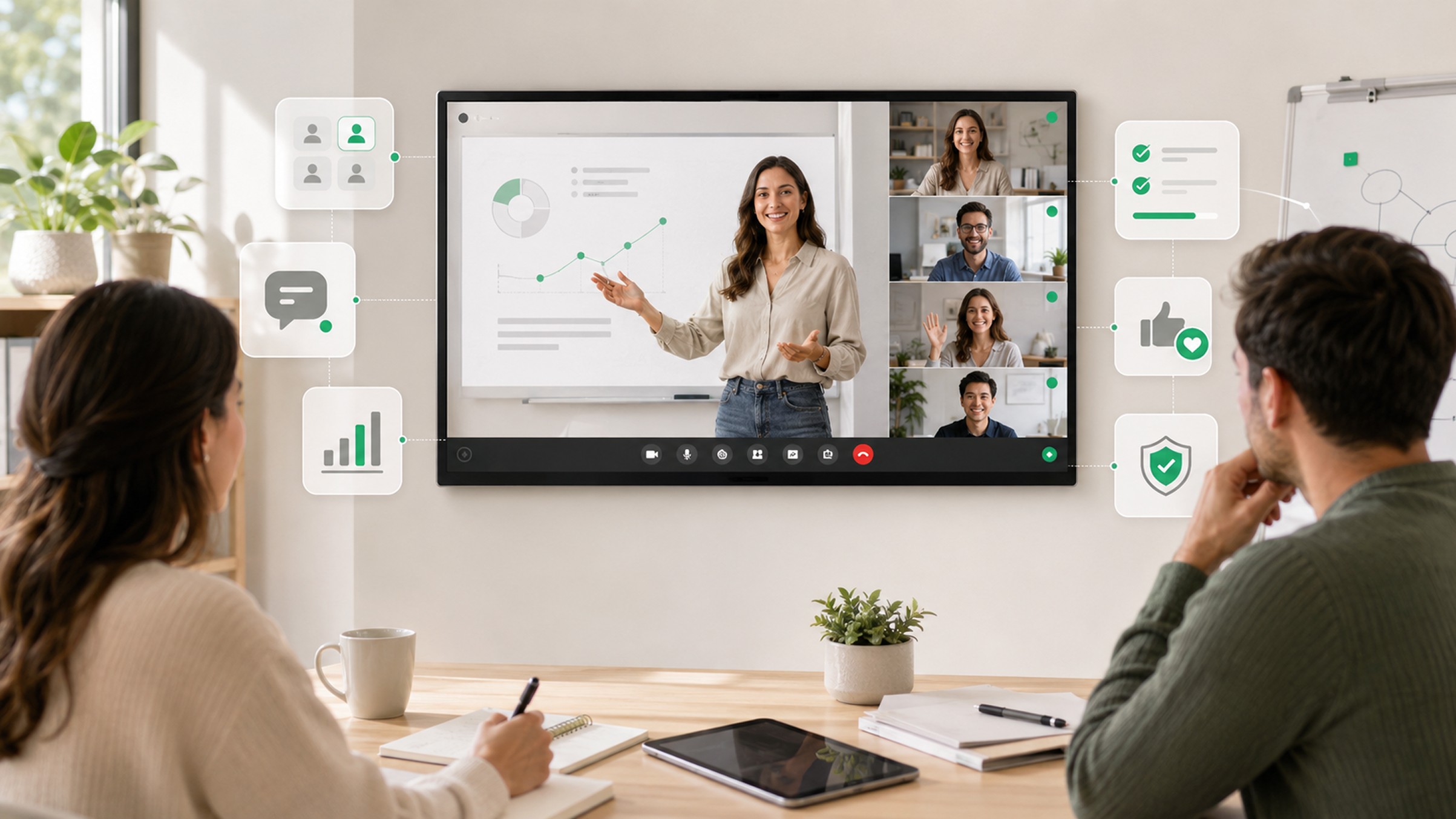
An effective virtual classroom is not just a reliable video connection with a knowledgeable person on the other end. It's a structured environment designed to support how people actually learn -- with tools that make thinking visible, workflows that maintain continuity across sessions, and operational systems that give educators the information they need to teach responsively rather than blindly.
Most virtual classrooms are built to be adequate. A few are built to be effective. Understanding the difference is useful for anyone building, buying, or evaluating online learning systems.
Why Online Learning Quality Varies
Online learning quality is notoriously inconsistent, and that inconsistency is rarely explained well.
The surface explanations are common: some teachers are better than others, some students are more motivated, some subjects are better suited to virtual delivery. These things are true, but they're not the whole story. They also tend to place responsibility on individuals -- the instructor, the student -- and away from the systems that surround them.
The deeper explanation for quality variation in online learning is structural. When two educators with similar skills and similar students produce consistently different outcomes, the variable is usually the environment they're operating in: the tools available to them, the data they have access to, the workflow support the platform provides, and the operational infrastructure behind the session.
An instructor teaching inside an effective virtual classroom has ambient information about student engagement. They have structured ways to check comprehension. They have session continuity -- they can walk into each lesson with the student's history surfaced and ready. They have less administrative overhead pulling their attention away from the actual teaching.
An instructor teaching inside an inadequate virtual classroom has a video feed, a chat window, and everything else to manage by themselves.
Same instructor. Meaningfully different experience for the student.
The implication is that improving online learning quality is not only a question of instructor hiring and curriculum design. It's also -- importantly -- a question of platform design and operational infrastructure. The environment shapes the teaching, and the teaching shapes the learning.
Engagement vs Passive Communication
The most common mistake in virtual classroom design is treating online learning as a communication problem rather than an engagement problem.
These are different problems with different solutions.
A communication problem asks: how do we reliably transmit information from an instructor to a student? The solution is stable video, clear audio, and some mechanism for the student to ask questions. Video conferencing tools solve this reasonably well.
An engagement problem asks: how do we ensure the student is actively processing and internalizing the information, not just receiving it? This is a much harder problem, and it requires a different class of tool.
Research on how people learn is fairly consistent on one point: passive reception is a weak form of learning. Listening to an explanation, watching a demonstration, or reading a summary produces shallow retention compared to actively doing something with the information -- solving a problem, applying a concept, explaining something back, making a decision under conditions of uncertainty. This is true in physical classrooms and true in virtual ones.
An effective virtual classroom is designed to create structured opportunities for active engagement throughout the session, not just at the end when the instructor says "any questions?" -- a prompt that almost never produces the honest assessment of comprehension it's intended to.
What this looks like in practice: comprehension checks distributed throughout the lesson rather than at the end. Collaborative problem-solving that requires students to show their reasoning, not just state an answer. Discussion prompts that create structured peer interaction rather than open-ended silence. Activities that require the student to apply what was just explained before the session moves on.
These are not features for their own sake. They're implementations of what good in-person teaching does naturally, adapted for an environment where that natural interaction has to be deliberately designed rather than assumed.
Interactive Learning Systems
Interactive tools in a virtual classroom earn their place when they change what an instructor can see and respond to, not just what the student can do.
The distinction matters. A poll that collects student responses but doesn't surface them to the instructor in real time doesn't improve teaching. A whiteboard that lets students draw on a shared canvas but produces no output the instructor can reference after the session is a novelty. Interactive tools are only effective virtual classroom components when they create a feedback loop between student action and instructor awareness.
The whiteboard is a good example. In a physical classroom, watching a student work through a problem on a whiteboard tells a teacher more than hearing the student state an answer. The process -- where they hesitate, where they make errors, how they correct them -- is information. An online whiteboard that replicates this, with real-time multi-participant input and low enough latency that the activity feels natural, gives an instructor access to that same quality of information in a virtual environment.
Annotation tools extend this to content. When a student can mark up a document, diagram, or image directly -- highlighting the part they don't understand, circling the step where they got confused, underlining the claim they're questioning -- the instructor gets a precise signal rather than a vague one. "I don't understand this section" is less useful than a highlighted paragraph.
Breakout rooms are effective when they're structured -- when students have a specific task to work on and the instructor can move between groups to observe and intervene. They're not effective when they're just unmonitored holding areas. The quality of breakout room use depends on the platform's ability to give the main instructor visibility into what's happening in each group, and the ability to join or message groups without disrupting the work.
The common thread: interactive tools create structured visibility. They give instructors more information about student understanding in real time, and they give students more structured ways to demonstrate that understanding. Both sides of that exchange contribute to effective virtual learning.
Operational Structure and Continuity
Teaching a student once is different from teaching them over time. Effective virtual classrooms are designed for the latter.
Continuity is the quality that distinguishes a session from a relationship. A single session can be well-delivered and still not produce learning if there's no connection between what happened last time and what happens this time. Students need to build on prior knowledge, not start from scratch each session. Instructors need context about where a student is and where they need to go.
In an effective virtual classroom, this continuity is supported operationally. The instructor has access to session history before the lesson starts: what was covered last time, what the student struggled with, what was planned for this session. That context isn't something the instructor has to reconstruct from memory or dig from personal notes. It's surfaced by the platform.
Session structure supports this too. When lessons follow a consistent architecture -- a review of previous material, new instruction, practice, close -- students develop reliable expectations for how learning sessions work. That predictability is cognitively useful; it reduces the overhead of orienting to a new format every time and lets the student's attention go toward the content.
Operational structure also means the session documentation that makes continuity possible actually gets produced. Notes about curriculum coverage. Records of what the student understood and what they didn't. Flags for what needs revisiting next time. In a virtual environment, this documentation doesn't generate itself -- it has to be captured systematically, either by the instructor or by automated processes that reduce the burden on the instructor while maintaining the record.
When continuity is maintained well, every session builds on the last. When it breaks -- because notes weren't taken, because a substitute instructor had no context, because the student's record wasn't updated -- the teaching quality drops even if the instructor is skilled. Structure enables the skill to compound over time rather than reset with each session.
Visibility for Educators and Organizations
An effective virtual classroom gives educators the information they need to teach responsively. It also gives organizations the information they need to manage quality at scale.
These are related but distinct forms of visibility.
For the instructor, visibility during a session means knowing which students are engaged, which are struggling, which have been quiet too long. Not through surveillance, but through the same ambient awareness a teacher has in a physical classroom -- reconstructed for a virtual environment through participation signals, engagement tools, and real-time feedback mechanisms. Instructors who have this visibility can adapt in the moment. Those who don't are teaching into a void.
For operations teams, visibility across sessions means being able to identify patterns that no individual instructor can see from inside their own sessions. A student whose engagement has declined across the last six sessions. An instructor whose sessions consistently run short. A time slot that produces reliably lower participation than others. These are organizational signals that require aggregate data to detect -- and they require that data to be captured consistently in the first place.
Organizations that have this visibility can manage quality proactively. They can reach out to students before they disengage completely. They can support instructors before performance issues become patterns. They can make curriculum adjustments based on what the data shows rather than what someone remembers from a session three weeks ago.
Organizations without this visibility manage reactively. They find out about problems when parents complain, which is always later than is ideal and often after the relationship is already damaged.
An effective virtual classroom captures the data that makes both kinds of visibility possible -- not as an afterthought, but as a designed feature of how sessions are structured.
AI-Supported Learning Environments
AI has a place in effective virtual classrooms, but that place is specific.
The most practical AI contributions to effective virtual learning are in the layer around the session, not inside it. Automated transcription that feeds into session summaries. Summaries that maintain curriculum continuity without requiring instructors to produce detailed notes after every lesson. Engagement analysis that surfaces at-risk students without requiring a coordinator to review session data manually. Progress reports that are drafted from session history and reviewed by instructors rather than written from scratch.
These applications reduce the operational friction that competes with teaching quality. When instructors spend less time on post-session administration, they have more time for the preparation and relationship-building that improve session quality. When operations teams have AI-assisted visibility into engagement patterns, they can intervene earlier and with better information.
What AI doesn't improve is the teaching itself. An effective virtual classroom is effective because of the instructor's skill, the platform's design, and the operational systems that support both. AI supports those systems. It doesn't substitute for them.
The platforms building AI into virtual classroom infrastructure correctly are treating it as a layer of operational support -- reducing burden, surfacing signals, maintaining continuity records -- rather than a feature that replaces the human elements that make learning work.
HiLink is built with this approach. As AI-powered virtual classroom infrastructure, the platform integrates automated session summaries, real-time engagement signals, and progress tracking directly into the operational layer -- giving instructors and organizations the information and continuity support that make effective virtual teaching consistently achievable, not just occasionally possible.
That's the standard worth holding virtual classrooms to: not whether sessions can happen, but whether the environment is designed to make them consistently effective.