What Large-Scale Virtual Learning Requires
There's a version of virtual learning that works reliably at small scale. A handful of instructors. A few dozen students. Sessions managed through shared calendars and group messaging. Documentation handled through personal notes and email. Quality monitored through direct observation and informal feedback.
Most organizations that deliver online education start here. Some stay here intentionally. But many find themselves managing significantly more sessions than this model was designed to support, and discovering the hard way that the approach that worked at twenty students per week doesn't work at two hundred, and doesn't work at all at two thousand.
Large-scale virtual learning -- hundreds or thousands of concurrent sessions, large instructor cohorts, geographically distributed students, complex scheduling requirements, and organizational accountability for learning outcomes across all of it -- places demands on infrastructure, operations, and technology that small-scale approaches cannot meet. Understanding what those demands actually are is the difference between building for scale deliberately and discovering its requirements under pressure.
Why Scale Changes Everything
The common assumption about scaling online learning is that it's primarily a technical problem. More bandwidth, more servers, more concurrent session capacity. Handle the infrastructure and the rest follows.
That assumption is wrong, and the organizations that operate under it find out expensively.
The technical infrastructure is necessary and has to be right. But the operational complexity of large-scale virtual learning grows faster than the technical complexity, and it's less tractable once it accumulates. A server can be upgraded. An operational system that wasn't designed for volume can't be patched -- it has to be rebuilt, while the organization is running live sessions that can't stop for a rebuild.
The specific ways scale changes the operational reality:
Coordination overhead multiplies nonlinearly. Each additional instructor and student doesn't just add one more relationship to manage -- it adds to the number of possible interactions between people, sessions, and systems. Scheduling decisions that were made informally become impossible to make informally without errors that compound. Communication that happened naturally through proximity has to be replaced by workflows that operate systematically.
Quality management requires different mechanisms. At small scale, quality is managed through direct observation and personal relationship. At large scale, no one has direct observation of most sessions. Quality management requires systems that capture session data systematically, surface patterns and exceptions, and direct human attention to where it's needed -- rather than depending on someone to personally review what can't be personally reviewed.
Failure modes become more expensive. A missed session notification affects one student at small scale. At large scale, systematic failures in notification, documentation, or communication affect hundreds of students simultaneously and produce compounding damage to organizational reputation and student retention.
These aren't problems that better people solve. They're problems that better systems solve. Scale creates a transition point where the limiting factor in organizational performance shifts from the quality of individual instructors and coordinators to the quality of the infrastructure and operations surrounding them.
Infrastructure Reliability
The technical foundation for large-scale virtual learning has requirements that are categorically different from small-scale deployments.
Session delivery at volume requires infrastructure that was designed for concurrent load, not infrastructure that handles small concurrency well and scales up through provisioning increases. The difference matters under sudden load spikes -- an enrollment surge, a seasonal peak, a cohort of students in a new time zone all logging in simultaneously -- which are exactly the conditions where under-designed infrastructure fails.
Geographic distribution is a requirement at scale that's optional at small scale. When a virtual learning organization serves students and instructors across multiple regions, session quality depends on routing traffic through infrastructure that's geographically close to participants, not just infrastructure that exists. A session hosted in a single region produces acceptable quality for participants nearby and degraded quality for participants far away -- which is fine for a small organization serving a local market and a serious problem for one serving a distributed population.
Recording infrastructure at scale has specific requirements that go beyond storage. At small scale, missed recordings are isolated incidents. At large scale, a recording pipeline with even a low failure rate produces systematic failures that affect a predictable number of students every week. Recording infrastructure for large-scale virtual learning requires redundancy -- the ability to detect and recover from component failures without losing session data -- and proactive failure detection that surfaces problems before students and parents ask where their recordings are.
Reliability under maintenance is also a consideration that only becomes critical at scale. Small organizations can tolerate scheduled downtime during off-peak hours. Organizations running sessions across time zones have no off-peak hours. Infrastructure that requires session disruption for updates is infrastructure that creates a recurring operational problem for organizations running large-scale virtual learning globally.
The practical evaluation criterion: does the infrastructure perform consistently at your peak session volume, across all the geographies you serve, without requiring manual intervention to maintain? If the answer requires qualification, the infrastructure isn't ready for scale.
Managing Engagement at Scale
Engagement management at small scale is a personal practice. An instructor who knows their students can read the room, adjust in the moment, and follow up personally when something seems off. An operations manager who knows every student can notice patterns and intervene proactively.
At large scale, personal practice doesn't transfer. The instructor doesn't know all the students. The operations manager can't notice patterns across hundreds of active learners individually. The ambient awareness that makes engagement management effective at small scale has to be replaced by systems that create equivalent visibility at volume.
The challenge is that engagement is genuinely hard to measure in a virtual environment. Presence is not the same as engagement. A student who joins a session and leaves their camera on for an hour may be completely absent cognitively. The signals that indicate engagement in a physical classroom -- eye contact, body language, the pace of note-taking, the quality of silence after a question -- are absent in most online settings.
Large-scale virtual learning requires engagement infrastructure that creates structured opportunities to surface student understanding and captures the resulting data systematically.
At the session level, this means tools that require active student response rather than passive reception: comprehension checks, interactive exercises, annotation tasks, structured discussion prompts. The engagement data generated by student responses is captured automatically and linked to the session record.
At the organizational level, this means aggregation and analysis: engagement scores across sessions for individual students, engagement patterns across instructors, engagement by session type or time slot. The patterns that indicate a student is at risk of disengaging are often detectable weeks before the student cancels -- but only if the data exists and is being analyzed.
The system requirement: engagement data capture has to be automatic and consistent across all sessions, not configured per session or dependent on instructor initiative. Engagement data that exists for some sessions and not others can't be used for the longitudinal analysis that makes it organizationally useful. Consistent capture is the prerequisite for useful analysis.
Session Coordination Challenges
Session coordination at large scale is a combinatorial problem that manual approaches cannot solve reliably.
A simple illustration: an organization running five hundred sessions per week, with one hundred instructors and three hundred active students, making assignments across subject specializations, time zone preferences, recurring bookings, and individual student-instructor relationship histories. Adding a new student means finding the right instructor match. A cancelled session means finding a qualified substitute who is available at that time and knows the student's history. A scheduling change cascades through a chain of conflicts that all have to be resolved correctly.
No human scheduler can hold all of this in their head without errors. The errors that accumulate in under-systematized scheduling at scale are predictable in type -- double-bookings, unqualified instructor assignments, students left without notification when sessions change -- and expensive in consequence: service failures, parent complaints, instructor frustration, operational team bandwidth consumed by reactive problem-solving.
Automated scheduling logic is not a luxury for large-scale virtual learning. It's a structural requirement. The logic needs to enforce business rules: which instructors are qualified for which subjects, what availability windows are valid, when buffer time between sessions is required. It needs to handle changes automatically: when a student reschedules, the downstream effects on instructor availability should cascade through the system, not through a coordinator's inbox.
Session room provisioning is a connected requirement. At large scale, manually creating session environments -- configuring recording, setting permissions, distributing access credentials -- doesn't scale. Room provisioning should be a consequence of scheduling: when a session is scheduled, the environment is configured automatically, participants receive access, and everything is ready before anyone has to do anything manually.
The coordination layer of large-scale virtual learning is where organizations often underestimate the infrastructure investment required. Coordination problems are invisible when they're working and acutely visible when they're not. Organizations that build robust coordination infrastructure early find it's never something they think about. Organizations that defer it find it's all they think about.
Operational Visibility Systems
Operational visibility at large scale is the mechanism by which an education organization maintains quality without being able to personally observe every session.
Quality management in a physical school relies partly on physical presence: a department head can walk through classrooms, observe instructors, and notice when something is off. In a large-scale virtual learning environment, there are no hallways to walk through. The equivalent of that ambient awareness has to be built through data capture and systematic surfacing.
The visibility systems that large-scale virtual learning requires:
Session outcome data. What was the attendance rate across this week's sessions? Which sessions had recording issues? Which instructors completed their session documentation? Which students attended fewer than half their scheduled sessions? These questions should have immediate answers from dashboards that aggregate session data in real time -- not answers that require a coordinator to compile a weekly report.
Progress patterns by student cohort. Which students are showing declining engagement trends? Which are progressing ahead of curriculum plan? Which have had three consecutive sessions with the same comprehension gap? At large scale, these patterns exist in the data and have to be surfaced systematically, because no individual instructor sees enough of the picture to detect them personally.
Instructor performance patterns. Not as a surveillance mechanism, but as a quality management tool. Instructors whose session quality metrics differ significantly from peers may need support, different student assignments, or additional training. Those patterns are only detectable when session data is captured consistently and analyzed across the instructor's full caseload.
Operational exception queues. Things that need human attention: missed sessions that haven't received follow-up, students flagged as at-risk, recording failures that haven't been resolved, sessions where the scheduled instructor didn't show. These need to be surfaced automatically and assigned for resolution, not discovered by whoever happens to notice them.
The visibility layer is what transforms large-scale virtual learning from an operation that reacts to problems into one that manages ahead of them.
The Role of Automation and AI
Automation and AI in large-scale virtual learning serve the same function: they absorb the operational work that would otherwise require proportionally more human effort as session volume grows.
Automation handles the predictable. Session room creation when a booking is made. Participant notifications at the right intervals before a session. Post-session communication triggered by session end. Absence alerts when a student doesn't join. Curriculum coverage logging when a session closes. These workflows should run reliably for every session without human initiation, because at large scale the human initiation required per session adds up to a coordination burden no operations team can sustain.
AI handles the pattern-dependent. Session documentation that requires processing a transcript into structured output -- predictable in structure, variable in content. Progress monitoring that requires detecting trends across accumulated session data -- consistent in method, specific to each student. Engagement analysis that requires aggregating signals across many data points -- systematic in process, contextual in interpretation.
The boundary between automation and AI in large-scale virtual learning is permeable, but the principle is consistent: neither replaces human judgment. Both reduce the cost of doing things that have to happen at every session, at every scale, in order for the operation to function. When automation and AI absorb that cost, human effort is freed for the decisions that actually require it.
For large-scale virtual learning, the organizations that get this right treat automation and AI as load-bearing components of their operational infrastructure, not features that enhance the experience at the margin. At small scale, those features are nice to have. At large scale, they're what makes the operation viable.
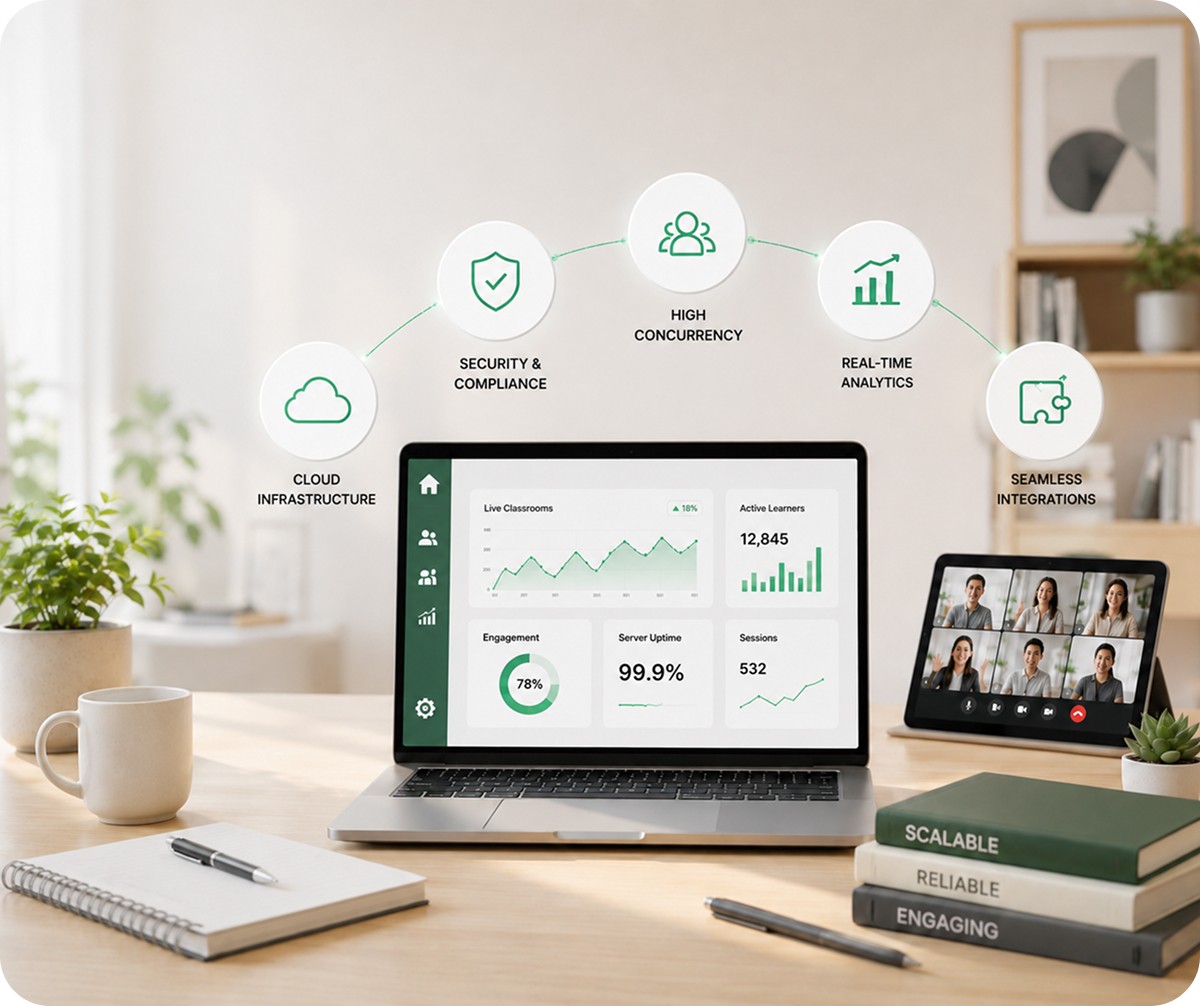
Platforms like HiLink are designed for this operational reality. As AI-powered virtual classroom infrastructure, HiLink provides the session management, automated coordination workflows, systematic engagement data capture, real-time operational visibility, and AI-powered documentation and monitoring that large-scale virtual learning requires -- built as integrated infrastructure rather than assembled from tools designed for a smaller problem.
Scale doesn't change what good online education looks like. It changes what it takes to deliver it consistently. The organizations that understand that distinction build for it. The ones that don't discover it.