What Is Live Session AI — And How It's Changing Online Education
Introduction
For most of the history of online education, the session was a black box.
A tutor and a learner connected. Something happened for 60 minutes. The session ended. If it went well, the learner came back. If it did not, you usually found out two weeks later when the cancellation email arrived.
The tools built around that black box -- session recordings, post-session surveys, star ratings -- were attempts to see inside it. They helped at the margins. But they were all retrospective. By the time the data arrived, the session was long over and the tutor had run twenty more just like it.
Live session AI changes that. Not by adding another layer of retrospective reporting, but by moving the analysis inside the session itself -- in real time, while there is still something to act on.
This is a meaningful shift. Not a feature upgrade. A different way of thinking about what a session is and what it can produce.
How We Got Here
The first generation of session intelligence was recordings.
Recording a session meant you could go back and watch it. For quality assurance teams, this was genuinely useful -- in theory. In practice, nobody had time to watch more than a small fraction of recorded sessions. Recordings piled up. Storage costs grew. The sessions that got reviewed were the ones flagged by complaints, which meant the review process was reactive by design.
The second generation added automated analysis on top of recordings. Transcription services converted audio to text. Sentiment analysis flagged sessions where language patterns suggested frustration or disengagement. Some platforms began scoring sessions automatically based on transcript features -- how much the tutor talked versus the learner, whether certain phrases appeared, how often the learner responded.
This was better. It scaled. You could analyze 10,000 sessions without watching any of them. But it was still retrospective. The analysis happened after the session ended, which meant the insights arrived too late to change anything about that specific session.
Live session AI is the third generation. The analysis happens during the session. Signals are detected, processed, and surfaced in real time -- to tutors, to supervisors, to the platform itself -- while the session is still running.
What Live Session AI Actually Does
The term covers a range of capabilities that are worth separating out, because they serve different purposes and have different implications for how platforms are built.
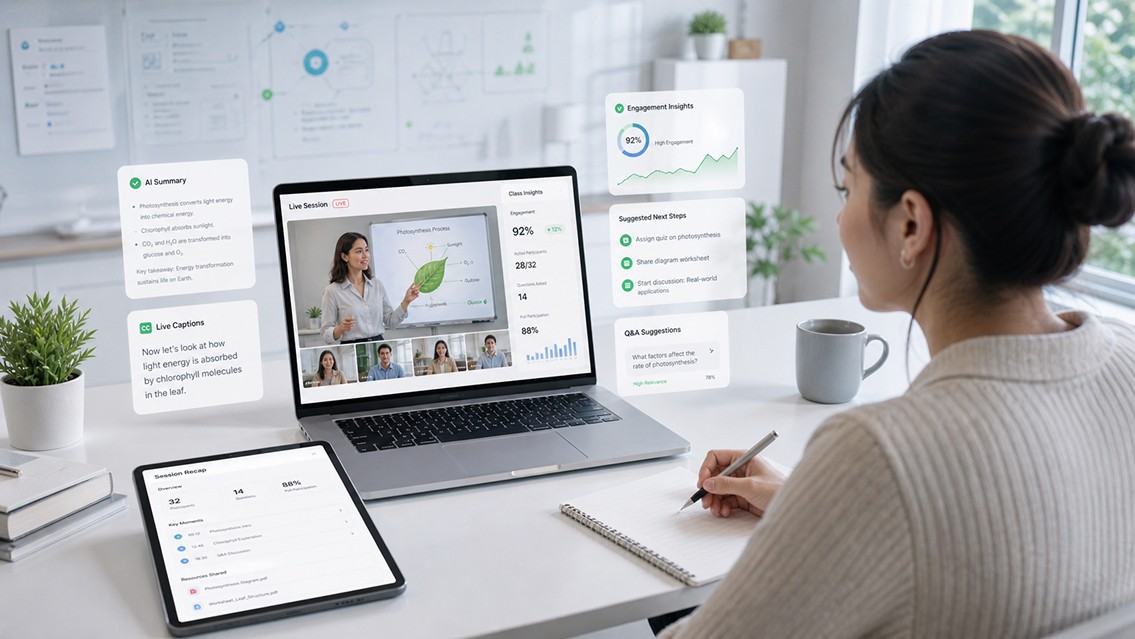
Real-time transcription and captioning. The most basic layer. Audio is converted to text as it is spoken, with low enough latency to be useful during the session rather than just after it. For learners with accessibility needs, this is a baseline requirement. For everything built on top of it -- analysis, summaries, searchable records -- it is the data foundation.
Engagement detection. Models trained on session data identify signals that correlate with learner engagement or disengagement. Response latency, participation patterns, silence duration, camera-on rates, interaction frequency with collaborative tools. None of these signals is definitive on its own. Together, they produce an engagement signal that is more reliable than a post-session rating and arrives in time to act on.
Automated session summaries. At session end, a structured summary is generated automatically. Key topics covered, questions asked, moments flagged for follow-up, learning objectives addressed or missed. For tutors running six sessions a day, this removes a significant administrative burden. For operations teams, it means consistent session records without relying on tutor self-reporting.
Real-time coaching nudges. The most forward-looking capability. Based on what is happening in the session -- tutor talk time running high, learner engagement dropping, a concept being revisited for the third time -- the system surfaces a prompt to the tutor. Not a grade. Not a post-session note. A nudge, during the session, when it can still change the outcome.
Quality scoring and flagging. Sessions are scored automatically against defined quality criteria. Sessions that fall outside expected parameters are flagged for human review. This is what makes signal-based quality monitoring tractable at scale -- instead of sampling randomly, operations teams spend review time on the sessions most likely to have problems.
Why This Matters for EdTech Product and Operations Teams
The product implications are significant. The operational implications are larger.
For product teams, live session AI changes what the platform can promise. Not just session delivery, but session quality. Not just attendance records, but learning outcomes. Features that were previously roadmap items -- adaptive learning, personalized tutor matching, real-time quality assurance -- become buildable once the session data infrastructure exists to support them.
For operations teams, the shift is more immediate. The core problem of scaling quality -- that manual oversight hits a ceiling long before session volume does -- becomes tractable with live session AI in the infrastructure layer. Quality monitoring stops being a sampling exercise and becomes a systematic process. Tutor coaching stops being reactive and becomes continuous. The feedback loop between session and correction compresses from weeks to hours.
The teams that benefit most are not the ones with the most sophisticated AI ambitions. They are the ones with the most pressing operational problems -- quality variance across a large tutor pool, compliance requirements around session documentation, the need to demonstrate learning outcomes to institutional clients. Live session AI addresses those problems directly, not as a future capability but as a current operational tool.
What It Requires to Work
Live session AI is not a feature you add to an existing platform. It is a capability that depends on infrastructure built to support it.
The data has to be captured at the session layer -- structured, consistent, and in real time. Transcription pipelines have to run with low enough latency to be useful during the session, not just after. Engagement models have to be trained on education-specific session data, not generic audio or video data. The event stream has to be rich enough to support the analysis being run on top of it.
Platforms that try to add live session AI on top of infrastructure not built for it end up with capabilities that are inconsistent, incomplete, or expensive to maintain. The transcription works sometimes. The engagement signals are noisy. The session summaries miss things because the underlying event data was not captured cleanly.
The infrastructure question is not separate from the AI question. It is the AI question. What live session AI can do is determined entirely by the quality and completeness of the session data it has access to.
Where HiLink Fits
HiLink is built around this infrastructure requirement.
Session events are captured as structured data at the platform layer -- in real time, across every session, regardless of volume. Transcription, engagement signals, participation patterns, learning milestones -- these are first-class outputs of the infrastructure, not add-ons bolted onto a video feed.
The live session AI capabilities built on top of that foundation reflect what the infrastructure makes possible. Real-time engagement detection that surfaces during the session. Automated session summaries generated at session end with structured learning records. Quality scoring that flags sessions for review based on defined criteria rather than random sampling. Coaching nudges delivered to tutors in the moment, based on what is actually happening in the room.
For product teams, this means AI features are buildable now rather than dependent on a future data infrastructure project. For operations teams, it means quality monitoring and tutor development shift from reactive processes to systematic ones.
The shift from retrospective reporting to real-time analysis is not incremental. It changes what operations teams can know, how fast they can act, and what the platform can credibly promise to the institutions and learners it serves.
The Bottom Line
Live session AI is not a marketing category. It is a meaningful shift in what online education platforms can do with the time inside a session -- and with the data that session produces.
The move from recording to real-time analysis changes the operational math for EdTech businesses running at scale. Quality monitoring becomes systematic. Tutor development becomes continuous. Learning outcome data becomes something the platform produces rather than something it approximates from surveys.
Getting there requires infrastructure built for it. Platforms that treat session data as an afterthought will find that live session AI remains a roadmap item regardless of which AI tools they layer on top. Platforms that build the data foundation first will find that the AI capabilities follow naturally -- and so do the operational improvements that make scaling without quality erosion actually possible.