What Is Education Infrastructure?
Infrastructure is one of those words that sounds technical until you try to define it precisely, at which point it becomes clear the word is doing a lot of work.
In physical education, infrastructure is concrete: the buildings, the classrooms, the furniture, the network that keeps the projectors running. Everyone understands what it means and why it matters. When a school loses power, or the heating fails, or the internet goes down, no one argues about whether infrastructure is important. The absence of it makes the point.
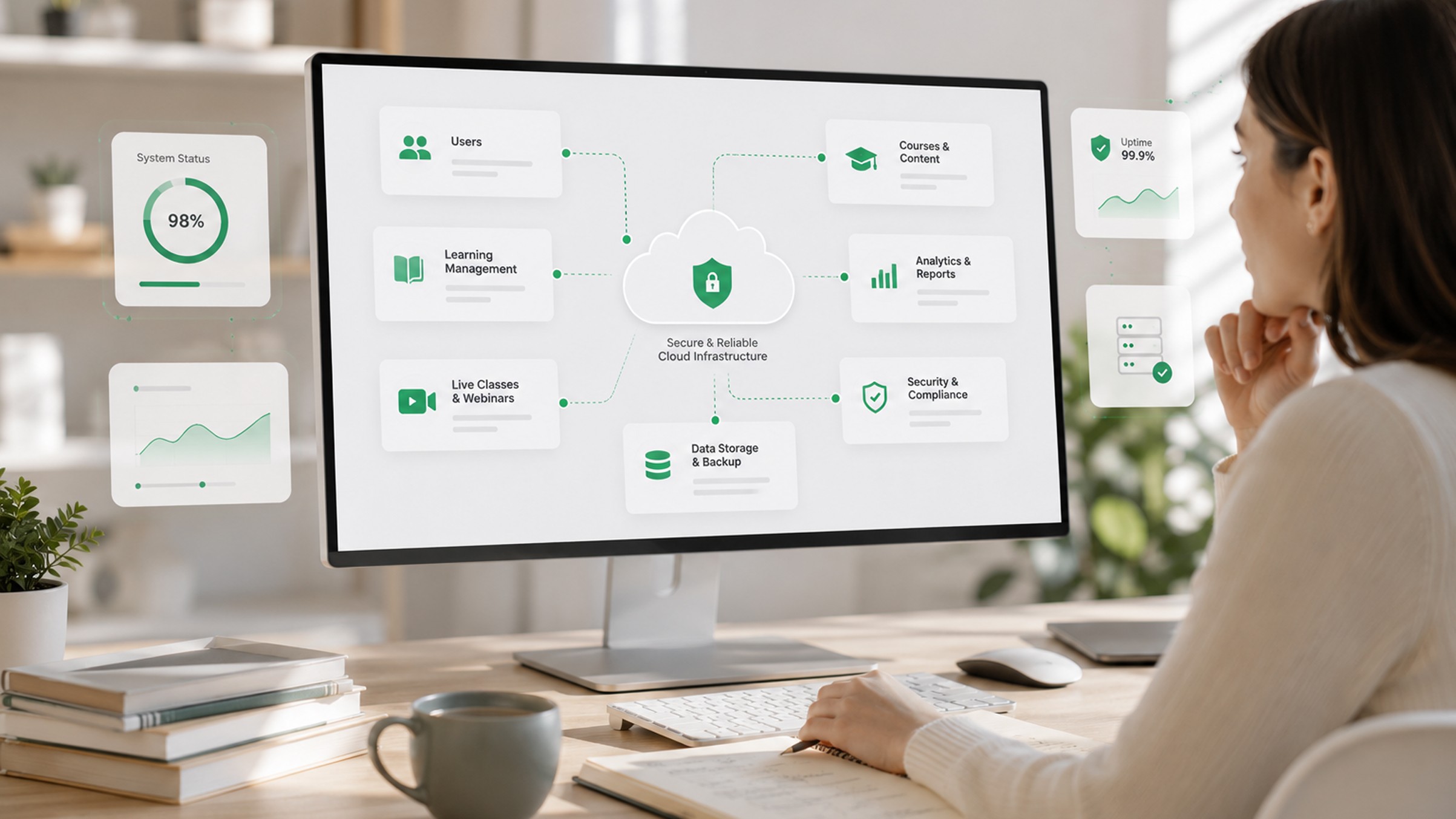
In online education, the concept is less visible but no less real. Education infrastructure -- the operational and technological foundation behind modern learning systems -- is what determines whether an online school, tutoring company, or EdTech platform can deliver consistent, scalable, high-quality learning at all. Without it, everything depends on individual effort and informal coordination. With it, an organization can grow, adapt, and maintain quality without the whole operation depending on a handful of people working very hard.
Understanding what education infrastructure actually includes, and why it's distinct from the tools organizations typically buy, is what this article is about.
Why Education Infrastructure Matters
The word infrastructure carries a specific implication: it's foundational. It's the layer everything else is built on. When it works, it's invisible. When it fails or was never properly built in the first place, everything above it is unstable.
That framing applies directly to online education. Most organizations can run ten sessions a week on almost anything. A video meeting tool, a shared calendar, a messaging app for instructor coordination. The infrastructure doesn't matter much at that scale because informal human effort can fill the gaps.
The problems surface at a hundred sessions a week. At three hundred. At a thousand. The gaps that were filled by individual memory and direct communication start to break under volume. Scheduling errors accumulate. Parent communication becomes inconsistent. Session data isn't captured reliably. Instructors are overwhelmed by administrative tasks that should be handled by systems. Quality control becomes reactive rather than proactive.
What's missing in those moments is not better tools for individual tasks. It's infrastructure -- the underlying systems that make operations reliable at scale. Infrastructure is why a well-run organization with competent instructors can deliver consistent quality across five hundred concurrent sessions, and a poorly-built one with equally competent instructors cannot.
The case for investing in education infrastructure is not primarily about technology. It's about organizational capability. What can your operation actually do reliably, at volume, without depending on heroic individual effort?
The Evolution of Digital Learning Systems
To understand what education infrastructure has become, it helps to trace briefly how it developed.
The first generation of online learning was built primarily around content delivery. Static materials -- documents, videos, recorded lectures -- made accessible through learning management systems. The core problem was distribution: how do you get educational content to students who aren't physically present? LMS platforms solved that problem, and they solved it well enough that the category became standard in institutional education.
The second generation added synchronous communication. Video conferencing became cheap and accessible, and live virtual sessions became possible at scale. This was a significant development. Real-time interaction between teachers and students, regardless of location, changed what online education could do. But the tools were primarily communication tools adapted for education -- not systems built around how learning actually operates.
The third generation -- which is where the most interesting infrastructure questions now live -- is about operations. Not just can students and teachers be in the same virtual room, but: can the operation behind that room run reliably at scale? Can it capture the right data? Can it automate the routine so humans can focus on the judgment-dependent? Can it integrate with the other systems an organization runs on? Can it use AI to reduce administrative friction without reducing educational quality?
This is the generation where education infrastructure becomes a meaningful distinct category rather than a synonym for "the software schools use." The LMS is part of the infrastructure. The session platform is part of it. But so are the scheduling systems, the communication workflows, the data pipelines, the analytics layer, and the AI tools that reduce coordination overhead. Infrastructure is the whole operational and technological foundation -- not any single piece of it.
Infrastructure vs Standalone Tools
The distinction between infrastructure and standalone tools is practical, not semantic.
A standalone tool solves a specific problem in isolation. A video conferencing product gives you sessions. A scheduling tool manages bookings. A messaging platform handles communication. A spreadsheet tracks attendance. Each tool does its job. The problem is that learning operations require all of these functions to work together, and standalone tools don't naturally integrate.
The result of building on standalone tools is data fragmentation. Attendance lives in the video platform. Session notes live in an email thread or a shared document. Billing lives in a payment processor. Parent communication happens through a messaging app. Student progress is tracked manually, when anyone tracks it at all. To understand what's happening across the operation, someone has to pull from all of these sources simultaneously and reconcile them by hand. That process is slow, error-prone, and unsustainable at scale.
Infrastructure is different in intent. It's designed to function as a unified system rather than a collection of separate tools. Session management, data capture, workflow automation, analytics, and communication are built to work together -- sharing data, triggering each other, and producing a coherent operational picture rather than a fragmented one.
The practical difference is most visible in how each approach handles a routine operational event. Consider what happens when a student misses a session.
In a standalone tool environment: the video platform logs the absence, but that information doesn't go anywhere automatically. Someone has to notice, check the record, decide whether to follow up, open the messaging app, and send a message to the parent. Maybe this happens promptly. Often it doesn't. The student's absence record exists somewhere, but no one's acting on it unless someone makes it a priority.
In an infrastructure-based environment: the session platform registers the no-show, triggers a parent notification automatically, flags the student in the operations dashboard, and logs the absence in the student's record without any manual intervention. The right people know about the problem within minutes of the session ending. The data is in the right place.
That's not a marginal difference. It's the difference between a system that runs and one that has to be pushed.
The Operational Layer Behind Online Learning
Education infrastructure's most underappreciated component is the operational layer: the systems and workflows that manage everything around the session rather than inside it.
Most conversations about online learning tools focus on the session experience -- the video quality, the interactive features, the instructor interface. Those things matter. But sessions exist inside an operational context that shapes whether they can be delivered consistently, documented accurately, and improved over time.
The operational layer includes:
Scheduling and coordination. The systems that match instructors and students, manage availability, handle cancellations and rescheduling, enforce policies, and distribute access and materials. At scale, this layer has to be largely automated -- not because human judgment isn't needed, but because the volume of routine coordination decisions exceeds what any human team can handle reliably by hand.
Session data capture. Attendance, engagement signals, comprehension check results, curriculum coverage, recording status -- all of this needs to be captured systematically during every session, without depending on instructor compliance or manual data entry. Data that isn't captured automatically tends not to be captured consistently, which means it can't be used for quality monitoring, progress reporting, or organizational improvement.
Communication workflows. The automated sequences that keep students, parents, and instructors informed: pre-session reminders, post-session summaries, progress updates, absence notifications, billing communications. These workflows exist in every education operation, but they're often handled manually -- which means they're slow, inconsistent, and a significant operational burden at scale.
Reporting and visibility. The analytics layer that surfaces what's happening across the operation: which students are at risk, which sessions are underperforming, which instructors need support, where quality gaps are developing. Without systematic reporting, organizations manage reactively -- responding to parent complaints rather than catching problems before they become complaints.
When these components work together as a unified system, the operational layer practically runs itself for routine situations, freeing human attention for the cases that genuinely require it.
AI and Modern Education Infrastructure
AI has become a component of modern education infrastructure, but it's worth being precise about what role it plays well and where it has clear limits.
The strongest AI applications in education infrastructure are the ones that reduce the cost of doing things that were always worth doing but rarely got done consistently. Automated session summaries are the clearest example. Post-session documentation has always had operational value -- for curriculum continuity, parent communication, quality monitoring -- but the burden of producing it manually meant it happened inconsistently, if at all. AI-generated summaries, reviewed and approved by instructors, make consistent documentation achievable without making it the instructor's time sink.
Similar logic applies to engagement analysis, progress tracking, and at-risk student identification. The patterns that would tell an experienced operations manager that a student is disengaging or falling behind exist in the session data. AI can surface those patterns systematically across an operation at scale, where manual review would be impractical.
What AI doesn't do -- and education infrastructure shouldn't pretend it does -- is replace the judgment and relationship that make teaching effective. The decision about what a struggling student actually needs: more practice, a different explanation, a conversation about what's happening outside of academics. The relationship between instructor and student that makes students willing to struggle openly rather than hide confusion. The professional judgment about when to push and when to slow down.
Those remain human. Infrastructure supports them by reducing the administrative overhead that competes for the same human attention. Less time spent on documentation and routine coordination means more time and attention available for the teaching work that actually requires a person.
AI built into education infrastructure as a supporting layer -- not a replacement layer -- is the configuration that delivers real value.
The Future of Scalable Learning Systems
Education infrastructure is becoming more sophisticated and more central to how serious online learning organizations compete.
The organizations building durable online education businesses are increasingly those that treat infrastructure as a strategic capability rather than an operational afterthought. They invest in platforms that capture data systematically, automate routine operations, and integrate the session layer with the broader organizational systems -- CRM, billing, student information, communication channels -- in ways that reduce friction and increase visibility.
The shift is from managing sessions to building systems. From one-off decisions to systematic workflows. From reactive quality control to proactive quality management enabled by real-time data.
That shift requires infrastructure that was designed for it -- not communication tools adapted to fill the gap, but platforms built around the operational complexity of online education from the start.
HiLink is built for this. As API-first education infrastructure, HiLink provides the session management, real-time engagement data, AI-powered summaries, workflow automation, and operational analytics that modern online learning organizations need to run at scale. It's infrastructure in the actual sense: the foundational layer that makes everything above it more reliable, more consistent, and more capable of growing without breaking.
The question for any organization building or scaling online education today is whether their infrastructure is designed for where they're going -- or just for where they've been. The answer shapes everything about what the operation can actually do.