What Is an AI-Powered Virtual Classroom — And What Does It Actually Do?
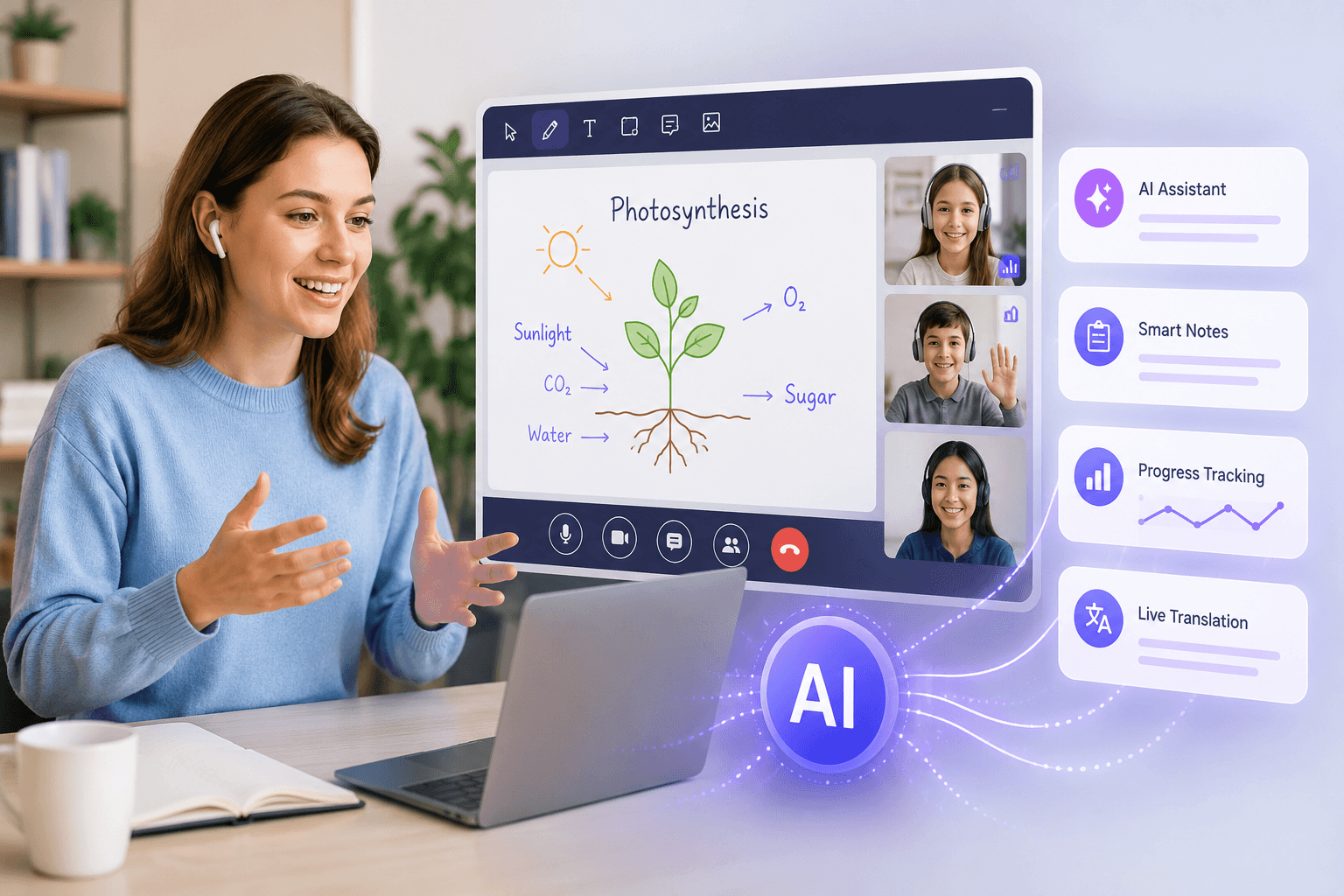
AI did not enter online education through a grand strategic decision. It entered through operational pressure.
Tutoring businesses running thousands of sessions a month were drowning in manual work. Session notes written by hand. Attendance tracked in spreadsheets. Quality monitored through random spot-checks. Parent updates assembled from tutor memory. The session itself was the easy part. Everything around it was expensive, inconsistent, and slow.
At the same time, the underlying technology -- real-time transcription, natural language processing, engagement modeling -- matured enough to be useful inside a live session rather than just applied to recordings afterward.
Those two things meeting in the same moment is why AI is now a serious part of how online education infrastructure gets built. Not because it is exciting, but because it solves real operational problems that manual processes cannot solve at scale.
What an AI-Powered Virtual Classroom Actually Is
Before getting into what it does, the distinction that matters most is what it is not.
AI study tools for students -- flashcard generators, essay feedback tools, homework assistants -- are external applications students use before or after class. They are useful. They are not what this article is about.
An AI-powered virtual classroom is different. The AI is not a tool students open in another tab. It is infrastructure built into the session itself, running continuously, producing structured outputs that feed into the platform's operational layer.
The session happens. The AI runs alongside it -- capturing, processing, and organizing what is happening in real time. When the session ends, the outputs are already there: a structured summary, a transcript, engagement signals, flagged moments, a parent-ready recap. Not assembled afterward by a person. Produced automatically by infrastructure that was running the whole time.
This is the distinction that matters when evaluating AI claims from virtual classroom vendors. AI as a feature means a transcription button someone can click. AI as infrastructure means the transcription pipeline runs on every session, produces consistent outputs, and feeds into downstream systems automatically.
What AI Actually Does Inside a Session
The capabilities worth understanding are concrete, not conceptual.
Live Captions
Real-time transcription converts spoken audio to text with low enough latency to display as captions during the session. For learners with hearing impairments, this is an accessibility requirement. For learners in noisy environments or working in a second language, it significantly improves comprehension.
The infrastructure requirement is low-latency transcription that keeps pace with natural speech -- typically under two seconds of lag -- across different accents, pacing, and audio quality levels. This is harder than it sounds when sessions involve learners on degraded network connections or tutors in imperfect acoustic environments.
Engagement Detection
Engagement models analyze participation patterns in real time. How often is the learner responding? How long are their silences? Are they interacting with collaborative tools? Has their camera been off for an extended period?
No single signal is definitive. Combined, they produce an engagement indicator that is more reliable than a post-session rating and arrives during the session -- while there is still something to do about it.
A tutor who can see that a learner's engagement has dropped in the last eight minutes can adjust. A platform that can flag that pattern for supervisors can route coaching conversations to the right tutors at the right time. Neither of these is possible with retrospective feedback alone.
AI Lesson Summaries
At session end, a structured summary is generated automatically. Topics covered. Questions the learner asked. Concepts revisited more than once. Learning objectives addressed or not addressed. Follow-up items flagged for the next session.
For tutors running five or six sessions a day, writing session notes manually is a significant time cost and produces inconsistent records. Automated lesson summaries remove that burden and produce consistent documentation that operations teams can actually use -- for quality review, for learner progress tracking, for tutor performance assessment.
After-Class Recaps and Parent Communication
One of the highest-value and most underappreciated AI outputs in a tutoring context is the parent recap.
Parents who pay for tutoring want to know what happened. Most tutoring businesses handle this through tutor-written notes or post-session emails assembled manually. At scale, this is inconsistent and slow. Tutors with full session loads deprioritize it. Parents receive updates that vary in quality and timing depending on which tutor they happen to have.
AI session recaps change this. A structured summary generated at session end can be formatted automatically into a parent-facing communication -- what was covered, what the learner did well, what needs more work, what to expect next session. Sent within minutes of session end, consistently, across every session, regardless of which tutor delivered it.
This is not a small operational improvement. For tutoring businesses competing on learner experience and family trust, consistent post-session communication is a meaningful differentiator.
Operational Automation
Beyond the session-facing outputs, AI infrastructure produces data that feeds operational workflows.
Session quality scores generated automatically from engagement signals, tutor talk time ratios, and session structure indicators. Flags surfaced to supervisors when a session falls outside expected parameters. Tutor performance trends built from session-level data captured consistently over time. Compliance documentation produced automatically from session records rather than assembled manually.
These outputs do not require anyone to configure a report or review a recording. They are products of infrastructure running on every session.
AI Features That Genuinely Help Teachers
The AI capabilities that tutors actually find useful share a common characteristic: they reduce administrative burden without adding new tasks.
Automated session notes mean tutors end a session and the documentation is already done. A brief review and confirmation rather than ten minutes of writing.
Real-time engagement signals mean tutors have a signal to act on during the session rather than finding out after the fact that a learner was disengaged for most of it.
AI-generated follow-up suggestions -- based on what topics were covered and where the learner struggled -- give tutors a starting point for session planning rather than relying entirely on memory of the previous session.
What tutors do not find useful is AI that adds steps, requires new inputs, or produces outputs they have to correct before they can use them. The bar for useful AI in a teaching context is that it saves real time and produces outputs accurate enough to trust. That bar is set by the quality of the underlying infrastructure -- the transcription accuracy, the event capture completeness, the consistency of the models running on session data.
AI Infrastructure vs. AI Bolt-Ons
This is the distinction that determines whether AI capabilities actually work in production.
A bolt-on AI feature is applied to a session after the fact, or requires manual activation, or is built on incomplete session data. Transcription that only runs when a tutor clicks record. Session summaries that miss context because the event data was not captured cleanly. Engagement signals that are noisy because the models were not trained on education-specific session data.
AI infrastructure is built into the session layer. Transcription runs on every session automatically. Event capture is consistent across session types. The models running on session data are trained on education contexts, not generic audio or text. The outputs feed into downstream systems through an API rather than sitting in a dashboard someone has to check manually.
The practical difference shows up in consistency. Bolt-on AI works sometimes, in ideal conditions, for sessions where everything was set up correctly. Infrastructure-level AI works on every session, regardless of tutor behavior or session configuration, and produces outputs that downstream systems can depend on.
For tutoring businesses evaluating platforms, the question to ask is not "does this platform have AI features." It is "where does the AI run and what does it depend on." If the answer involves manual activation, optional recording, or post-session processing applied to incomplete data, the AI layer is a bolt-on regardless of how it is marketed.
What Tutoring Businesses Should Look For
The evaluation criteria for AI in a virtual classroom context are more specific than general AI feature comparisons suggest.
Transcription quality across real-world conditions. Not in a controlled demo. In sessions with background noise, non-native speakers, variable audio quality, and degraded network connections. Ask for accuracy benchmarks on education-specific data, not general transcription benchmarks.
Output consistency across all sessions. AI summaries and recaps are only operationally useful if they are produced consistently. If outputs require manual activation or only appear for recorded sessions, they cannot be built into operational workflows reliably.
API access to AI outputs. Lesson summaries, engagement signals, session transcripts, quality scores -- these should be accessible through a clean API so they can feed into CRM systems, parent communication tools, LMS platforms, and internal reporting without manual export.
Training data relevance. Engagement models trained on education session data perform differently than models trained on general video call data. Ask vendors specifically what data their models are trained on and how they handle education-specific interaction patterns.
Integration with existing workflows. AI outputs that live inside a vendor dashboard do not improve operations. AI outputs that flow automatically into the tools operations teams already use do. Evaluate the integration surface, not just the features.
The Future of AI-Powered Learning Operations
The direction this is heading is not more AI features. It is deeper AI integration into the operational layer of education businesses.
Tutor-learner matching based on historical session outcome data rather than availability alone. Adaptive session planning that adjusts based on what the AI detected in the previous session. Quality monitoring that identifies performance trends before they become learner churn. Parent communication that is personalized to each learner's session history rather than generic.
None of this is speculative. It is the natural output of session data infrastructure that is already being built. The platforms that capture structured session data consistently today are the ones that can build these capabilities tomorrow. The ones that do not will find that the AI roadmap they want requires infrastructure work that should have been done first.
Where HiLink Fits
HiLink treats AI as infrastructure, which means it runs on every session rather than being activated per session.
Transcription runs automatically. Engagement signals are captured in real time. Lesson summaries are generated at session end and accessible through the API. Parent recaps are structured and ready to send within minutes of the session closing. Quality scores feed into operations dashboards without manual configuration.
The AI layer is built on session data infrastructure that captures learning events consistently across every session type -- one-to-one tutoring, group sessions, large lectures, breakout-based workshops. The outputs are consistent because the data underneath them is consistent.
For tutoring businesses, this means AI capabilities are operational from the start rather than dependent on a future infrastructure project. The summaries, the engagement signals, the parent recaps, the quality monitoring -- these are products of how the platform is built, not features added on top of a video call.
The Bottom Line
An AI-powered virtual classroom is not a virtual classroom with a transcription button. It is a session environment where AI runs at the infrastructure layer, producing structured outputs that feed into operational workflows automatically and consistently.
The difference between AI as infrastructure and AI as a bolt-on determines whether any of the promised capabilities actually work in production -- across thousands of sessions, different tutors, varied network conditions, and the operational complexity of a real education business.
For tutoring businesses evaluating platforms, the question is not which platform has the most AI features. It is which platform has the infrastructure underneath those features to make them work reliably at scale.
That is a narrower field. And it is the right field to be evaluating.