What Is a Virtual Classroom Platform — And Why the Distinction From Video Conferencing Actually Matters
Why Virtual Classrooms Became Necessary
Online education did not start with a clean slate. It started with the tools that already existed.
When live instruction moved online at scale, the default was video conferencing. Zoom, Teams, Google Meet -- these were already installed, already understood, and already reliable enough to get a session started without friction. They became the infrastructure of online learning by default rather than by design.
That default held longer than it should have because the problems it created were slow to surface. A tutoring business running 50 sessions a week on Zoom can manage the gaps manually. The reporting is assembled by hand. The quality monitoring is done by watching recordings. The parent communication is written by individual tutors. The engagement data does not exist, so nobody misses it yet.
The gaps become operational constraints somewhere between 500 and 2,000 sessions a month. Not because the video quality degrades, but because everything around the video -- the data, the reporting, the AI capabilities, the compliance documentation, the organizational complexity -- cannot be built on a foundation that was never designed to support it.
This is why the virtual classroom platform emerged as a distinct category. Not as a feature upgrade to video conferencing, but as a different architectural approach to what online learning actually requires.
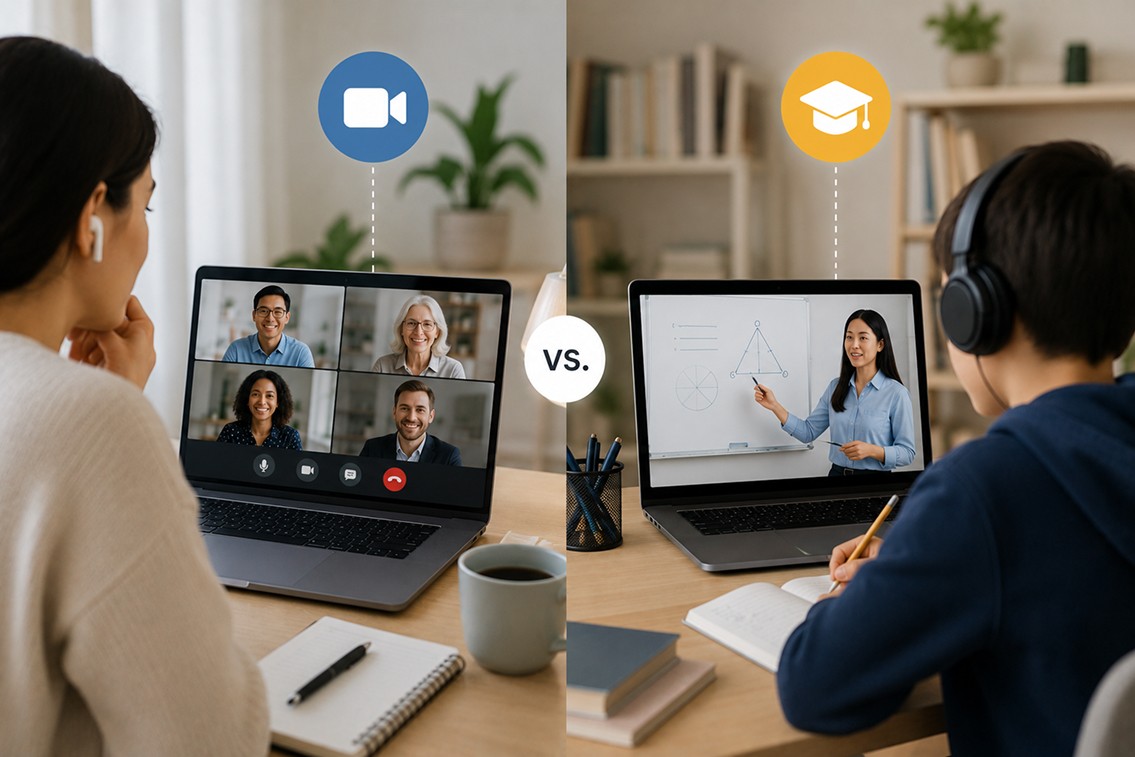
Why Video Conferencing Is Insufficient
The insufficiency of video conferencing for online education at scale is architectural, not superficial. It cannot be fixed by adding features to a meeting tool because the problem is in what the tool was designed to produce.
A video conferencing tool is designed to facilitate communication between participants. It succeeds when participants can hear and see each other clearly and the session completes without technical failure. That is the design contract. Everything the tool does is oriented toward that outcome.
An online learning platform is designed to facilitate learning. It succeeds when learners make progress, when that progress is documented, when instructors have the information they need to teach effectively, when the organization can demonstrate outcomes to clients and stakeholders, and when quality holds as volume grows. That is a fundamentally different design contract.
The gap between those two contracts shows up consistently across the same set of dimensions.
Session data. A video conferencing tool records that a session occurred, who attended, and for how long. An online learning platform records what happened inside the session -- engagement patterns, participation signals, assessment responses, learning milestones, moments where comprehension was uncertain. The first produces an attendance log. The second produces a learning record. These are not the same thing, and one cannot be reconstructed from the other.
Roles and permissions. In a meeting, participants have roughly equal standing. In a classroom, roles are differentiated and meaningful. An instructor has different capabilities than a learner. A teaching assistant has different capabilities than both. A guest observer has different access than a participating student. These distinctions need to be built into the architecture, not approximated through meeting settings designed for a different context.
Lesson structure. A meeting has an agenda. A lesson has a shape -- a pedagogical arc that moves from introduction through instruction, practice, assessment, and review. A virtual classroom platform supports that arc natively. Video conferencing tools do not. The structure has to be imposed entirely by the instructor through discipline and habit, which works inconsistently across a large tutor pool and fails entirely as a basis for operational quality monitoring.
Operational infrastructure. Reporting, quality monitoring, parent communication, compliance documentation -- these are operational requirements that grow in complexity with session volume. Video conferencing tools produce raw data that requires manual assembly into something useful. Virtual classroom platforms produce structured operational outputs as a natural consequence of how they capture session data.
Components of a Real Virtual Classroom Platform
A virtual classroom platform that deserves the name is not a video call with a whiteboard attached. It is a set of integrated systems, each designed for the specific requirements of live online instruction.
Real-time communication layer. The foundation is reliable, low-latency audio and video transmission across a range of network conditions and devices. But unlike general video conferencing, this layer is designed to degrade gracefully under poor conditions -- prioritizing audio continuity over video quality, resuming sessions without data loss after connection interruptions, and adapting media quality to network conditions in real time rather than dropping participants when bandwidth drops.
Collaborative workspace. The whiteboard and collaborative tools in a virtual classroom are not annotation features. They are the workspace where instruction happens. A purpose-built collaborative workspace supports the kinds of work that actually occur in learning sessions -- multi-step problem solving, shared document annotation, concept mapping, interactive exercises -- and maintains the state of that workspace persistently across the session and retrievably afterward.
Session role architecture. Instructors, learners, teaching assistants, observers, guest speakers -- each with defined capabilities, permission scopes, and data access. This is not a configuration option. It is an architectural requirement for any platform serving real educational deployments, where the flat participant model of video conferencing creates immediate friction.
Engagement and moderation systems. A virtual classroom platform monitors session engagement as structured data -- participation rates, response patterns, interaction frequency, hand raise queues, poll responses -- and provides moderation controls designed for classroom dynamics rather than meeting management. Who can speak, in what order, under what conditions. How disruptive participants are managed without ending the session for everyone else. These are education-specific requirements that meeting moderation tools approximate poorly.
Learning event capture. Every meaningful interaction in a session -- a hand raise, a poll submission, a whiteboard contribution, a breakout room transition, an assessment response -- is a structured data event. This event stream is the foundation for everything built on top of the session: AI summaries, engagement analytics, compliance reporting, tutor performance modeling, learner progress tracking. Platforms that do not capture learning events natively cannot build these capabilities reliably, regardless of what they layer on top.
Session continuity systems. Learning is not a series of isolated sessions. It is a progression across many sessions, and the value of each session depends partly on how well it connects to the ones before and after it. A virtual classroom platform maintains session continuity -- structured records of what was covered, what needs reinforcement, where individual learners are in their progress -- so each session starts from an informed position rather than reconstructing context from memory.
Infrastructure Considerations
The components above describe what a virtual classroom platform needs to do. The infrastructure considerations describe what it needs to be built on to do those things reliably at scale.
Data architecture. Session data needs to be captured as structured events, stored in a consistent schema, and made accessible programmatically. This is not a reporting feature. It is an architectural decision that determines what the platform can produce -- for analytics, for AI, for compliance, for integration with downstream systems. Platforms built on thin data architecture cannot add these capabilities later without rebuilding from the foundation.
API-first design. A virtual classroom platform serving EdTech companies, institutional clients, and scaling tutoring businesses needs to be built on rather than just used. API-first design means every significant capability -- session management, user and role administration, learning event data, AI outputs, reporting -- is accessible programmatically. This allows organizations to integrate virtual classroom infrastructure into their own products and operational systems without depending on vendor dashboards and manual exports.
Multi-tenancy. Organizations serving multiple institutions, markets, or client accounts need multi-tenant architecture that manages each tenant independently -- separate data, separate branding, separate configuration -- without requiring separate platform instances. This is an architectural requirement that cannot be bolted onto a single-tenant product at scale.
Edge and network infrastructure. Latency is not just a technical metric in online education. It is a pedagogical one. A 400ms round-trip delay changes how discussion feels, how questions land, how collaborative work proceeds. Virtual classroom infrastructure designed for global learner populations deploys media processing close to participants, not at a central point that serves some learners well and others poorly.
Compliance infrastructure. Data residency, FERPA, GDPR, PDPA, institutional procurement requirements around data handling -- these are not features. They are architectural constraints that need to be built into how data is captured, stored, and accessed. Platforms that address compliance through configuration of systems not designed for it produce fragile compliance postures that institutional procurement teams recognize and reject.
The AI-Powered Classroom Evolution
AI is not arriving in virtual classrooms as a distinct feature category. It is emerging as a layer built on top of the session data infrastructure that purpose-built virtual classroom platforms already capture.
This is why the AI capabilities of a virtual classroom platform are not separable from the infrastructure underneath them. Live captions are the visible output of a transcription pipeline running throughout every session. AI lesson summaries are generated from timestamped transcripts and structured learning event data. Engagement detection is built on participation signals captured in real time. Parent recaps are structured from session data that exists because the platform captured it, not because a tutor wrote it down.
Platforms that capture rich session data produce useful AI outputs. Platforms that capture thin session data produce AI outputs that are structurally similar but operationally shallow -- summaries that describe what happened in general terms rather than what specifically needs to happen next, engagement signals that reflect technical events rather than learning behavior, recaps that could describe any session rather than this one.
The AI evolution of virtual classroom platforms is, at its core, an infrastructure evolution. The platforms that will lead in AI-powered education are not the ones that add the most AI features. They are the ones that built the session data infrastructure that makes AI outputs operationally meaningful.
What Organizations Should Look For
The evaluation criteria that separate real virtual classroom infrastructure from well-designed video tools are worth being explicit about.
Session data access. Can session-level learning events be accessed programmatically through an API? Are transcripts stored, indexed, and searchable? Is the data schema consistent enough to build analytics on top of it? If the answer to these questions is no or partial, the platform's AI and reporting capabilities are constrained regardless of what the feature list says.
AI consistency. Do AI features run on every session automatically, or do they require manual activation? Are AI outputs produced for every session or only for recorded ones? Consistency is what makes AI outputs operationally useful. Inconsistent AI outputs cannot be built into operational workflows reliably.
Role architecture depth. Does the platform support differentiated roles with meaningful capability differences, or does it approximate role differentiation through meeting settings? For organizations running group sessions, multi-instructor environments, or institutional deployments, shallow role architecture creates immediate operational friction.
White-label and multi-tenant capability. Does the platform support full brand ownership at the domain level? Can multiple tenants be managed independently within a single account? For EdTech companies building products and organizations serving institutional clients, these are procurement requirements, not preferences.
Integration surface. LTI, xAPI, SCORM, webhook-driven event streams -- what standards does the platform support natively? Integration requirements from institutional clients are predictable and specific. Platforms that handle them through custom development rather than native standards create ongoing maintenance costs and slow enterprise sales cycles.
Scalability economics. How does the pricing model behave at 5x current session volume? Does the cost structure improve or degrade as scale increases? Infrastructure designed for scale should produce improving unit economics as volume grows, not worsening ones.
Where HiLink Fits
HiLink is built as virtual learning infrastructure -- not a virtual classroom application with infrastructure aspirations, and not a video conferencing tool adapted for education.
The session environment is designed for online instruction. The data layer captures learning events as structured data across every session. The AI layer runs from the infrastructure up -- live captions, lesson summaries, engagement signals, parent recaps -- automatically, on every session, producing consistent outputs that feed into downstream workflows through a clean API.
Multi-tenant architecture handles institutional hierarchy natively. Full white-label capability supports brand ownership at the domain and tenant level. LTI, xAPI, and SCORM interoperability satisfies enterprise integration requirements without custom development. Compliance infrastructure handles data residency and regulatory requirements as architectural properties rather than configuration options.
For EdTech companies building platforms, tutoring businesses scaling past the limits of video conferencing, and institutional deployments with real compliance and integration requirements, HiLink provides the infrastructure layer that the virtual classroom category has been building toward.
The Bottom Line
A virtual classroom platform is not a better video call. It is a different category of infrastructure designed around a different set of requirements -- learning outcomes, session data, AI-powered workflows, operational scale, and the organizational complexity of real educational deployments.
The organizations that recognize this distinction early build on infrastructure designed for what they are actually trying to do. The ones that defer the recognition spend years working around a foundation that was never designed to carry the weight placed on it.
Choosing a virtual classroom platform is an infrastructure decision. It shapes what is buildable, what is scalable, what is compliant, and what is possible with AI. Making that decision with a clear understanding of what real virtual classroom infrastructure requires -- rather than what the nearest available tool can approximate -- is what separates platforms that grow cleanly from ones that re-architect under pressure.