Virtual Classroom With Live Captions: Why Real-Time Transcription Is Now a Core Infrastructure Decision
Why Captions Matter in Online Learning
The case for live captions in online education is usually made on accessibility grounds. That case is correct and worth making. But it understates what captions actually do when they are built into the classroom infrastructure rather than added as an afterthought.
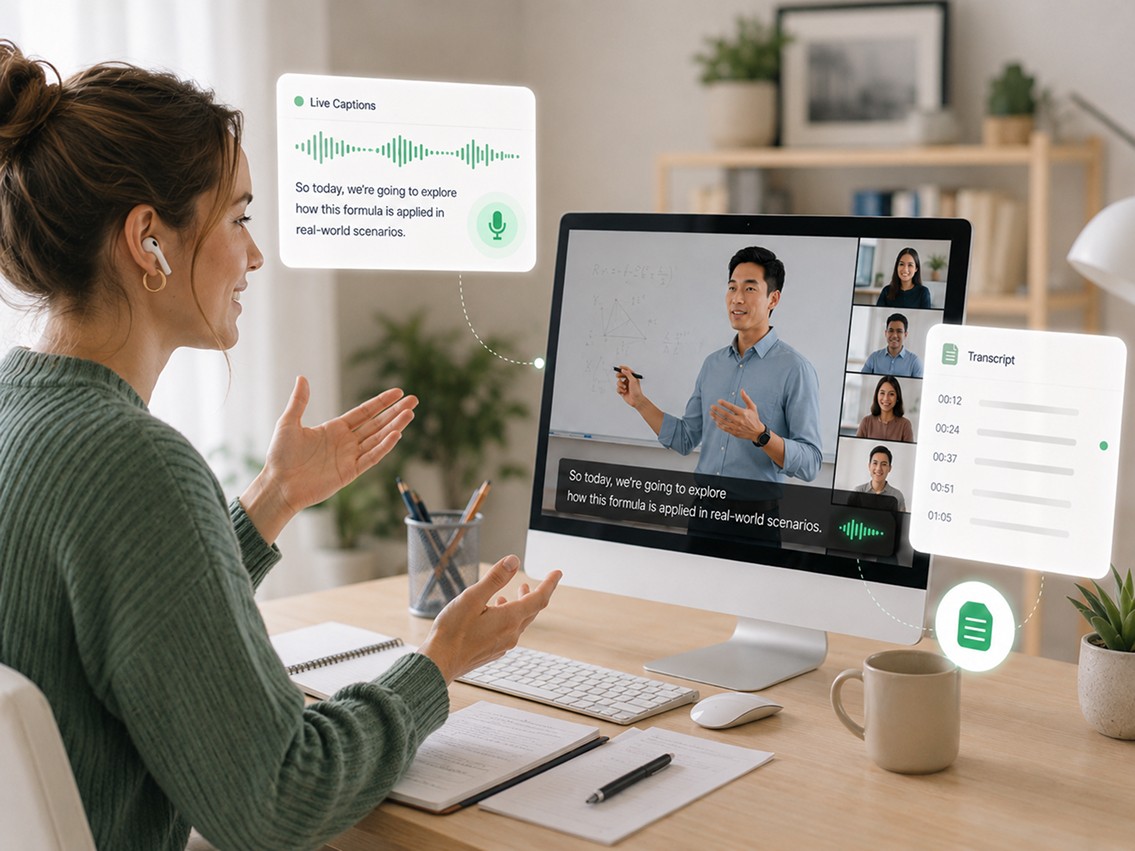
Live captions in a virtual classroom are not just a feature for learners with hearing impairments. They are the visible surface of a transcription infrastructure that, when built properly, powers session search, AI-generated lesson summaries, learning continuity between sessions, compliance documentation, and multilingual comprehension support. The caption itself is the output a learner sees. Underneath it is a real-time text record of everything spoken in the session -- a data layer that becomes more valuable the more the platform is built to use it.
This is why the conversation about live captions has shifted among education infrastructure teams from "do we support accessibility" to "how do we build the transcription layer that makes everything else possible." The accessibility case and the operational case are not separate arguments. They point to the same infrastructure investment.
Problems Captions Help Solve
Before getting into how live captions work technically, it is worth being specific about the problems they address -- because the list is longer than it appears from the outside.
Comprehension gaps from audio quality. Online learning sessions happen across a wide range of audio environments. A tutor with a decent microphone in a quiet room sounds very different from one on a laptop microphone with background noise. A learner on a mobile connection in a noisy household hears something different from what was transmitted. Audio quality variance is a consistent feature of online education at scale, not an edge case. Live captions reduce the comprehension cost of that variance significantly. A learner who missed a word or phrase due to audio degradation can read it rather than asking for a repeat or, more commonly, filling the gap with a guess.
Non-native language learners. A student learning in their second or third language processes spoken instruction more slowly than a native speaker. The gap between hearing and understanding is wider. Captions give that student a second channel -- not a translation, but a text representation of the same content that can be processed at a pace that accommodates the additional cognitive load of language processing. This is a meaningful comprehension support for a large proportion of online learners globally, and it requires no special configuration per student.
Attention and processing differences. Students with attention-related learning differences, auditory processing challenges, or anxiety that affects concentration in live sessions benefit from a text channel that does not require them to sustain perfect audio attention throughout the session. This is not about labeling students or requiring disclosure. It is about building a learning environment where comprehension does not depend entirely on uninterrupted auditory attention.
Session review and retention. Material covered in a 60-minute tutoring session is not fully retained by most learners immediately after the session. The ability to review what was said -- not a recording that requires 60 minutes to watch, but a searchable transcript that allows a student to find the explanation of a specific concept in seconds -- changes how effective post-session review is. This is a learning outcome benefit, not just an accessibility one.
Instructor awareness. Captions give instructors a real-time text representation of their own speech, which is more useful than it might seem. An instructor who sees their spoken explanation rendered as text can catch unclear phrasing, notice when a technical term was mispronounced, and observe their own pacing in a way that audio alone does not support.
How Live Captions Work Inside Virtual Classrooms
The technical implementation of live captions varies significantly between platforms, and the differences matter for educational use.
At the basic level, live captions convert audio to text using automatic speech recognition and display that text to participants with a short delay -- typically one to three seconds from speech to caption display. This is the minimum viable implementation, and it is what most video conferencing tools offer when they advertise caption support.
The limitations of this baseline implementation are worth understanding. Generic speech recognition models are trained on general audio data. They perform well on clear speech with standard vocabulary. They perform less well on subject-specific terminology -- mathematical notation spoken aloud, scientific and technical vocabulary, proper names, non-native accents. For a tutoring session covering calculus or chemistry, a generic speech recognition model produces captions that are accurate enough for general comprehension but unreliable for the specific content being taught.
Education-specific transcription infrastructure addresses this through models trained on or adapted for educational content -- subject vocabulary, academic register, the interaction patterns specific to tutoring and instruction. The accuracy difference on education-specific content is significant enough to matter for learner comprehension and for the downstream uses of the transcript.
The second implementation distinction is where the caption data goes after it is displayed. In a basic caption implementation, the text is rendered for display and discarded. In an infrastructure-level implementation, the text is stored as a timestamped record, indexed for search, and made available to downstream systems -- AI summarization, session review tools, compliance reporting, learning record stores. The caption is the visible output. The stored transcript is the durable asset.
This distinction determines whether captions are a session feature or a foundational data layer. Most platforms offer the former. Education infrastructure platforms build the latter.
Educational and Operational Benefits
The benefits of live captions that get the most attention are session-level comprehension improvements. These are real. The benefits that compound over time are operational.
Searchable session transcripts. A tutoring session that produced a timestamped, searchable transcript is a different kind of asset from one that produced a recording. A student preparing for an exam can search across the last three months of session transcripts for every explanation of a topic they found difficult. A tutor preparing for next week can search the student's session history to find the specific moment a misconception appeared. An operations manager reviewing tutor quality can pull every session where a particular concept was covered and assess how it was explained across different tutors.
None of this is possible with recordings alone. Recordings are archives. Transcripts are databases.
AI-generated lesson summaries. The transcription layer is the foundation for AI lesson summaries. A summary generated from a timestamped transcript is more accurate and more structured than one generated from a recording alone, because the text layer allows the AI to identify topic boundaries, question-and-answer patterns, and moments of emphasis or repetition that indicate pedagogically significant content. The quality of the caption infrastructure directly determines the quality of the AI outputs built on top of it.
Compliance documentation. Many regulated education markets require documented records of session content -- what was covered, who attended, how long instruction occurred. A session transcript satisfies this requirement automatically, without requiring tutors to produce manual records. For platforms serving institutional clients with compliance obligations, the transcript is not a convenience. It is a contractual and regulatory necessity.
Post-session recaps for parents and learners. An AI-generated session recap sent to parents within 30 minutes of session end is built on the session transcript. The accuracy and specificity of that recap -- whether it actually reflects what was covered in the session rather than producing generic observations -- depends entirely on the quality of the transcription layer underneath it.
Accessibility and Inclusion
The accessibility case for live captions in virtual classrooms is worth making precisely and without the generic language that usually surrounds it.
Accessibility in online education is not about adding features for a small minority of users with disclosed disabilities. It is about building learning environments where comprehension does not depend on a single channel -- perfect audio reception, uninterrupted attention, native language fluency -- that a significant proportion of learners cannot consistently maintain.
The proportion of online learners who benefit meaningfully from live captions is larger than most platform teams assume. Non-native speakers represent a substantial portion of online tutoring enrollments globally. Students with undisclosed attention or processing differences are present in every cohort. Learners on variable network connections experience audio degradation regularly. Students in shared living situations deal with ambient noise that affects listening. Each of these is a comprehension risk that captions mitigate.
The legal dimension is also worth being clear about. WCAG 2.1 guidelines, the Americans with Disabilities Act, and equivalent frameworks in other jurisdictions establish caption requirements for educational content. For platforms serving institutional clients -- schools, universities, corporate training programs -- caption support is not optional. It is a procurement requirement. Platforms without it are excluded from a significant portion of the institutional market regardless of their other capabilities.
Building live captions into the platform infrastructure rather than adding them as an optional feature changes the compliance posture. Captions that are always on, always accurate, and always producing a stored transcript satisfy institutional requirements without per-session configuration. Captions that require manual activation or are accurate only under ideal conditions do not.
AI-Powered Learning Continuity
The most forward-looking argument for live caption infrastructure is its role in learning continuity -- the ability of a learning system to carry what happened in one session forward into the next.
In most online tutoring contexts, session continuity depends on tutor memory and manual notes. A tutor who remembers that a student struggled with a specific concept three sessions ago adapts accordingly. A tutor who does not remember, or who is new to the student, starts from a less informed position. The quality of the session is partially determined by how good the knowledge transfer between sessions is.
Transcript infrastructure changes this. A tutor opening a session with a student can review a structured summary of the previous session generated from its transcript -- not a vague "we covered quadratic equations" but a specific record of which problems the student struggled with, which explanation seemed to land, what the student asked that suggested a gap in understanding. The next session starts from an informed position regardless of whether the tutor has perfect recall.
At scale, this produces a qualitatively different learning operation. The knowledge accumulated across thousands of sessions is not lost when tutors change or memory fades. It is stored, structured, and accessible -- a learning record that compounds in value as sessions accumulate.
This is what AI-powered learning continuity looks like in practice. Not a futuristic capability. A direct consequence of building transcription infrastructure that stores, indexes, and makes accessible what happens in every session.
Where HiLink Fits
HiLink integrates live captions, session transcription, and AI-powered session intelligence into the classroom infrastructure layer -- not as optional features that require activation, but as capabilities that run on every session automatically.
Captions are displayed in real time during the session. The underlying transcript is stored as a timestamped, searchable record. At session end, AI lesson summaries are generated from the transcript and session event data -- structured outputs for tutors, students, and parents, accessible through the platform and through the API for integration into downstream workflows.
The transcription infrastructure is designed for education-specific content -- subject vocabulary, academic register, the interaction patterns of tutoring and instruction -- which produces caption accuracy and summary quality that general-purpose transcription does not match for educational use cases.
For platforms serving institutional clients, the compliance posture is built in. Captions run on every session. Transcripts are retained as structured records. The documentation requirements that institutional procurement demands are satisfied by how the infrastructure works, not by manual configuration per session.
The Bottom Line
Live captions in a virtual classroom are an accessibility feature. They are also the visible surface of a transcription infrastructure that, when built properly, powers searchable session records, AI lesson summaries, learning continuity between sessions, parent communication workflows, and institutional compliance documentation.
The decision to build live caption infrastructure is not a decision about supporting one category of learner. It is a decision about what kind of data layer the platform produces from every session -- and what that data layer makes possible for the learners, tutors, operations teams, and institutional clients the platform serves.
Platforms that treat captions as an accessibility add-on build the visible feature without the underlying infrastructure. Platforms that treat captions as a foundational data layer build something that compounds in operational and educational value over time.
That distinction is what separates a caption feature from caption infrastructure. And it is worth getting right early, before the downstream capabilities that depend on it are already on the roadmap.