Virtual Classroom With AI Notes: What Automatic Lesson Summaries Actually Do
Why Lesson Documentation Matters
Every tutoring session produces something worth keeping.
Not just the recording -- the substance of what happened. What concept the student finally understood after three attempts. What question revealed a gap in foundational knowledge. What the tutor planned to cover versus what actually got covered. What needs to happen in the next session for this one to have been worth the hour.
That information has real value. For the student reviewing before the next session. For the parent trying to understand whether progress is happening. For the tutor preparing a follow-up plan. For the operations team tracking whether learning objectives are being met consistently across hundreds of sessions.
Most of it disappears within 48 hours of the session ending.
Not because anyone decides to discard it. Because capturing it manually is slow, inconsistent, and competes with everything else tutors and students have to do after a session ends. The value is real. The system for preserving it either does not exist or does not hold up in practice.
This is the problem AI classroom notes are built to solve. Not as a convenience feature. As an operational infrastructure decision.
The Problems With Manual Note-Taking
Manual session documentation fails in predictable ways. Understanding them is useful because it clarifies exactly what AI classroom notes need to do differently.
Tutor notes are inconsistent by design. When note quality depends on individual tutor discipline, it varies with tutor discipline. Some tutors write detailed session notes within 20 minutes of a session ending. Others write two sentences the following morning. Others update their notes when a parent asks a question. Across a tutoring operation with 50 or 100 tutors, this produces a session record that is comprehensive for some students and nearly empty for others -- not because those students' sessions were less important, but because their tutors happened to be less systematic.
Students do not take notes effectively during sessions. This is not a student failure. It is a task design problem. Taking notes while trying to understand a concept requires splitting attention between comprehension and documentation in a way that undermines both. Students who are engaged in working through a problem with a tutor are not in a good position to simultaneously produce a structured record of what they are learning.
Note-taking apps that live outside the classroom create friction. A student who opens a separate app to take notes during a tutoring session is context-switching between the session and the documentation tool every few minutes. The note quality suffers. The session engagement suffers. And the notes that result are disconnected from the session structure -- timestamps, tutor questions, specific moments of difficulty -- that make them useful for review later.
The information that matters most is hardest to capture manually. The moment a student's response time lengthened because a concept did not land. The third time a specific topic came up in a single session. The question the student asked that revealed they had been confused about something for weeks. These are the signals that inform good teaching and support genuine progress. They are also exactly the signals a tutor cannot capture manually while simultaneously trying to teach.
What AI Classroom Notes Actually Do
A virtual classroom with AI notes built into the infrastructure produces session documentation differently -- not as a downstream task someone completes after the session, but as a continuous output of what is happening during it.
Real-time transcription as the data layer. The foundation is transcription that runs throughout the session. Not activated manually. Not applied to a recording afterward. Running from the moment the session opens, converting spoken audio to structured text with low enough latency to be accurate and timestamped.
This transcript is not the end product. It is the raw material for everything built on top of it.
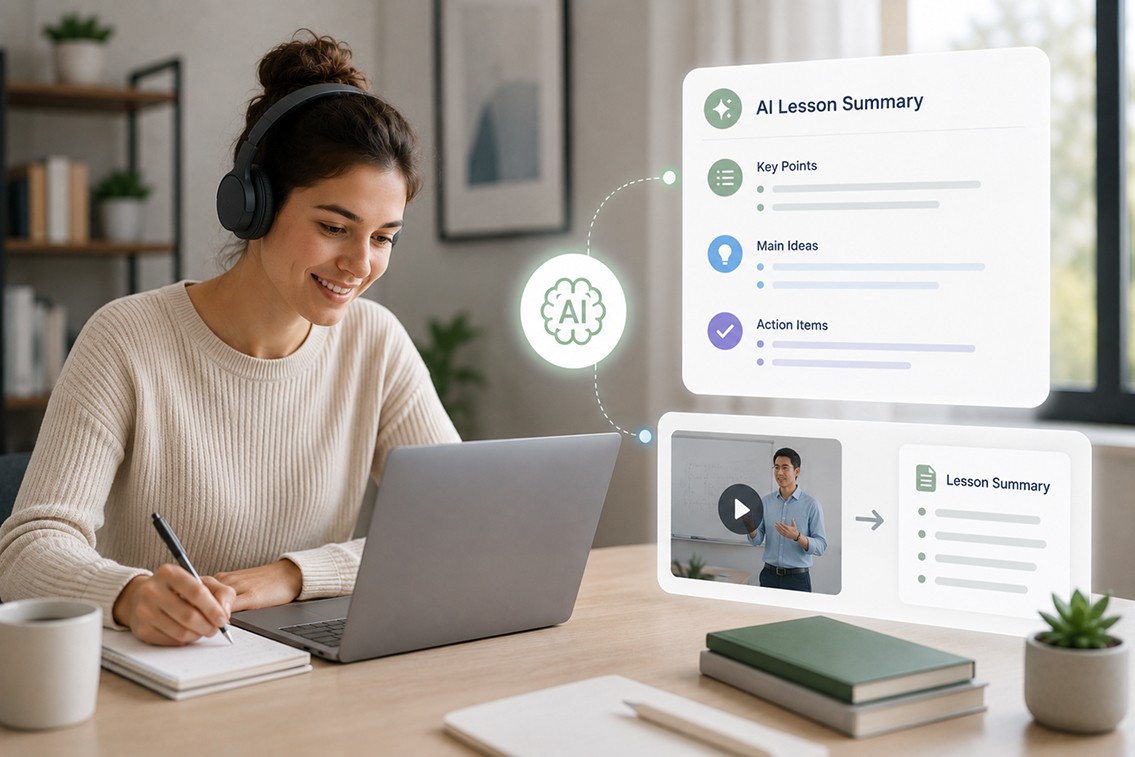
Automated lesson summaries at session end. When the session closes, a structured summary is generated from the transcript and session event data. Not a word-for-word transcript formatted into paragraphs -- a genuinely summarized document that identifies the learning objectives addressed, the concepts covered, the questions the student asked, the moments where understanding was uncertain, and the follow-up items flagged for next time.
The difference between a lesson summary and a meeting summary matters here. A meeting summary extracts action items and discussion points. A lesson summary extracts pedagogical content -- what was taught, how the student responded, what needs reinforcement. These require different models trained on education-specific session data, not generic audio or text.
Searchable session records. Transcripts and summaries that are stored and indexed create a learning record that is actually usable over time. A tutor preparing for next week's session can search the student's session history for every time a specific concept came up. An operations manager reviewing a tutor's performance can pull session summaries across the last month without watching recordings. A student preparing for an exam can search their own session history for every explanation of a topic they struggled with.
This is categorically different from a folder of recording files organized by date. Recordings are archives. Searchable, structured session records are a knowledge base.
Structured recap generation for different audiences. The same underlying session data produces different outputs depending on who needs them. A tutor-facing summary emphasizes pedagogical detail -- what was covered, where gaps appeared, what to prioritize next. A student-facing recap is structured around review -- key points from the session, concepts to revisit, questions to think about before next time. A parent-facing update is clear and brief -- what was worked on today, one specific strength observed, one area to support at home.
These are not three separate documents assembled manually. They are structured views of the same underlying session data, generated automatically and formatted for their respective audiences.
Benefits for Tutors, Students, and Parents
For tutors, the primary benefit is administrative time recovered without documentation quality declining. A tutor who runs five sessions a day and spends 10 minutes writing notes after each one is investing nearly an hour daily in documentation. Automated lesson summaries reduce this to a brief review and confirmation -- two minutes rather than ten, with more consistent output.
The secondary benefit is continuity between sessions. A tutor who can review a structured summary of the previous session before opening the next one teaches more effectively than one who is reconstructing from memory. The AI summary does not replace tutor judgment. It makes tutor judgment better-informed.
For students, the primary benefit is a reliable review resource. Students who can access a structured summary of what was covered -- with the specific concepts, examples, and questions from their actual session -- review more effectively than students working from their own incomplete notes or a general textbook. The session recap is personalized to exactly what happened in their session, which makes it more relevant than any generic study resource.
For parents, consistent post-session communication built on structured AI summaries changes the relationship with the tutoring business. A parent who receives a clear, specific update within 30 minutes of every session -- not a vague "good session today" but a concrete account of what was covered and what to watch for -- stays informed and stays enrolled. The research on tutoring retention is consistent on this point: parent communication quality is one of the strongest predictors of student retention, and AI-generated session recaps make consistent, high-quality communication operationally sustainable at scale.
Operational Advantages for Tutoring Companies
Beyond the session-level benefits, AI classroom notes produce operational advantages that compound as volume grows.
Quality monitoring becomes data-driven. When every session produces a structured summary, operations teams can review session quality systematically rather than relying on spot-checks of recordings. A summary that shows a tutor spent 70 percent of the session talking and addressed one of three planned objectives is a quality signal. Across 50 sessions from the same tutor, it is a performance trend. This visibility does not exist when documentation depends on tutor self-reporting.
Tutor development is grounded in specifics. Coaching conversations built on AI session summaries are more effective than those built on general impressions. A manager who can point to specific session patterns -- the tutor consistently moves on before confirming understanding, for instance -- has a more productive coaching conversation than one offering general feedback about session pacing.
Compliance and reporting become straightforward. Institutional clients -- schools, corporate training programs, government education contracts -- often require documentation of what was covered in each session, attendance records, and evidence of learning objective alignment. AI-generated session summaries, stored as structured records, satisfy these requirements without requiring manual assembly. The documentation exists because the infrastructure produces it, not because someone remembered to write it.
Onboarding new tutors accelerates. A library of structured session summaries from experienced tutors becomes a training resource. New tutors who can review how experienced colleagues handled specific concepts, managed student confusion, or structured sessions for different learner profiles learn faster than those working from general onboarding materials alone.
What to Look for in AI Classroom Note Systems
Not all AI note features in virtual classrooms are equivalent. The evaluation criteria that matter are more specific than they might appear.
Is the AI built into the classroom infrastructure or added on top? Transcription that runs automatically on every session from the infrastructure layer produces consistent outputs. A note-taking feature that requires manual activation, works only on recorded sessions, or lives in a separate app produces inconsistent ones. Consistency is what makes AI notes operationally useful rather than occasionally helpful.
What does the summary actually contain? Ask to see an example output. A useful lesson summary contains structured pedagogical information -- learning objectives, concept coverage, student response patterns, follow-up items. A generic summary contains a transcript formatted into paragraphs. The difference is significant for educational usefulness.
Is the session record searchable and accessible through an API? Summaries that live inside a vendor dashboard are useful for individual review. Summaries accessible through an API can feed into CRM systems, parent communication tools, LMS platforms, and internal reporting without manual export. API accessibility determines whether AI notes become infrastructure or remain a feature.
What audience formats are supported? A platform that produces one summary format for all audiences requires manual reformatting before each use. A platform that generates tutor-facing, student-facing, and parent-facing outputs from the same session data removes that step from the operational workflow.
How is accuracy handled for education-specific content? Transcription accuracy on general speech is different from accuracy on subject-specific vocabulary -- mathematical notation, scientific terminology, proper names, technical concepts. Ask specifically how the system handles the subject areas your tutors teach.
Where HiLink Fits
HiLink integrates AI notes at the infrastructure layer, which means they run on every session without manual configuration.
Transcription runs from session open to session close. At session end, structured summaries are generated automatically -- tutor-facing, student-facing, and parent-facing formats from the same underlying session data. Summaries and transcripts are stored as searchable records and accessible through the API, which means they can feed into parent communication workflows, CRM systems, and reporting infrastructure without manual export steps.
The AI layer is built on session event data captured throughout the session -- not just the transcript, but structured learning events, engagement signals, and session milestones that give the summary context a transcript alone cannot provide. This is what makes the output a lesson summary rather than a formatted transcript.
For tutoring operations, this means session documentation is consistent across every tutor and every session. The quality of the record does not depend on which tutor delivered the session. The parent communication workflow does not depend on tutor memory. The operations team's visibility into session quality does not depend on manual review of recordings.
The Bottom Line
A virtual classroom with AI notes is not a convenience feature. It is an operational infrastructure decision with consequences for tutor efficiency, student retention, parent communication, and quality monitoring at scale.
The difference between AI notes built into classroom infrastructure and note-taking apps added on top of a session is the difference between documentation that happens consistently and documentation that happens when someone remembers to do it. At low volume, the distinction is manageable. At scale, it determines whether the session record is a reliable operational asset or an inconsistent archive nobody has time to review.
What makes AI classroom notes worth investing in is not the technology. It is the consistency -- session after session, tutor after tutor, student after student -- that only infrastructure-level integration can reliably produce.