Virtual Classroom Systems for Enterprise Training
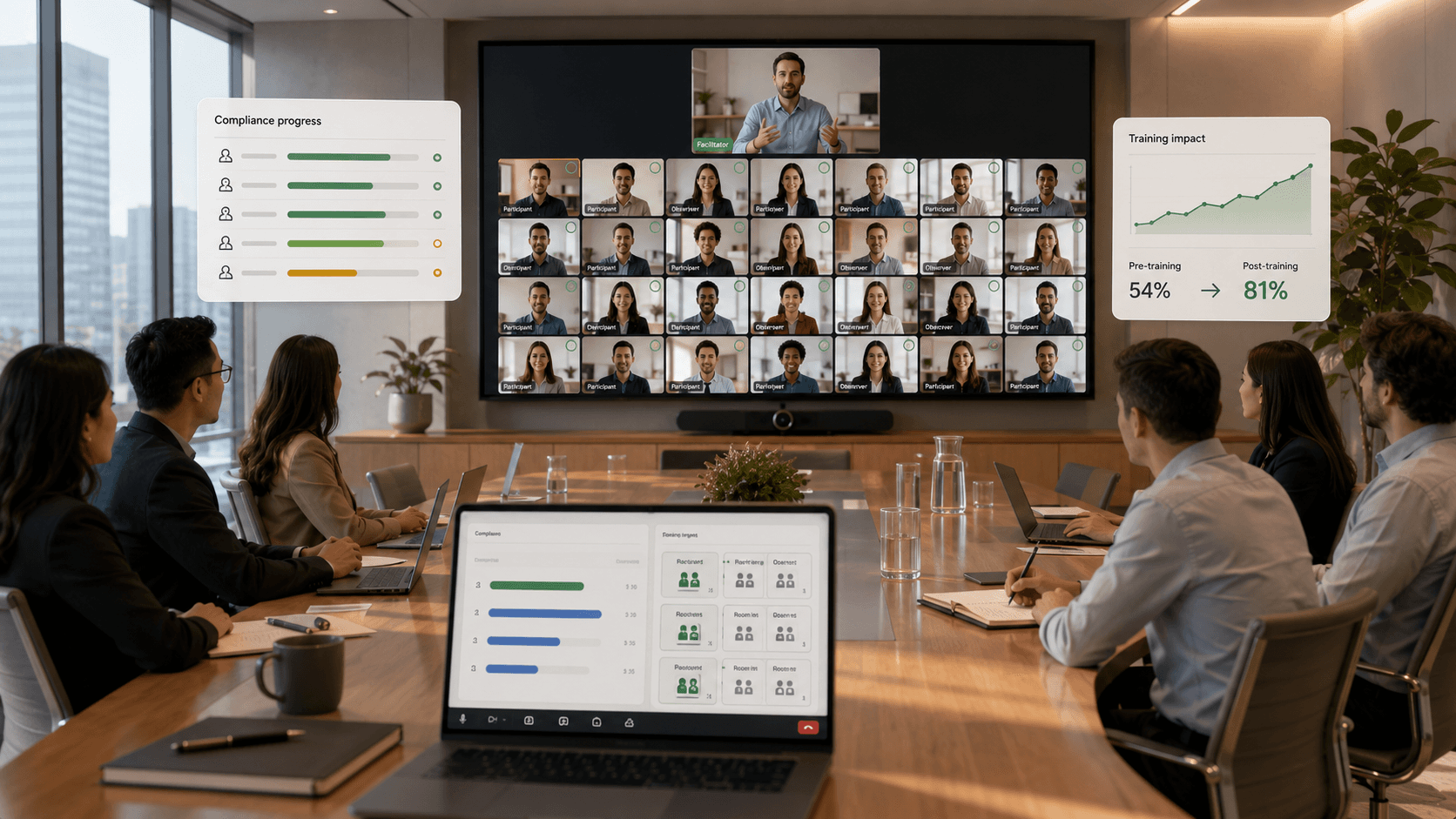
Enterprise training has always been a large-scale operational challenge. Organizations with thousands of employees across multiple locations, time zones, and business units need to deliver consistent learning experiences to people with different roles, different knowledge levels, and different relationships to learning as an activity.
The shift to virtual training solved some of these challenges and created new ones.
On the benefit side: geographic barriers fell. An organization that once needed to fly trainers to offices or bring employees to central locations can now deliver the same session to participants anywhere. Scheduling flexibility improved. Content can reach people who were previously excluded by logistics. The infrastructure cost of a dedicated physical training center is no longer the baseline.
On the challenge side: virtual training environments require operational infrastructure that physical training rooms don't. When everyone is in the same room, presence is visible, participation is ambient, and the social dynamics of a live group handle much of the engagement work. When everyone is in separate locations on separate screens, engagement has to be actively designed, participation has to be structured, and the operational complexity of coordinating large live sessions -- with consistent quality across participants who may have very different technical setups -- has to be managed systematically.
This article examines what enterprise training requires from virtual classroom systems that differs from consumer education or tutoring use cases, and what capabilities organizations should prioritize when selecting infrastructure.
The Rise of Virtual Corporate Learning
Corporate learning was already moving toward virtual delivery before external events accelerated that transition dramatically. The direction was clear: enterprise training that previously required physical co-location was becoming economically and operationally sustainable through virtual delivery.
Several factors have driven this shift and are maintaining it.
Geographic workforce distribution means that most enterprise organizations can't deliver consistent in-person training to their full employee base without logistics costs that make many training programs unviable. Virtual delivery changes that equation: the same session can reach participants in New York, London, and Singapore at the same time, at a fraction of what comparable in-person delivery would cost.
Learning frequency requirements have increased. Organizations that previously delivered annual or quarterly training now recognize that more frequent, shorter learning interventions produce better skill development and better retention than infrequent intensive programs. Virtual delivery makes frequent short sessions operationally practical in ways that physical training never was.
Regulatory and compliance requirements are creating demand for documented, auditable learning records. Many industries -- financial services, healthcare, pharmaceuticals, technology -- have mandatory training requirements with documentation obligations. Virtual classroom systems that produce automatic, reliable session records support compliance functions that informal learning methods don't.
Measurement expectations have shifted. Senior stakeholders who fund enterprise training programs increasingly expect evidence that the programs produce learning outcomes, not just training hours. Virtual classroom infrastructure that captures engagement data, comprehension check results, and participant performance enables the outcome measurement that asynchronous content delivery and physical classroom training can't support with the same rigor.
Requirements for Enterprise-Scale Training
Enterprise training has specific requirements that distinguish it from consumer education contexts and that shape what virtual classroom systems need to deliver.
Scale without quality degradation is the fundamental technical requirement. Enterprise training sessions range from small cohort sessions to organization-wide events with hundreds of simultaneous participants. The virtual classroom infrastructure has to perform reliably across this range without the technical degradation that smaller platforms show at high participant counts. An enterprise session that drops at the peak participant moment is not just an inconvenience -- it's a visible organizational failure that affects credibility.
Multi-session program management is an enterprise-specific operational requirement. Enterprise learning programs typically involve multiple sessions per learner -- an onboarding program might have eight sessions over four weeks, while a management development program might span months. Managing participant progress across these multi-session programs, tracking completion, maintaining continuity between sessions, and producing program-level reporting requires more than single-session session management.
Role-based access and permissions are more complex in enterprise contexts than in tutoring or school contexts. A training session might include participants, facilitators, subject matter experts, observers from HR, and managers reviewing their direct reports' participation. Each role has different access requirements and different data access. The virtual classroom system has to support these role distinctions rather than treating all participants identically.
SSO and identity management integration is a practical enterprise requirement that affects adoption. Enterprise employees don't want to manage separate credentials for training platforms. Integration with corporate identity providers -- Active Directory, Okta, other SSO systems -- is a baseline expectation in enterprise contexts that many consumer-facing platforms don't support natively.
Security and data governance are enterprise requirements with compliance and legal implications. Where is session data stored? Who has access? How long is it retained? Are recordings subject to the organization's data retention policies? Can the organization enforce its own data governance policies on session data? These questions have straightforward answers in enterprise IT procurement contexts and need direct answers from any virtual classroom vendor.
Collaboration and Engagement Tools
Enterprise training uses collaboration and engagement tools for purposes that partially overlap with K-12 or tutoring contexts but differ in important ways.
Large-group facilitation requires engagement tools that work at scale. A whiteboard activity that works well for a group of eight becomes unwieldy for a group of forty without design modifications and tool support. Poll features that surface fifty participant responses need to present those responses in ways that facilitate facilitated discussion rather than overwhelming the facilitator with unmanageable data. Enterprise virtual classroom systems need engagement tools designed for larger groups, not just features that work at small group sizes.
Breakout room functionality in enterprise training supports a specific learning design: cohort-level work in the main session, small-group practice or discussion in breakouts, reintegration to share outputs. The facilitation complexity increases with the number of simultaneous breakout groups. A facilitator managing eight simultaneous groups of four needs different monitoring and control tools than one managing two groups of twelve. Enterprise-grade breakout functionality includes facilitator visibility into multiple groups simultaneously and smooth transitions between breakout and main session.
Asynchronous follow-up capability is increasingly important in enterprise training. Sessions often assign tasks, readings, or practices to be completed between sessions. Virtual classroom infrastructure that connects synchronous sessions to asynchronous assignments -- where completion can be tracked and brought into the next session's context -- bridges the synchronous-asynchronous divide more effectively than treating each session as isolated.
Technical accessibility across enterprise devices and networks is a practical consideration that consumer platforms don't always address. Enterprise employees may be using corporate-managed devices with specific software configurations, connecting through corporate VPNs with traffic inspection, or on secure networks with restricted access to some cloud services. Enterprise virtual classroom systems need to be tested and validated in corporate network environments rather than just in consumer settings.
Reporting and Compliance
Reporting and compliance capabilities are often the deciding factor in enterprise training platform selection -- more so than in consumer education contexts where reporting serves parents and individual instructors.
Learning completion tracking documents which employees have completed which training components, when, and at what performance level. For compliance-mandatory training, this documentation is a legal requirement. For development programs, it's the organizational evidence that the investment in training is being realized. Enterprise virtual classroom systems need to produce completion records that meet the documentation standards of the organization's compliance and audit functions.
Attendance and participation records that are automatically generated and reliably stored are more valuable than records that require manual administration. An enterprise training operation running fifty sessions per week across multiple facilitators cannot depend on manual attendance entry. Automated, timestamped attendance records that can be exported and integrated with HR systems are a baseline enterprise capability.
Assessment and knowledge check reporting provides the outcome measurement that justifies enterprise training investment. When a session includes comprehension checks, quiz questions, or performance assessments, those results should be captured at the participant level, aggregated at the session and program level, and available in reporting formats that HR and training stakeholders can present to program sponsors. The ability to show that participants scored X% on knowledge checks at the beginning of a program and Y% at the end is the measurement that distinguishes effective training from training hours.
LMS integration is a practical requirement for enterprise organizations that have existing learning management systems. Enterprise training programs are managed, tracked, and reported through LMS platforms in most organizations. A virtual classroom system that integrates with the existing LMS -- passing completion records, attendance data, and assessment results through standard integration protocols -- is more valuable than one that requires managing training records in a separate system.
Custom reporting and data export capabilities give enterprise training operations the flexibility to produce the specific reports their stakeholders require. Standard report formats serve many needs. Custom reporting that allows the organization to define its own metrics, produce reports in its own formats, and export data for analysis in its own tools serves enterprise stakeholders who have specific, established reporting requirements.
AI-Supported Training Operations
AI in enterprise training operations follows the same operational principles as AI in consumer education -- absorbing high-volume, pattern-dependent work that human capacity can't cover consistently -- but applies them to enterprise-specific workflows.
Session summary generation is as valuable in enterprise contexts as in tutoring. An enterprise training session produces a large amount of content and discussion that should be captured in a form that participants can review and that program administrators can use for quality monitoring. AI-generated session summaries that are reviewed by facilitators and distributed to participants and program managers are more consistent and more timely than manually produced summaries at enterprise training volume.
Engagement analytics at scale help enterprise training facilitators understand what's working in real time and program administrators understand what's working across their training portfolio. Which topics generated the most participant activity? Which sessions produced the lowest engagement scores? Which cohorts showed the highest learning gains? These organizational questions require AI processing of engagement data at enterprise scale rather than manual analysis.
Compliance training automation is an enterprise-specific AI application. Tracking which employees have completed which mandatory training requirements, sending reminders to employees approaching compliance deadlines, generating audit-ready documentation of training completion, and alerting managers when their teams have compliance gaps -- these are high-volume, time-sensitive coordination tasks that AI-powered automation handles more reliably than manual administration at enterprise scale.
Coaching and facilitation support is an emerging AI application in enterprise training. AI that analyzes session patterns to suggest facilitation improvements, identifies participant cohorts whose engagement trajectories suggest additional support, or surfaces knowledge check topics where the organization consistently shows gaps is providing the kind of learning intelligence that helps enterprise training programs improve over time.
Future Trends in Enterprise Learning
The trajectory of enterprise virtual training is toward more sophisticated learning experiences, better measurement, and tighter integration with the operational context where employees apply their learning.
Personalized learning pathways at enterprise scale are becoming achievable as AI systems become capable of analyzing individual employee learning histories, performance data, and role requirements to recommend tailored training programs. The enterprise organization that can deliver personalized development paths at scale -- rather than one-size-fits-all programs -- has a learning infrastructure advantage.
Skills-based learning measurement is replacing completion-based measurement in progressive enterprise learning functions. Rather than tracking whether an employee completed a training module, skills-based measurement tracks whether the employee can demonstrate the skill the training was designed to develop. Virtual classroom systems that capture performance data from applied skill exercises are better positioned to support skills-based measurement than those that only track attendance.
Real-time coaching integration is an emerging capability that applies AI analysis to live training sessions to give facilitators real-time guidance: which participants are showing engagement signals that suggest confusion, which discussion threads are producing the most insight, where the session pacing is running behind or ahead of the content plan. This kind of facilitator support produces better learning experiences without requiring facilitators to simultaneously teach and monitor analytics.
Integration with enterprise performance management systems is increasing. The connection between training completion and performance outcomes -- whether employees who completed development programs show measurable improvement in performance metrics -- is the measurement that enterprise HR and L&D functions are being asked to demonstrate. Virtual classroom systems that can pass learning data into performance management systems enable this connection without manual data reconciliation.
For enterprise organizations evaluating virtual classroom infrastructure for training, the platform decisions made now will shape training operations for years. The organizations that select infrastructure that meets their current needs and supports their future growth -- in scale, in measurement sophistication, and in integration with the enterprise systems they already run -- build training functions that improve with their organizations. Those that select infrastructure that meets current needs without considering future requirements rebuild when those requirements arrive.
HiLink's API-first virtual classroom infrastructure is designed to support the operational complexity that enterprise training requires: reliable performance at enterprise session volumes, flexible role and permission management, comprehensive session data capture, robust API integration with enterprise systems, and AI-powered operational support for high-volume training programs. For enterprise organizations building or evolving their virtual training capabilities, infrastructure that grows with the organization is the investment worth making.