Virtual Classroom Software vs. Live Collaboration Infrastructure: Why the Distinction Matters
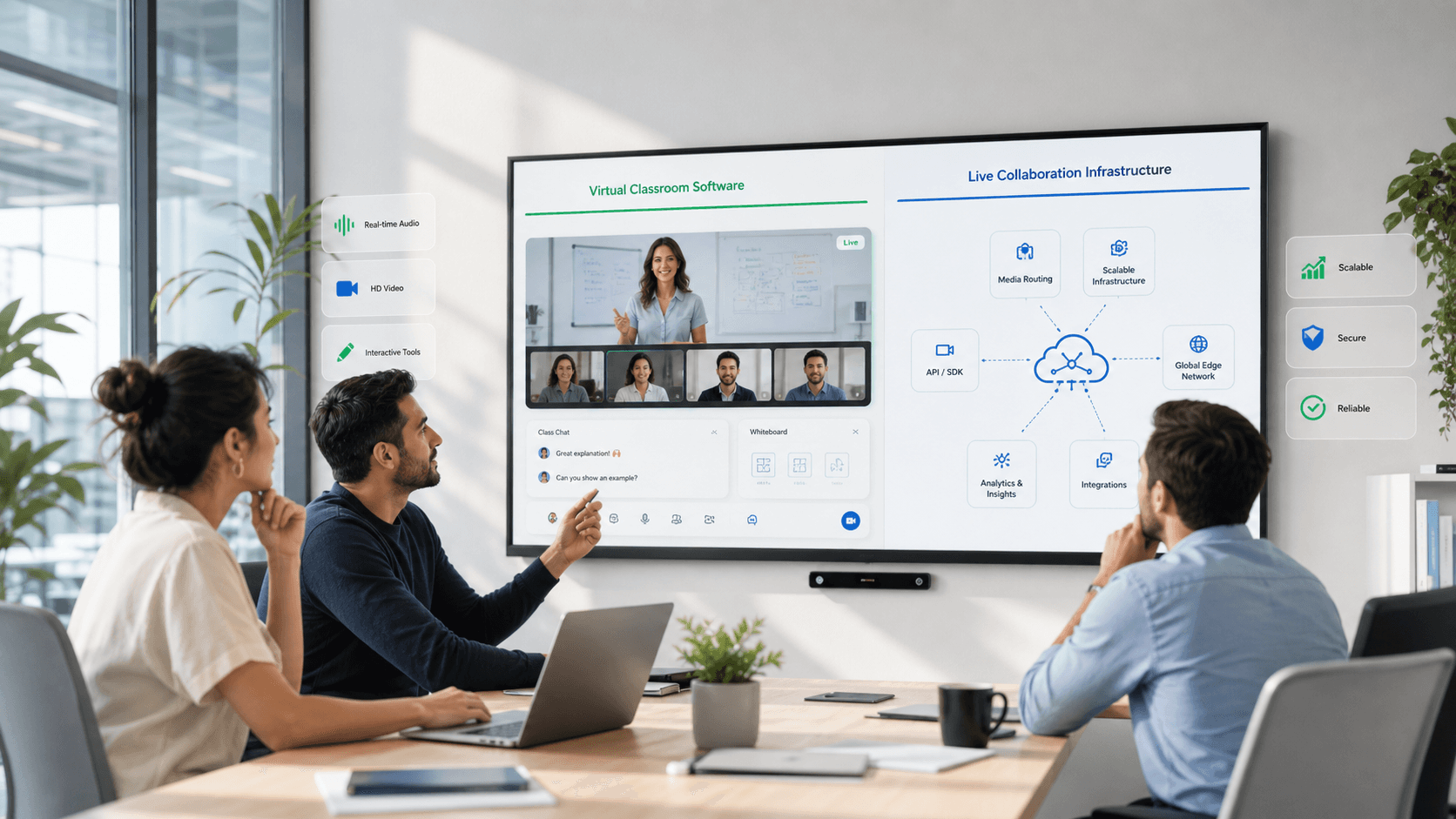
If you are evaluating virtual classroom software right now, you are probably comparing features.
Video quality. Whiteboard tools. Breakout room limits. Pricing per seat. Integration with your LMS. Mobile app ratings. Support response times. You have a spreadsheet, or something like one, and you are working through it.
That process is not wrong. But it is answering the wrong question for a significant number of the organizations doing it.
The more important question is not which virtual classroom software is better. It is whether you need software at all -- or whether you need infrastructure.
That distinction sounds academic. It is not. Getting it wrong means choosing a solution that works fine today and becomes a serious constraint in twelve to eighteen months.
What Virtual Classroom Software Actually Is
Virtual classroom software is an application. It has an interface, a feature set, a pricing model, and a support team. You configure it, deploy it, and use it. Your learners log in, attend sessions, and log out.
The major players in this category are well known. Zoom, Google Meet, and Microsoft Teams dominate general use. Education-specific options like Adobe Connect, Blackboard Collaborate, and BigBlueButton have been around long enough to have established feature sets and known limitations. Newer entrants like Whereby, Butter, and Engageli have cleaner interfaces and more modern architecture.
These products compete on features, pricing, and user experience. Comparing them on those dimensions is reasonable because they are genuinely comparable. They are applications solving roughly the same problem with different tradeoffs.
What they share, regardless of those differences, is that they are built to deliver sessions. The session is the product. What happens before it, after it, and across thousands of them over time is largely outside the scope of what the software was designed to handle.
What Live Collaboration Infrastructure Is
Infrastructure is a different category. Not better or worse in absolute terms -- different in what it is designed to do and what it is designed to support.
Live collaboration infrastructure is the foundational layer that virtual classroom experiences are built on top of. It handles real-time communication protocols, session state management, media delivery, identity and access architecture, learning event capture, data pipelines, and integration interoperability. It is designed to be built on, not just used.
The distinction matters because infrastructure solves a different set of problems than software does.
Software solves the session delivery problem. Infrastructure solves the session reliability, session data, organizational complexity, and scale economics problems -- and it solves them at the layer where they need to be solved, rather than leaving them to be patched at the application layer.
When a product team picks virtual classroom software and then needs tutor performance analytics, they build an analytics layer on top of the software. When they need compliance-ready recording, they build that. When they need multi-tenant branding for institutional clients, they build that too. At some point they have built an infrastructure layer themselves, on top of software that was never designed to support it.
Infrastructure-first platforms make that layer part of the product rather than part of the customer's engineering burden.
How to Know Which One You Actually Need
This is where most evaluations go wrong. Teams default to software comparisons because software is easier to evaluate. You can run a trial, compare interfaces, and get a price quote. Infrastructure requires a more architectural conversation, and those are slower and harder to have under procurement pressure.
But the signals that point toward infrastructure are usually visible early if you know what to look for.
You are building a platform, not using one. If the virtual classroom is something your team is integrating into a product you own -- not just a tool your organization uses -- you almost certainly need infrastructure. Software is designed for end users. Infrastructure is designed for builders.
Your clients have enterprise or institutional requirements. Branded environments, data residency, SSO integration, LTI compliance, custom reporting -- these requirements accumulate fast in enterprise education sales. Software solutions handle some of them with configuration. Infrastructure handles them natively.
Session data is part of your value proposition. If your platform promises learner progress tracking, tutor quality monitoring, or any kind of learning analytics, you need session data captured at the infrastructure level. Software solutions export attendance logs. Infrastructure captures structured learning events that analytics can actually be built on.
You expect to scale significantly within two years. At low volume, software economics work. As session volume grows, per-seat and per-minute pricing models become cost problems. More importantly, the operational complexity of managing quality across high volume requires instrumentation that software solutions were not designed to provide.
You are selling into multiple institutions or markets. Multi-tenancy, regional compliance, localization, and organizational hierarchy are infrastructure problems. Software solutions approximate them with configuration. The approximation breaks down at scale.
If none of these apply -- if you are a single organization looking for a reliable tool to run internal training or small-cohort courses -- virtual classroom software is probably the right answer. Zoom or Google Meet will do the job at a price that infrastructure solutions cannot match for simple use cases.
The mistake is applying software-level thinking to infrastructure-level problems.
Why This Reframe Matters for Evaluation
Most virtual classroom software evaluations end with a winner that the team is mildly confident in and a lingering sense that none of the options quite fit.
That feeling is usually diagnostic. It means the evaluation was comparing products that solve a different problem than the one the organization actually has.
Reframing the question -- from "which software is better" to "do we need software or infrastructure" -- changes what gets evaluated and who needs to be involved in the decision.
Software evaluations are primarily product decisions. Feature fit, user experience, vendor support. Product managers and end users are the right people in the room.
Infrastructure evaluations are architectural decisions. API design, data ownership, integration surface, scale economics, compliance posture. Engineering leads, CTOs, and operations teams need to be in the room alongside product.
Skipping the architectural conversation because it is slower leads to software decisions that engineering teams spend the next two years working around.
Where HiLink Fits
HiLink sits in the infrastructure category -- deliberately and by design.
The session experience is there. Video, whiteboard, breakout rooms, scheduling, recording. But the architecture underneath is built around the assumption that the session is the beginning of a data and operational story, not the end of it.
Session events are captured as structured data at the infrastructure layer. Learning events, engagement signals, attendance records, assessment responses -- accessible through a clean API, not locked inside a reporting dashboard. Multi-tenant architecture handles institutional hierarchy natively. Compliance infrastructure supports regional data residency and the regulatory requirements that come with enterprise education markets. The integration surface -- LTI, xAPI, SCORM, webhook-driven event streams -- is designed for builders, not just administrators.
For decision-makers in the middle of a software evaluation, the honest question HiLink asks is whether the evaluation is solving the right problem. If the answer is software, HiLink is probably not the right fit. If the answer is infrastructure, the comparison set changes entirely.
That is not a sales position. It is an architectural one. And it is the distinction that determines whether the platform you choose today is still the right foundation in two years.
The Bottom Line
Virtual classroom software and live collaboration infrastructure are not the same category. Comparing them on feature checklists produces misleading results because they are designed to solve different problems at different layers.
Software is the right answer for organizations that need a reliable tool to deliver sessions. Infrastructure is the right answer for teams building platforms, serving enterprise clients, operating at scale, or staking business value on what session data can tell them.
Most evaluations default to software comparisons because they are faster and easier to run. The cost of that default shows up later -- in engineering debt, compliance gaps, scale problems, and a growing sense that the platform is being worked around rather than built on.
The distinction matters. Getting clear on which category you actually need -- before the procurement decision is made -- is the most valuable thing a decision-maker can do at the start of an evaluation.