Virtual Classroom Software vs Generic Video Tools
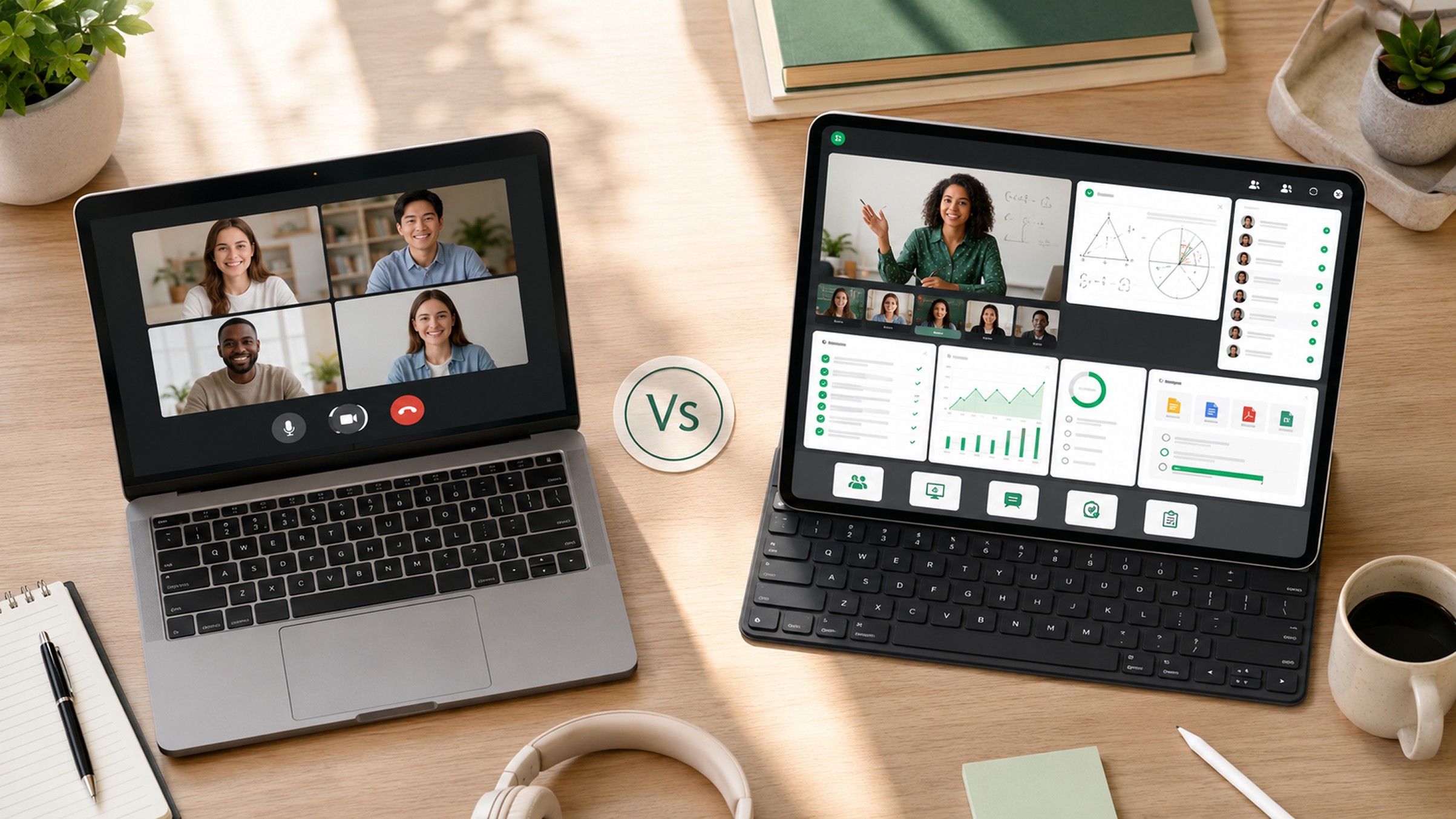
When video conferencing became widely accessible, it seemed like an obvious solution for online education. Teachers and students were already using it to communicate. Why not teach through it?
The answer, for anyone who has spent time running online education at any meaningful scale, is that teaching and communicating are different activities with different requirements -- and the tools built for one don't serve the other particularly well.
This is the fundamental distinction between virtual classroom software and generic video tools. Both transmit audio and video between people in different locations. Beyond that, they're solving different problems, optimized for different workflows, and limited in ways that matter differently depending on what you're trying to do.
Understanding that distinction helps organizations make better infrastructure decisions. It also explains why so many online learning operations plateau -- not because of poor teaching, but because the tools underneath the teaching weren't built for what education actually requires.
Communication vs Learning Systems
Video conferencing tools were built around one core problem: how do people who aren't in the same room have a productive conversation?
That's a real and worthwhile problem. The solutions that emerged -- stable video, clear audio, screen sharing, chat, the ability to record -- solve it well. A modern video call is reliable, accessible, and significantly better than what existed a decade ago.
But productive conversation and effective learning are not the same activity.
Communication optimizes for information exchange. The goal is that a message is sent, received, and understood. Whether the recipient can demonstrate understanding, apply the information, or build on it tomorrow isn't the communication tool's concern.
Learning optimizes for knowledge construction. The goal is that a student doesn't just receive information but integrates it -- can use it, remember it, apply it, build on it. That process requires structure, repetition, feedback, practice, and assessment. It requires tools that make the student's understanding visible to the instructor so the instructor can respond to it. It requires systems that maintain continuity across sessions so learning compounds rather than resets.
Virtual classroom software is designed around the learning problem, not the communication problem. The session is not a conversation that happens to have educational content. It's a structured environment designed to support the cognitive and operational requirements of teaching and learning.
When organizations use generic video tools for education, they're using a communication system for a learning problem. The mismatch is real, and it shows up in the quality and consistency of outcomes -- especially at scale.
Why Education Has Operational Complexity
The difference between virtual classroom software and generic video tools becomes most visible in the operational layer that surrounds the session.
A video call starts and ends. What happens before it starts and after it ends is entirely outside the tool's scope. The tool isn't responsible for getting the right people in the room, making sure they have the right context, capturing what happened, communicating it to relevant parties, or ensuring it connects to the session before and after.
In business communication, that's fine. A meeting has a purpose, the participants organize around it informally, and whatever outcomes emerge are handled elsewhere.
In education, that operational layer is essential. Every session is part of a longer learning arc. What happened last session determines what should happen this one. What happens in this session determines what should happen next. Documentation, continuity, curriculum coverage, parent communication, quality monitoring -- these aren't administrative overhead that could theoretically be eliminated. They're the infrastructure that makes education work over time rather than as a series of disconnected events.
The operational requirements of online education include:
Scheduling that matches instructors to students correctly, handles availability constraints, manages cancellations automatically, and triggers appropriate communications at each step. Instructors that walk into sessions with the student's history surfaced and ready -- what was covered, what was difficult, what the plan is today. Session documentation that is produced consistently, reviewed efficiently, and distributed without manual effort per session. Parent communication that is timely and informative without requiring a coordinator to craft each message individually. Quality monitoring that surfaces struggling students and underperforming sessions before the problems compound.
None of these requirements exist inside a video conferencing tool. They exist in virtual classroom software built specifically for education operations.
Engagement and Collaboration Requirements
There's a specific kind of problem that shows up repeatedly in online education built on generic video tools: instructors can't tell whether students are actually learning.
A student on a video call can appear engaged while thinking about something else entirely. They can answer "yes" when asked if they understand, because saying yes is socially easier than admitting confusion. They can be physically present and cognitively absent for an entire session with no signal visible to the instructor.
This problem exists in physical classrooms too, but physical environments produce ambient signals that partially compensate for it. Body language, proximity, eye contact, the way a student holds a pen, the quality of silence when a question is asked -- experienced teachers read these signals constantly, often without conscious awareness. Online, they disappear.
Virtual classroom software addresses this through structured engagement tools that create deliberate checkpoints for surfacing student understanding. Polls that run throughout the lesson rather than at the end. Annotation tools that require students to show their thinking rather than state a conclusion. Interactive whiteboards where problem-solving happens in view of the instructor rather than privately. Breakout rooms with defined tasks and instructor visibility into each group.
These aren't features competing with video conferencing features. They're features serving a different function: making the student's understanding visible to the instructor in real time, so the instructor can teach responsively rather than delivering content into an opaque environment.
Collaboration tools in virtual classroom software serve a connected purpose. When students work together on a shared problem -- annotating the same document, building on each other's whiteboard contributions, dividing a task in a structured breakout -- they're doing the active processing that research consistently identifies as more effective than passive reception. The collaboration isn't a social activity. It's a learning mechanism.
Generic video tools can host a group conversation. They can't reliably host the structured collaborative work that effective teaching requires.
Learning Continuity and Visibility
Every session in an ongoing learning program is connected to every other session. What makes the connection is continuity -- the information and context that carries forward from one lesson to the next.
Continuity breaks quietly. An instructor who can't remember exactly where they left off with a particular student last week. A substitute who has no access to the regular instructor's notes. A student whose struggle in session three is never revisited because no one tracked it. A parent whose child has been covering the same concepts for three weeks without progressing, and who doesn't know because no one's documentation is reliable enough to surface the pattern.
Generic video tools have no mechanism for continuity. Sessions exist and then end. Whatever happened in them lives in the instructor's memory or, if the instructor was disciplined, in a separate notes system that isn't connected to anything else.
Virtual classroom software builds continuity into the session layer. Session recaps, curriculum coverage logs, student progress records, and pre-session briefings for instructors are not external tools bolted onto the video session -- they're part of what the platform manages. The instructor's context for the next session is built from the last session's data, automatically. The operations team's visibility into student progress is built from session data, systematically.
Organizational visibility extends beyond individual student progress. At what point in a lesson do students typically disengage? Which instructors consistently produce high engagement on comprehension checks? Which session times correlate with lower attendance? These organizational patterns exist in aggregate session data -- but only if that data is being captured in a form that enables analysis.
Virtual classroom software captures that data as a designed property of the system. Generic video tools don't, because there's no reason a communication tool would be designed to answer questions about learning outcomes.
AI and Workflow Systems
The difference between virtual classroom software and generic video tools is particularly evident in how AI fits into each.
AI in a generic video tool typically means meeting summaries, noise cancellation, and background blur. These are communication optimizations -- useful, but tangential to education.
AI in virtual classroom software addresses the operational problems specific to education. Session recaps generated from real-time transcripts and reviewed by instructors, so every session produces a structured documentation record without adding significant instructor overhead. Engagement analysis that surfaces at-risk students before they disengage completely. Progress monitoring that identifies patterns across many sessions and many students, flagging the cases that need human attention rather than requiring a coordinator to review everything manually.
The key quality that makes AI useful in this context is that it's embedded in the operational layer -- connected to real session data, producing outputs that feed into real workflows, reducing friction on tasks that need to happen consistently rather than occasionally.
AI that isn't embedded in operational workflows is a feature to demonstrate in a demo. AI that's connected to session transcripts, student records, and communication workflows is infrastructure that makes the operation run better every day.
Workflow automation is a related capability that distinguishes virtual classroom software from communication tools. When a student misses a session, the right response is a specific sequence: log the absence, trigger a parent notification, flag the student in the operations dashboard, ensure the instructor knows before the next session. That sequence should happen automatically. In a generic video tool, it doesn't happen at all. In virtual classroom software built for education operations, it's designed in.
What Modern Learning Platforms Require
The case for virtual classroom software over generic video tools ultimately comes down to what modern online education organizations are actually trying to build.
A communication tool can support occasional sessions between a teacher and a small number of students. It can handle the video and audio reliably. For that use case, it's sufficient.
An online learning platform -- whether a tutoring company, an online school, or an EdTech product with live learning functionality -- is trying to do something more complex: deliver consistent, high-quality education at scale, across many instructors and students, with operational visibility, documented continuity, and systems that maintain quality as volume grows.
That's a systems problem. And systems problems require systems solutions.
Modern learning platforms need session infrastructure that captures engagement data as a default, not an option. They need AI-powered documentation workflows that make consistent record-keeping achievable without making it burdensome. They need scheduling and coordination logic that handles routine decisions automatically and surfaces exceptions intelligently. They need reporting that gives organizations visibility into quality across all sessions, not just the ones someone happened to observe.
These requirements are what separate virtual classroom software from generic video tools at a fundamental level. Not features -- architecture. Virtual classroom software is designed to support the operational and pedagogical requirements of education. Generic video tools are designed to support communication.
Platforms like HiLink are built specifically for organizations that need the former. As API-first virtual classroom software and learning infrastructure, HiLink gives education operators, online schools, and platform builders the session management, engagement data, workflow automation, and AI-powered operational systems that running online education properly requires. Not adapted from a communication tool, but designed from the ground up for the specific complexity of live learning at scale.
The question for any organization running or building online education is which problem their current tools are designed to solve. If the answer is communication, and the problem is education, the mismatch is worth addressing before scale makes it expensive.