Virtual Classroom API: What to Look for When Building Live Education at Scale
Introduction
At some point in every EdTech build, the team lands on the same decision: do we build real-time communication from scratch, or do we integrate a virtual classroom API?
The answer is almost always to integrate. Building WebRTC infrastructure from the ground up is expensive, slow, and not the thing that differentiates your product. So the real question becomes which API to build on.
That choice matters more than most teams realize at the time they make it. The API you pick becomes load-bearing. It shapes your architecture, your reliability guarantees, your compliance posture, and your unit economics for years. Getting it wrong is not a small fix later.
This article walks through what actually matters when evaluating a virtual classroom API -- and why most point solutions fall short when education platforms try to scale.
The Difference Between a Video API and a Virtual Classroom API
This distinction is worth making clearly because the market conflates the two constantly.
A video API gives you real-time audio and video transmission. Twilio, Agora, Daily.co -- these are video infrastructure providers. They are good at what they do. But what they provide is communication primitives, not education primitives.
A virtual classroom API is built on top of that communication layer and adds the constructs that education actually requires. Session roles. Participant permissions. Hand raise queues. Breakout rooms with controlled transitions. Attendance tracking. Assessment events. Recording with pedagogical metadata attached.
The difference sounds subtle. In practice, it determines how much custom code your team writes, how long integrations take, and whether your platform can handle the complexity of real institutional deployments.
When teams pick a video API and try to build education features on top, they end up owning that middle layer themselves. That is not a competitive advantage. It is maintenance burden.
What to Look for When Evaluating a Virtual Classroom API
There is no shortage of options. The evaluation criteria that matter most are not always the ones that show up in marketing materials.
Session reliability under degraded conditions
This is the first thing to test and the last thing vendors talk about. A virtual classroom API has to perform for learners on slow or unstable connections -- not just for the demo audience on fiber.
Look for adaptive bitrate streaming that degrades gracefully instead of dropping participants. Look for reconnection handling that resumes a session without losing state. Ask vendors specifically how their system behaves at 50 percent packet loss. The answer tells you a lot.
Agora has strong global network infrastructure and performs well in low-bandwidth environments. Daily.co is developer-friendly but optimized more for general use cases than education-specific reliability requirements. Twilio's Programmable Video is flexible but puts significant session management responsibility on the developer.
Education-native event modeling
A video API emits connection events. A virtual classroom API should emit learning events.
The difference matters when you need to know not just that a participant was present, but whether they were engaged -- when they raised their hand, how they responded to a poll, when they submitted an assessment, when they moved between breakout rooms. These events need to be first-class objects in the API, not things your team reconstructs from logs.
If the API does not model learning events natively, your team will build that layer. That is a significant engineering investment that does not move your product forward.
Participant roles and permission architecture
Real classroom deployments are not two-party calls. They involve instructors, co-instructors, teaching assistants, learners, observers, and guest speakers -- each with different capabilities and data access.
A virtual classroom API should expose a role and permission model that maps to how education actually works. If you find yourself building a permission layer on top of the API to handle basic scenarios like a TA who can admit participants but not end the session, that is a signal the API was not designed for education.
Recording and compliance infrastructure
Recording is not a feature. In regulated education markets, it is a compliance requirement with specific rules around storage, access, retention, and data residency.
Look at how the API handles recording. Is it cloud-only, or can recordings be routed to your own storage? Is there support for regional data residency? Are attendance logs and session metadata retained in a format that satisfies FERPA or GDPR requirements?
Twilio and Agora both offer recording capabilities, but compliance configuration is largely left to the developer. For platforms serving institutional clients, that gap creates real risk.
SDK quality and integration surface
This matters more to developers than to PMs, but it has product implications. A well-designed SDK reduces integration time, surfaces errors clearly, and handles edge cases gracefully. A poorly designed one generates support tickets and slows down every feature that touches the API.
Look at the documentation quality. Look at how errors are surfaced. Check whether webhooks are reliable and well-documented. Talk to developers who have integrated the API in production -- not just built demos with it.
Daily.co is generally well-regarded for developer experience. Agora's documentation is comprehensive but can be dense. Twilio's SDK surface is large and sometimes inconsistent across products.
Scalability and pricing model
Unit economics matter. A virtual classroom API priced on per-minute per-participant terms can look affordable at low volume and become a serious cost problem at scale.
Understand the pricing model before you architect around an API. Understand what happens to your cost structure when a session has 200 participants instead of 20. Understand whether the API charges for recording separately, for PSTN access, for data egress.
The APIs that look cheapest early often become the most expensive at scale -- and switching providers at scale is not a small project.
Where Point Solutions Break Down
Twilio, Agora, and Daily.co are legitimate tools. They are not the wrong choice because they are bad products. They are the wrong choice for certain use cases because of what they are not designed to do.
Point solutions are optimized for the general case. Education is not the general case. It has specific requirements around session complexity, learning data, compliance, and organizational hierarchy that general-purpose video APIs were not built to handle natively.
The pattern that plays out consistently is this. A team picks a video API because the integration looks fast and the pricing looks reasonable. They ship the first version. Then institutional clients ask for LTI integration, and the team builds it. Then compliance teams ask for FERPA-compliant recording, and the team builds that. Then the product needs breakout room analytics, and the team builds that too.
At some point the team realizes they have built a virtual classroom layer on top of a video API, and they now own all of it. Every new requirement touches that layer. Every scaling problem compounds through it.
That is the hidden cost of starting with a point solution. Not the API cost -- the engineering cost of everything the API does not do.
Where HiLink Fits
HiLink is built to address this directly.
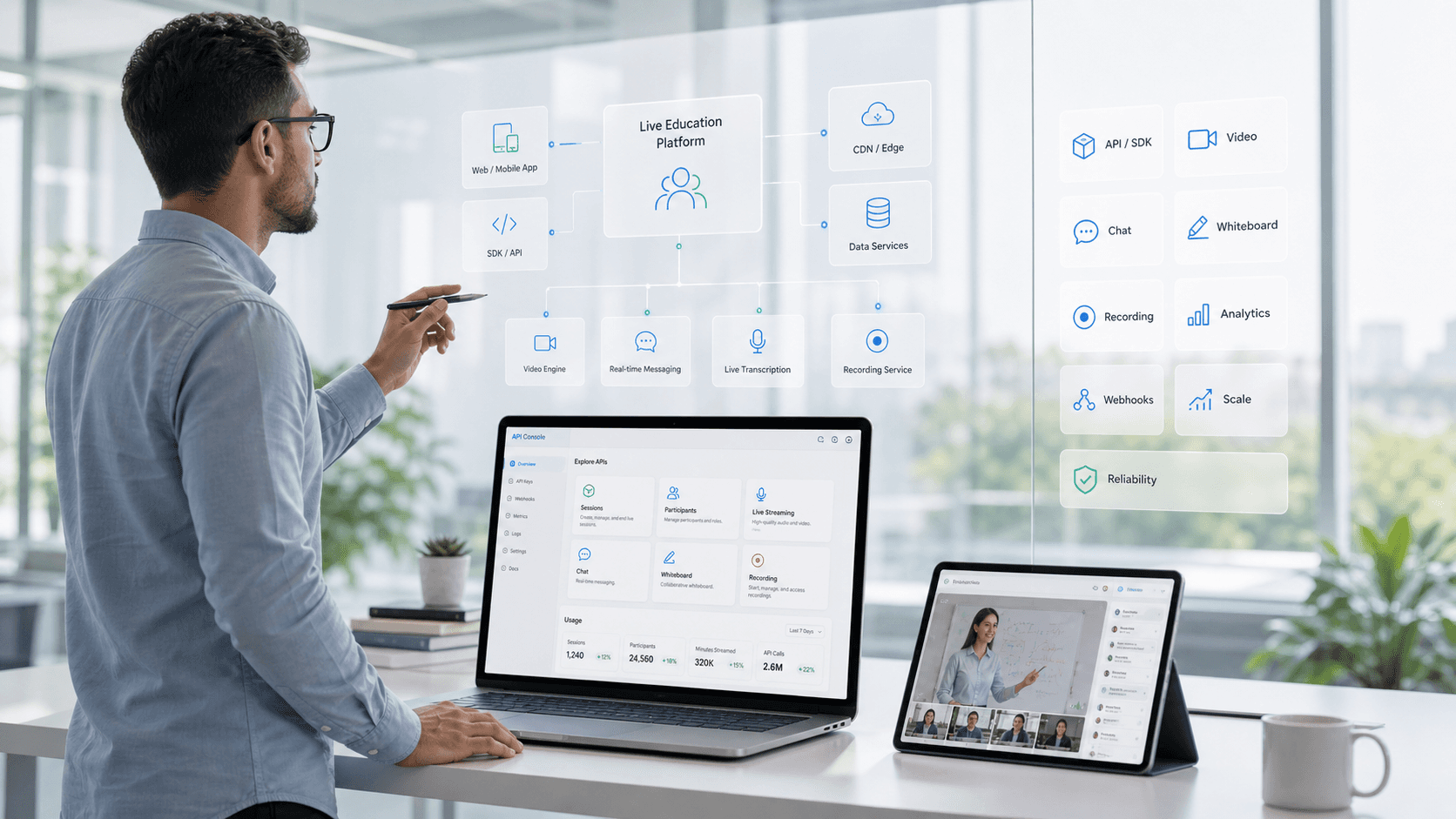
Rather than providing communication primitives and leaving the education layer to the developer, HiLink provides a virtual classroom API with education constructs built in. Session roles, learning event modeling, breakout room management, attendance and engagement data, LTI and xAPI interoperability -- these are part of the API surface, not things teams build on top of it.
For developers, this means the integration delivers more out of the box. The work goes into building differentiated product experience, not recreating infrastructure that should already exist at the API layer.
For product managers, it means faster time to feature parity with institutional requirements, and a cleaner compliance story when selling to regulated markets.
And for the business, it means unit economics that improve at scale rather than degrade -- because the cost structure is designed for education volume, not priced against it.
The Bottom Line
Choosing a virtual classroom API is not a short-term technical decision. It is a long-term architectural one.
The right API for your platform depends on what you are building, who you are selling to, and what scale looks like for your business in two or three years -- not just what ships fastest today.
General-purpose video APIs are fast to integrate and fine for simple use cases. But platforms serving institutional clients at scale need an API that handles education natively: the session complexity, the compliance requirements, the learning data, the organizational hierarchy.
Evaluating on those criteria -- rather than time to first video frame -- is what separates platforms that scale cleanly from those that spend years paying down infrastructure debt.