The Role of APIs in Modern Education Ecosystems
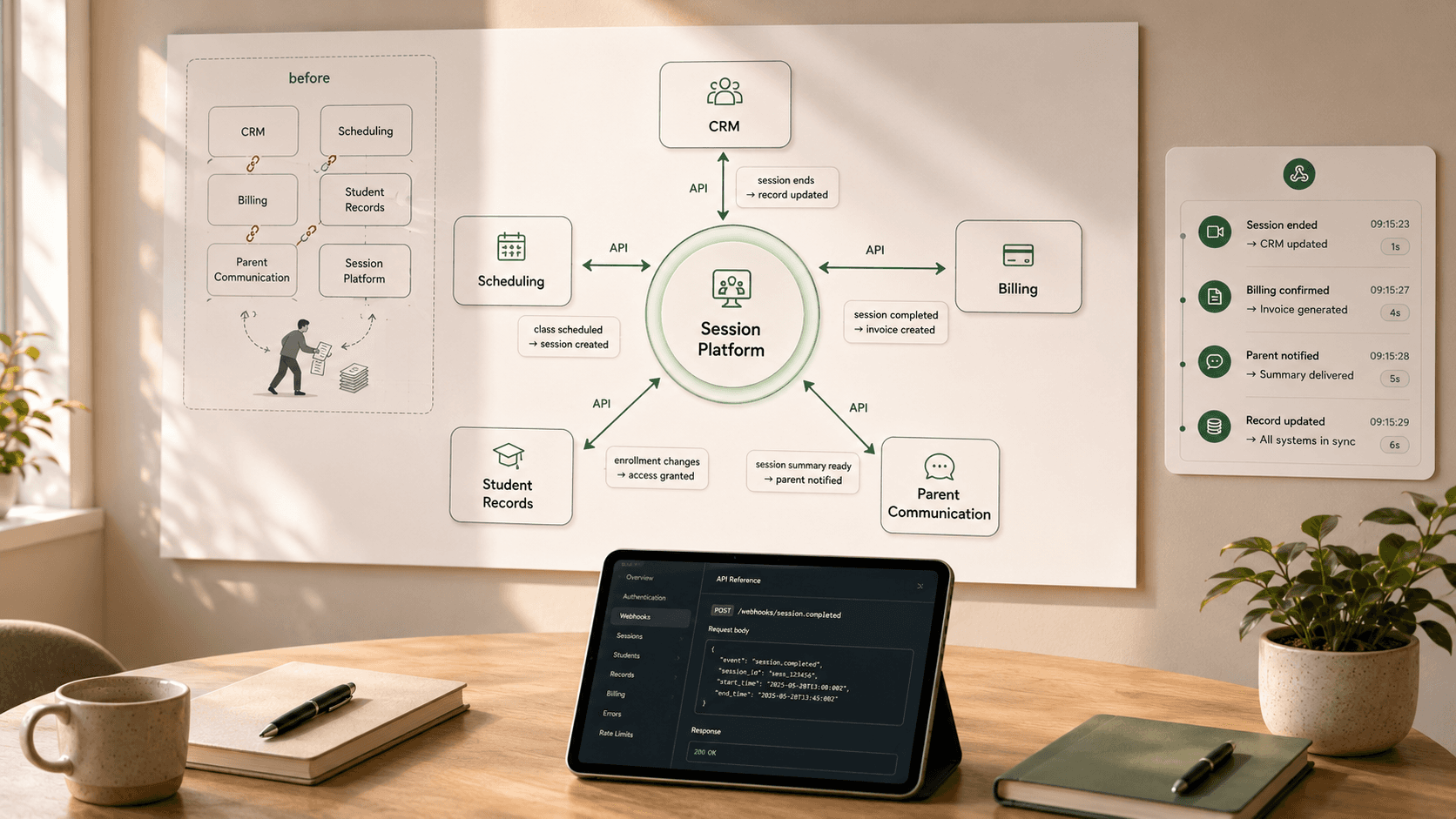
Every education organization is running more software than it was five years ago. A scheduling system. A virtual classroom. A CRM for student management. A billing platform. A student information system. A communication tool. An LMS.
Each of these systems was acquired to solve a specific problem, and each one does its job reasonably well in isolation. The problem is the isolation itself.
When a session ends and the attendance record doesn't automatically update the student information system, a coordinator has to transfer it. When a student cancels and the billing system needs to be updated, someone has to notify the billing team. When a parent asks what was covered in last week's sessions, the answer requires pulling from the session platform and the documentation system and hoping they match. Each of these transfers is a manual action. Each manual action is a potential error. Each error is an operational cost.
APIs are what close these gaps. Not by eliminating the software -- organizations need specialized tools for different functions -- but by connecting those tools so that information flows automatically between them rather than being manually transferred by coordinators who should be doing something more valuable.
Understanding APIs from a strategic rather than a technical perspective changes how education organizations think about platform selection, infrastructure investment, and the operational capability that is or isn't possible with their current technology stack.
Why Education Software Is Becoming Interconnected
The education software market is moving toward interconnection for the same reasons that most enterprise software markets have: the operational cost of fragmentation has become high enough that integration is no longer optional for organizations trying to compete on quality and efficiency.
In the early days of online education software, the priority was capability. Organizations needed tools that could do specific things -- schedule sessions, deliver video, store student records -- and the tools that did those things existed as separate products. Integration was a future problem.
As the market has matured, two things have changed. First, the baseline operational capability of most education software categories has converged. The difference between scheduling tools, or between virtual classroom platforms, is smaller than it was five years ago. Differentiation has shifted from individual product capability to ecosystem integration capability -- how well a platform connects to everything else.
Second, the operational consequences of fragmentation have become more visible and more expensive at scale. Organizations running hundreds of sessions per week with fragmented tool stacks are spending significant operations team capacity on manual data transfers that integrated systems would handle automatically. That operational cost has a direct business impact: coordinators can manage fewer students at the same quality level, documentation is less consistent, parent communication is less timely, and quality monitoring is less comprehensive.
The organizations recognizing these costs are making infrastructure investments that prioritize integration capability alongside feature capability. An API-first session platform that connects to a CRM, a scheduling system, and a billing platform is more valuable at scale than a feature-rich session platform that doesn't.
The Value of APIs
APIs are the mechanisms that allow software systems to share data and trigger actions in each other. When one system exposes an API, other systems can call that API to read data, write data, or initiate actions -- without any manual intervention.
The strategic value of APIs in education is the operational leverage they create. An API that connects a session platform to a CRM means that when a student's enrollment status changes in the CRM, the session platform is updated automatically. When a session ends in the session platform, the student record in the CRM is updated automatically. No coordinator has to check one system and manually update another.
That operational leverage scales in proportion to session volume. At fifty sessions per week, the manual updates between systems take an hour. At five hundred sessions per week, they take ten hours -- or they don't happen reliably, which is the more common outcome.
The strategic properties of a well-designed education API:
Coverage: what functions does the API expose? An API that allows external systems to read session attendance but not write configuration changes, or that exposes some session data but not engagement signal data, is less useful than one that exposes comprehensive session lifecycle control and data access. Coverage determines what integrations are possible.
Stability: how reliably does the API behave, and how are changes managed? An API that changes without warning breaks integrations that external systems depend on. Stable APIs with clear versioning and documented deprecation processes allow organizations to build on them with confidence.
Documentation: how clearly is the API described? An API with comprehensive documentation that external developers can implement without ongoing vendor support is more useful than one that requires support to understand. Documentation quality is a proxy for how much the vendor has invested in making the API genuinely composable.
Webhooks: does the API support event-based notifications? A polling-based API requires external systems to repeatedly check for changes. A webhook-based API pushes notifications to external systems when relevant events occur -- a session ends, a recording completes, a participant joins. Webhooks reduce latency and server load compared to polling.
Connecting Operational Systems
The most immediate operational value of education APIs is connecting the systems that need to share data to function coherently as an organization rather than as a collection of isolated tools.
The session platform and the CRM are the most important connection. Session outcomes -- who attended, what was covered, how the student performed -- should update the student record in the CRM automatically. The CRM's enrollment and billing status should be visible to the session platform so that access is granted and revoked correctly without manual administration. This bidirectional connection means that the student's full record -- relationship data, billing status, session history, progress data -- is coherent rather than split across two systems that may or may not be in sync.
The session platform and the scheduling system are another critical connection. When a session is scheduled in the scheduling system, the session room should be provisioned automatically in the session platform. When a scheduling change is made, the session platform should reflect it immediately. When a session ends, the scheduling system should be updated with the actual session completion data. These connections eliminate the class of errors that occur when scheduling and session management are done in separate systems without automatic synchronization.
The session platform and the billing system are a connection with direct revenue implications. When a student's billing status changes -- a payment fails, a subscription is renewed, a plan changes -- the session platform should respond accordingly: restricting or restoring access without requiring a coordinator to manually check both systems and update one based on the other. When sessions are delivered, billing records should be automatically updated with delivery confirmation.
The session platform and parent communication systems are a connection that determines the quality and consistency of parent outreach. Post-session summaries generated in the session platform should be deliverable to parent communication tools automatically -- the data flowing through the API rather than requiring a coordinator to copy content from one system to a messaging tool. Absence detection in the session platform should trigger absence notifications in the communication system without manual initiation.
Each of these connections reduces manual transfer work, reduces error rates from that manual transfer, and produces a more coherent operational picture across the organization.
Supporting Scalability
APIs are a scalability mechanism because they allow organizations to grow their session volume without growing their operational overhead at the same rate.
The operational overhead of running online education is substantially a coordination problem: keeping information consistent across systems, triggering the right actions when session events occur, routing exceptions to the right people, and producing reporting that draws from all relevant data sources. At small session volume, this coordination can be done manually by coordinators who understand all the relevant systems. At large session volume, the coordination exceeds manual capacity.
APIs allow the organization to automate the coordination work that previously required manual effort. When the session platform, CRM, scheduling system, billing platform, and communication tools are connected through APIs, the coordination happens automatically. A session ending triggers a cascade of automatic updates across all connected systems. The coordinator doesn't have to check six systems after each session to ensure consistency.
The scalability benefit is that this automation scales with session volume while the manual coordination effort it replaces does not. A coordinator managing coordination through manual transfers between five systems can support a certain number of sessions per week. The same coordinator, with API-based automation handling the transfers automatically, can support a significantly larger number of sessions -- because the automation handles the volume while the coordinator handles the exceptions.
For organizations building on API-first infrastructure, this scalability benefit is available from the start rather than requiring a migration when volume creates the pressure to automate. Organizations that start with well-integrated API-connected systems don't hit the coordination ceiling. Organizations that start with manual processes and fragmented tools hit that ceiling at the volume where automation becomes necessary -- and then face a migration under operational pressure.
Future-Ready Education Platforms
API readiness is increasingly a prerequisite for being a future-ready education platform rather than an emerging capability.
The direction of the education software market is toward more specialized tools, more complex operational requirements, and more demanding expectations from students, parents, and institutional customers about the consistency and quality of service delivery. Meeting these requirements while maintaining the flexibility to adopt new tools, integrate new capabilities, and respond to changing operational needs requires a platform architecture that is genuinely composable.
Composable means the platform's capabilities are accessible through a documented API that allows other systems to use them, extend them, and connect them to other capabilities. A composable session platform can be embedded in a custom product interface, connected to an analytics pipeline, integrated with an AI processing layer, and linked to operational systems -- all through API connections that the organization controls. A closed platform can only be used in the ways the vendor has designed.
For education organizations evaluating infrastructure now, the API question isn't just "does this platform have an API?" -- most platforms have some API exposure. The relevant questions are the ones that reveal how deep and reliable the API actually is: What events are available as webhooks? What data is accessible programmatically? How is versioning managed? Is the API documented well enough to implement without ongoing vendor support? These questions distinguish genuine API-first design from API as a marketing claim.
For EdTech product builders, API quality is not a technical consideration separate from product strategy. It's the infrastructure foundation that determines what product experiences are possible, how quickly the organization can build them, and how maintainable those experiences are as both the product and the underlying infrastructure evolve.
HiLink is designed as an API-first education infrastructure platform -- meaning session management, data access, engagement tools, documentation workflows, and operational intelligence are all accessible through a documented API that organizations can build on rather than just use. For education operators, this means the session layer can be connected to the CRM, billing, scheduling, and communication tools the organization depends on. For EdTech builders, it means the virtual classroom capabilities can be embedded in custom product experiences without inheriting the vendor's interface.
The role of APIs in modern education ecosystems is not incidental. APIs are what transform a collection of specialized education tools into an integrated operation. They're the connective tissue that allows the organization to function as a coherent whole rather than as a set of disconnected parts that coordinators spend their time manually bridging.
Education organizations that understand this are making infrastructure investments today that will determine their operational capability for years. The organizations that don't are managing coordination costs that will grow with every session they add.