The Rise of API-First Education Platforms
For most of the history of online education technology, platforms were monolithic. You adopted them wholesale, adjusted your workflows to match their assumptions, and lived with their limitations. If a platform didn't do something you needed, you waited for the roadmap, used a workaround, or built something parallel that created its own maintenance burden.
That model worked well enough when online learning was a secondary channel. When most education happened in physical spaces and digital tools were supplementary, flexibility didn't matter as much. The tool existed; it was good enough; you used it.
The model breaks down when online education is the primary delivery channel -- when the platform isn't supporting the business but is the operational foundation of it. At that point, being locked into someone else's product assumptions is a strategic constraint, not just an inconvenience.
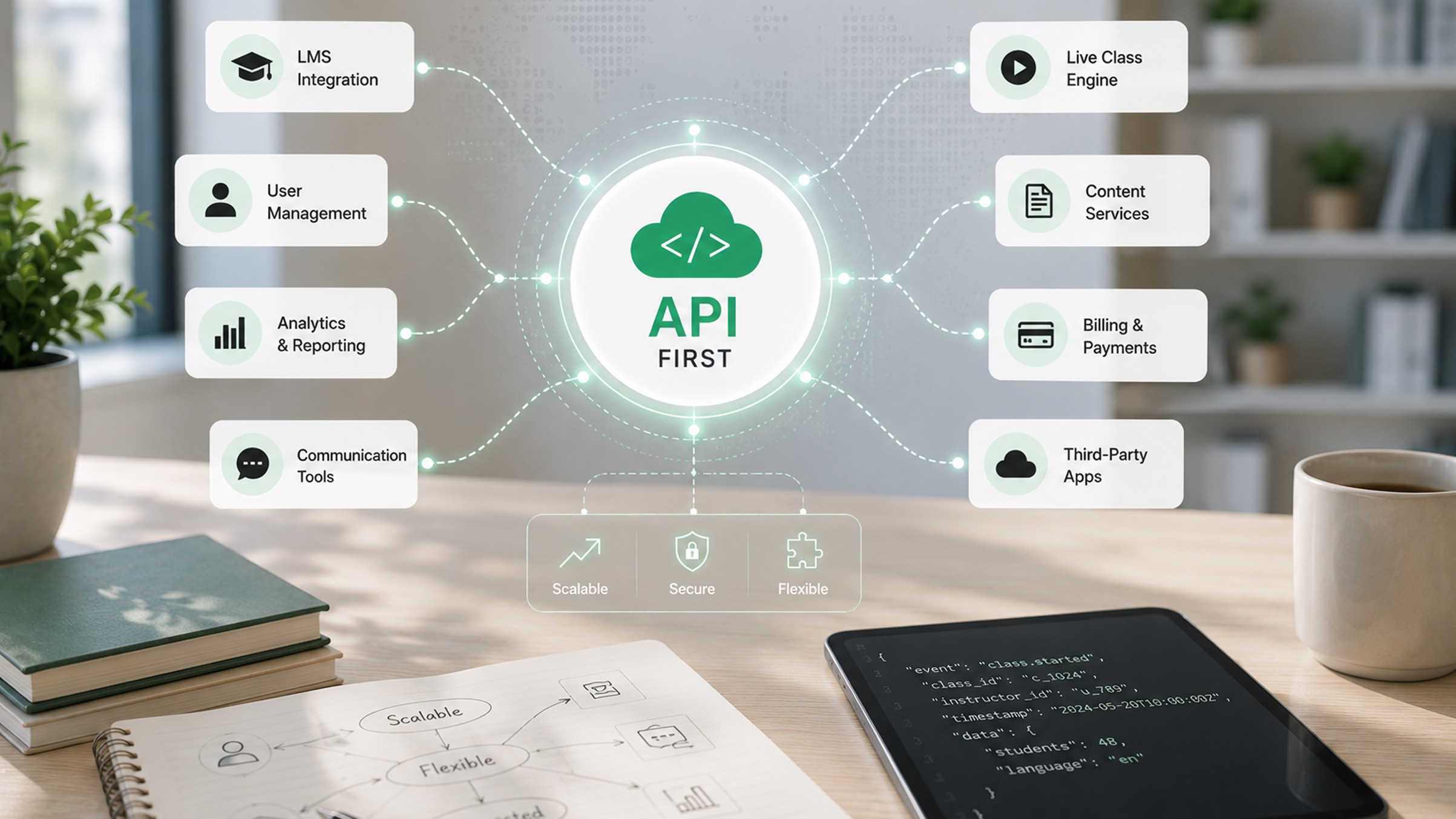
API-first education platforms exist to remove that constraint. They're built around the premise that the organizations using them have specific requirements that don't fit a one-size-fits-all product, and that the right architecture for serious online education isn't a closed platform but a programmable infrastructure layer that organizations can build on, customize, and integrate into their own systems.
What API-First Architecture Means
The term "API-first" gets used loosely, so it's worth being precise about what it means in practice -- and what distinguishes it from simply having an API.
Most software products have APIs. They expose a set of endpoints that allow external systems to read or write data, trigger certain actions, or access specific features. These APIs are useful, but they're typically designed as an afterthought to a product built primarily for direct user interaction. The API reflects the product's assumptions rather than enabling alternatives to them.
API-first architecture inverts that relationship. The API is the product. The platform is designed from the start to be consumed programmatically -- by other software, by custom interfaces, by integrated workflows that don't necessarily involve the platform's own UI at all. Whatever interfaces exist on top of the API are built the same way any external developer would build them, using the same API surface. There's no privileged layer.
The practical difference for education operators and platform builders is significant. With a conventional platform, you're using the product as it was designed to be used. Customization is possible within the bounds of what the platform allows. With an API-first platform, the product is the infrastructure layer, and you're building on top of it -- with the same flexibility that the platform's own engineers would have.
For education organizations with specific requirements -- a custom student portal, a proprietary CRM integration, a branded instructor interface that matches the rest of their product -- API-first architecture is what makes those requirements achievable rather than requiring a platform switch every time the requirements exceed what the existing UI supports.
Why Flexibility Matters in Education
Education is not a uniform activity. It takes place in many different contexts, serves many different populations, and operates under many different constraints. The product assumptions that work for one organization often don't work for another.
A tutoring company serving K-12 students in the United States has different requirements from an enterprise language training provider serving multinational corporations. An online school offering accredited courses has different compliance and reporting requirements from a coding bootcamp with a flexible curriculum. An EdTech startup building a consumer tutoring product has different customization needs from an institution integrating virtual classroom capabilities into an existing LMS.
A monolithic education platform tries to serve all of these by building a sufficiently large feature set that most use cases are covered, at least partially. The result is a product that does many things adequately and few things precisely. Organizations work around the gaps or accept the limitations.
API-first education platforms approach this differently. Rather than building a comprehensive product and distributing it uniformly, they build reliable, well-documented infrastructure that each organization can assemble and configure to match their specific requirements.
The flexibility this creates operates at several levels. Interface flexibility: organizations can build their own student and instructor interfaces on top of the API, matching their brand and UX requirements without inheriting the platform's design assumptions. Workflow flexibility: organizations can define their own pre- and post-session workflows, connecting session events to their own scheduling systems, CRMs, and communication tools. Data flexibility: organizations can consume session data in their own analytics pipelines rather than being limited to the reporting the platform provides. Feature flexibility: organizations can expose only the session capabilities they need to their users, rather than presenting a full feature set designed for a different context.
This level of flexibility isn't necessary for every organization. For a small tutoring operation, a well-designed product with limited customization may be entirely adequate. But for organizations building serious online education products -- especially those where the classroom layer is embedded in a larger product experience -- API-first architecture is often the difference between building on a solid foundation and being constrained by someone else's product decisions.
Embedded Learning Systems
One of the most direct applications of API-first education infrastructure is embedding live classroom capabilities into an existing product.
Consider an EdTech company that has built a learning management system with its own student portal, instructor dashboard, and content delivery. At some point, they need to add live session capability. The options, historically: build it themselves (expensive, slow, ongoing maintenance burden), or embed a third-party platform (fast, but the embedded experience looks and feels like someone else's product).
API-first education platforms create a third option: use the infrastructure layer without inheriting the interface. The session management, video delivery, recording, engagement tools, and data capture are all handled by the platform's API. The interface is entirely the EdTech company's own, built on top of the API surface. The student and instructor experience is seamless -- they never leave the product they enrolled in, interact with an interface they recognize, and have no awareness of the underlying infrastructure.
This embedding model is becoming the standard for any serious EdTech product that includes live learning. The alternative -- building the session infrastructure layer from scratch -- is a significant engineering investment that produces infrastructure rather than product. An engineering team that spends eight months building reliable video session management is an engineering team that spent eight months not building the things that differentiate the product.
API-first infrastructure makes that tradeoff explicit and favorable. Take the infrastructure from a platform designed to provide it. Build the product differentiation in-house. Ship faster, maintain less, and retain full control of the user experience.
The quality bar for embedded session infrastructure has risen in parallel with this shift. Organizations embedding session capabilities into their products expect the same reliability, feature depth, and data access they would get from building their own -- because their users experience the session as part of their product, and failures are their failures, not the infrastructure provider's.
Infrastructure Scalability
An API-first architecture has a specific scalability advantage over monolithic platforms: the infrastructure layer can scale independently of the application layer.
In a monolithic platform, the entire system scales together. The database, the application logic, the session delivery infrastructure, the reporting layer -- all of it runs as part of the same system. When one component has performance issues at scale, it affects everything. When one component needs to be upgraded or replaced, the upgrade affects everything.
API-first infrastructure separates these concerns. Session delivery, engagement data collection, recording pipelines, and AI processing can scale independently based on actual load patterns. An organization running heavy session volume with lighter analytics requirements doesn't need to over-provision the analytics layer. The components scale to match actual usage.
For education operators, this means that infrastructure can grow with the organization without requiring a platform migration every time scale requirements change. The API surface stays consistent. The underlying infrastructure scales to support more sessions, more concurrent users, more data throughput -- transparently, without the application layer needing to change.
Integration scalability is a related benefit. API-first platforms are designed to integrate with external systems -- scheduling tools, CRMs, student information systems, billing platforms -- through standard interfaces. As an organization grows and adds or replaces operational tools, the integrations don't require rebuilding from scratch. The API surface provides a stable integration point regardless of what's on either side of it.
For organizations evaluating education infrastructure with growth in mind, the scalability questions to ask are: Does the platform's architecture support the session volume we're planning for in two years, not just today? Can the integration layer accommodate changes to our operational stack without requiring re-integration work? Is the API surface stable enough to build on, or does it change in ways that break existing integrations?
AI Integration Opportunities
API-first architecture creates specific opportunities for AI integration that closed platforms don't allow.
In a closed platform, AI capabilities are whatever the platform vendor has chosen to build. Organizations can use them or not. They can't extend them, replace them, or connect them to their own AI workflows. The AI layer is part of the product, not part of the infrastructure.
In an API-first platform, AI capabilities are accessible as infrastructure components. Session transcripts are available as a data stream. Engagement signals are available as structured data. Session metadata -- timing, participation, curriculum coverage -- is accessible programmatically. An organization that wants to build its own AI models for student performance prediction, or integrate with a specialized AI tutoring layer, or build custom engagement analytics has the data access to do so.
This matters because AI applications in education are not generic. What's useful for a language learning platform is different from what's useful for a mathematics tutoring service, which is different from what's useful for an enterprise compliance training organization. The AI layer that serves all of these equally well doesn't exist. What does exist is an infrastructure layer that makes session data available in a form that each organization can use to build or integrate the AI capabilities that fit their specific context.
The session transcription and automated summary capabilities that serious API-first education platforms provide are a starting point, not a ceiling. They're the AI layer that works for most education contexts out of the box. The API access to the underlying data is what enables organizations to go further, building on a reliable data foundation rather than starting from scratch.
The Future of Customizable Education Platforms
The shift toward API-first education platforms reflects a broader maturation of the online education industry.
In early stages, any tool that enabled live online learning was valuable. The market needed proof that virtual education could work at all. Feature gaps were acceptable. Inflexibility was tolerable. The alternative was not teaching at all.
As online education has become mainstream infrastructure for learning organizations of all types, the bar has risen. Organizations building serious education products need infrastructure that matches their requirements -- not products they adapt to. They need session data they can use. They need workflow flexibility that matches their operational reality. They need AI capabilities they can extend. They need APIs that are stable enough to build on.
API-first education platforms are the response to that maturation. They're built for organizations that have moved past "we need a way to do live sessions" to "we need infrastructure that makes live learning work exactly the way our product and operation requires."
HiLink is built specifically for this moment. As an API-first virtual classroom and education infrastructure platform, HiLink provides the session management, engagement data, AI-powered operational tools, and integration flexibility that serious education organizations need to build on -- not a product to adopt wholesale, but infrastructure to build on, configure, and connect to the systems that make their specific operation work.
The organizations winning in online education over the next decade won't be the ones who found the best off-the-shelf platform. They'll be the ones who built the best education product on top of the right infrastructure. API-first architecture is what makes that possible.