The Importance of Attendance Infrastructure in Online Education
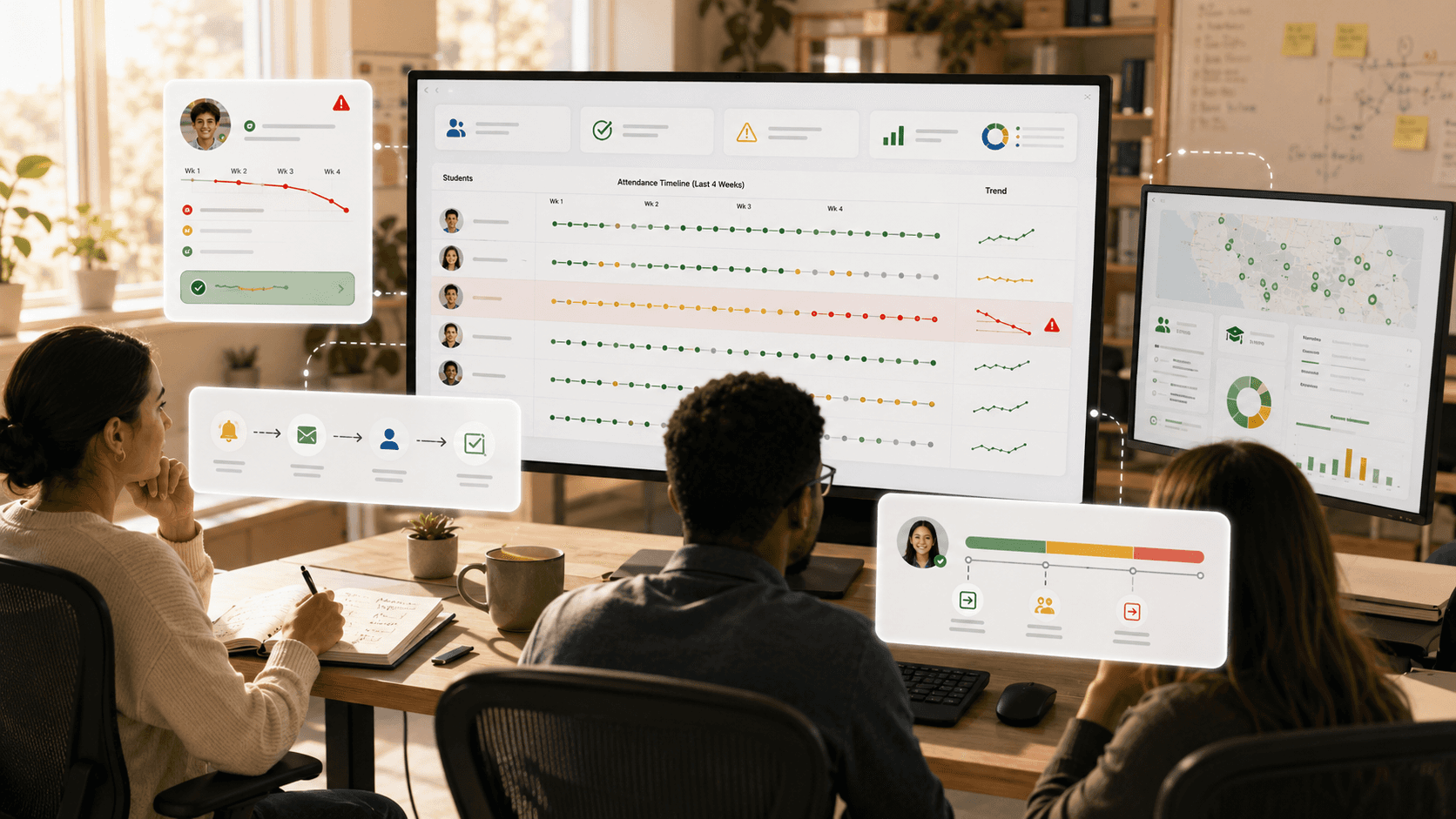
Attendance tracking sounds like one of the simpler problems in education. A student is either in the session or they're not. Record which.
In practice, attendance in online education is a more operationally significant function than this framing suggests -- and organizations that treat it as a simple administrative task rather than an operational system consistently discover its importance when something goes wrong.
A student who misses one session might have a schedule conflict. A student who misses three sessions in two weeks is at risk. A student whose attendance declines steadily from four sessions per week to two, then two to one, is on a trajectory that ends with cancellation. The difference between an organization that catches that trajectory early and one that discovers it when the student cancels isn't usually a difference in instructor quality or curriculum design. It's a difference in attendance infrastructure.
Attendance infrastructure in online education is the set of systems that capture, process, surface, and act on participation data. It's not a attendance register. It's the operational foundation for early intervention, retention management, and the organizational visibility that makes managing student outcomes at scale possible.
Why Attendance Data Matters
Attendance data is the most basic signal in an education operation, and basic signals are the foundation of everything more complex.
The obvious function: attendance records document whether a service was delivered. For compliance, billing, and basic accountability, attendance records confirm that sessions happened, who participated, and for how long. This function is administrative and exists in every education context.
The less obvious function: attendance data is predictive. Research on student retention in online education consistently shows that attendance patterns precede outcomes. Students who miss sessions at increasing rates are more likely to disengage and cancel than students with stable attendance. The signal appears in the data before the student or parent explicitly communicates that something is wrong.
This predictive quality transforms attendance from a documentation task into an early warning system. An organization that reviews attendance data proactively -- not just to confirm what happened, but to detect patterns that indicate where something is about to happen -- has a retention management capability that an organization reviewing attendance retrospectively lacks.
Attendance data also contextualizes other performance signals. Declining comprehension check scores look different depending on whether the student has been attending consistently or missing sessions. An engagement drop during sessions looks different if the student's attendance has also been declining. Attendance data is the context in which other session data is interpreted, which means poor attendance data quality degrades the usefulness of every other metric the organization collects.
For organizations accountable to parents, funders, or regulators, attendance data is also a transparency infrastructure. Parents who can see that their child has attended their sessions -- with timestamps, duration, and session records -- have more confidence in the program than parents who receive only a monthly invoice. Organizations that produce clear, accurate, and accessible attendance documentation build trust that pure session quality alone doesn't create.
The Limitations of Manual Tracking
Manual attendance tracking in online education fails in ways that are predictable and consistent.
The most immediate failure is completeness. Manual attendance tracking depends on someone taking the record for every session. When that responsibility falls on instructors who are also managing the session content, engagement tools, and student interaction simultaneously, it gets deprioritized. Sessions where attendance wasn't recorded -- because the instructor forgot, the session ran over, or the documentation process was burdensome -- create gaps in the attendance record that make analysis unreliable.
Latency is the second failure mode. Manual attendance records are often entered after the session ends -- sometimes minutes later, sometimes hours, sometimes the following day. By the time the record exists, the window for immediate follow-up on an absence has often closed. A parent notification sent six hours after a student's no-show is less useful than one sent within thirty minutes. A flag to the operations team about a missed session that appears in tomorrow's report is less actionable than one that appears when the session ends.
Standardization is the third failure. Manual records reflect individual instructor habits. One instructor records attendance in a shared spreadsheet. Another records it in a personal notes app. A third notes it in the video platform's built-in tools. The records exist, but in different formats, in different locations, with different levels of detail. Aggregating these records into an organizational view of attendance requires manual reconciliation that doesn't happen routinely.
The compound effect of these failures: an organization that depends on manual attendance tracking has attendance data that is incomplete, delayed, and inconsistent. Analysis built on that data produces unreliable conclusions. Early intervention systems built on that data produce false positives and missed signals in roughly equal measure. The organization is managing attendance in the sense that records exist, not in the sense that the records are driving operational decisions.
Attendance as Operational Intelligence
Reframing attendance as operational intelligence rather than administrative record-keeping changes what an organization expects from its attendance infrastructure.
Administrative attendance tracking asks: was the student present? Operational attendance intelligence asks: what does this student's participation pattern tell us, and what should we do about it?
The shift requires attendance data to be captured consistently, stored in a queryable format, and connected to other session data so that patterns can be detected. It requires the data to be processed and analyzed rather than merely recorded. And it requires the insights from that analysis to be surfaced to the right people in time to act on them.
At the student level, attendance intelligence means seeing each student's participation pattern across time -- not just whether they attended this week's sessions, but whether their attendance has been stable, improving, or declining across the past month. A student with a 90% attendance rate over two months and a 60% attendance rate over the past two weeks is a different situation from a student with a consistent 70% attendance rate. The trend is the intelligence. The raw number is not.
At the instructor level, attendance intelligence means seeing which sessions produce reliable attendance and which don't. If a specific instructor's sessions consistently have higher no-show rates than comparable sessions, that's operational information. If a specific time slot consistently produces lower attendance regardless of instructor, that's scheduling information. These patterns are only visible when attendance data is aggregated and analyzed at the organizational level.
At the organizational level, attendance intelligence means early identification of at-risk students -- not through individual reviews, which don't scale, but through automated pattern detection that surfaces exceptions for human follow-up. An attendance monitoring system that flags students whose patterns indicate risk, routes those flags to the appropriate coordinator, and tracks whether follow-up happened is operational infrastructure. A system that records attendance and displays it in a dashboard is administrative infrastructure.
The difference between these two is not incremental. It's the difference between attendance data as a record of what happened and attendance data as a system for managing what happens next.
Early Intervention Opportunities
The operational value of attendance infrastructure concentrates most clearly in early intervention.
The timeline of student disengagement in online education follows a pattern that's visible in attendance data before it's visible in any other way. The student misses a session. Then another. The frequency of sessions decreases. Engagement within sessions, when the student does attend, declines. Eventually the student or parent cancels. Each step in that sequence is detectable -- but only if the attendance and engagement data is being monitored in a way that surfaces the pattern rather than requiring someone to notice it manually.
Early intervention works because it happens before the student's commitment to the program has eroded. A student who has missed two sessions in a week and receives a thoughtful outreach from the organization -- acknowledging the missed sessions, offering support, asking if anything has changed -- is a student who understands the organization is paying attention. That experience of attentiveness is itself a retention mechanism. It demonstrates that the program is watching, cares, and responds.
Contrast this with late intervention: the parent calls to cancel, and the organization attempts to retain them. The parent's decision to cancel usually follows a period of dissatisfaction that has been accumulating without visible organizational response. By the time the cancellation comes, the relationship is already damaged. Late intervention sometimes succeeds, but it succeeds at a much lower rate than early intervention, and it requires more intensive effort.
Attendance infrastructure that enables early intervention needs three properties: real-time data capture so that absences are known immediately, pattern detection that identifies risk signals before they become obvious, and workflow automation that triggers the right follow-up without requiring a coordinator to manually review every student's attendance record and decide who needs attention.
The organizations that build this capability see measurable effects on retention. Catching at-risk students two weeks earlier in their disengagement trajectory, and reaching out with a specific, informed communication rather than a generic check-in, is a concrete operational advantage. Attendance infrastructure is what makes it possible.
AI-Powered Attendance Workflows
AI in attendance infrastructure serves two functions: pattern detection and workflow automation.
Pattern detection is the function that makes attendance monitoring scalable. Manually reviewing attendance trends across hundreds of active students to identify at-risk cases is time-consuming and inconsistent. AI can monitor attendance patterns for every student simultaneously, compare current patterns against each student's historical baseline, and surface the cases that fall outside expected parameters. The operations coordinator receives a flagged list rather than an undifferentiated dataset.
The patterns that AI can reliably detect in attendance data: consistent decline over a defined period, sudden change from an established pattern, a combination of attendance decline and engagement decline within sessions, attendance that drops below a threshold that correlates historically with cancellation. Each of these is a computable signal. AI computes it for every student, every day, and surfaces the cases that require human attention.
Workflow automation is the function that makes attendance follow-up consistent. When a student misses a session, a defined sequence should happen: the absence is logged, the parent receives a notification, the instructor is alerted for the next session, the operations team is notified if it's a recurring absence, and the outreach that follows is logged against the student's record. This sequence should happen automatically for every absence, not just the absences that a coordinator happened to notice.
AI contributes to this workflow both by triggering it reliably and by drafting the communications that it generates. An absence notification drafted from the session data -- including the session time, the subject, and a note about what the student will want to catch up on -- is more specific and more useful than a generic "we missed you" message. The coordinator reviews and sends; the AI handles the drafting.
Pre-session attendance monitoring is an AI capability worth naming separately. Flagging students who are consistently late to sessions, who join and leave early, or who have had a specific absence pattern that suggests they need a reminder call rather than just an automated message -- these are insights that AI can surface before each session week, giving coordinators a prioritized list of students to contact before the sessions happen rather than after.
The Future of Participation Tracking
The future of attendance infrastructure in online education is toward more granularity, better integration, and more proactive systems.
Granularity: attendance is increasingly understood as a spectrum rather than a binary. A student who joins a session for forty-five minutes of a sixty-minute session and participates actively in the first half before going quiet has a different attendance pattern than one who joins for the full sixty minutes and participates throughout. The binary present-or-absent record doesn't capture this nuance. Participation tracking that captures join time, leave time, and within-session engagement as a continuous measure produces a richer signal than attendance alone.
Integration: attendance data becomes more useful as it's connected to other operational data -- session summaries, comprehension check results, billing status, previous outreach records. An attendance flag that's accompanied by the student's engagement trend from the last five sessions, the last parent communication date, and the billing status is more actionable than an attendance flag alone. Integration is what makes the attendance signal contextually rich.
Proactive systems: the direction of development is away from attendance as a record of what happened and toward attendance as a predictor of what's about to happen. Systems that model the relationship between specific attendance patterns and cancellation probability -- and surface students who are approaching a high-risk threshold before they reach it -- are the next stage of operational sophistication in online education.
Platforms like HiLink build attendance infrastructure as part of the core session layer -- automatic capture, structured storage, AI-powered pattern detection, and workflow automation built together as components of the same system. For education operators and platform builders, this means attendance data that is complete, current, and connected to the operational workflows that depend on it. Not administrative record-keeping. Infrastructure for managing student outcomes.
That's the difference attendance infrastructure makes. And it's the kind of infrastructure worth investing in before its absence becomes obvious.