The Difference Between Video Conferencing and Learning Infrastructure
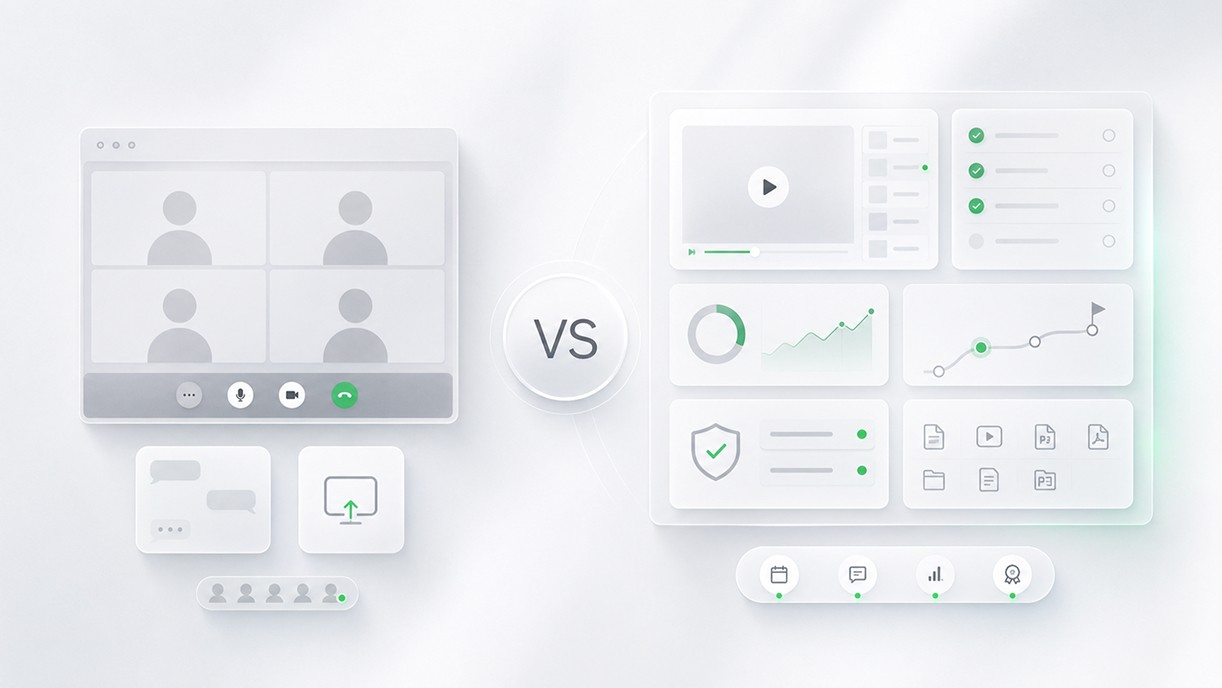
Put two people on a video call and you have communication. Put a teacher and thirty students on one, and you have a problem that video alone was never designed to solve.
The confusion between video conferencing and learning infrastructure is understandable. Both involve cameras, audio, and some kind of shared digital space. On the surface they look similar. But they're solving fundamentally different problems, and organizations that treat them as interchangeable tend to find out the hard way.
Video conferencing answers the question: how do we talk to each other when we're not in the same room? That's a real problem, and modern video tools solve it well.
Learning infrastructure answers a different set of questions. How do we deliver structured, consistent education at scale? How do we know if students are learning, not just attending? How do we give instructors the visibility and tools they need without burying them in administrative work? How do we connect what happens in a session to everything that happens around it -- scheduling, billing, parent communication, progress tracking, curriculum management?
Those questions don't have answers inside a video conferencing product. They require a different category of tool entirely.
Communication vs Operational Learning Systems
The clearest way to understand the gap is to think about what each type of system was optimized for.
Video conferencing tools were optimized for presence and clarity. Can both parties see and hear each other? Can they share their screens? Can they record the call? These are the core problems video conferencing products spent years solving. They solved them well. A video call today is dramatically more reliable, affordable, and accessible than it was a decade ago.
Operational learning systems are optimized for something different: the consistent delivery and management of education as a service. That includes everything that happens before a session starts, everything that needs to be captured and acted on while it's running, and everything that has to happen after it ends.
Before: Is the right instructor scheduled with the right student? Does the instructor have context from the previous session? Has the student received a reminder? Is the room ready?
During: Are attendance and engagement being recorded? Is the session following the planned structure? Do instructors have real-time signals about student comprehension? Is the content being transcribed?
After: Was a session summary generated and approved? Did the parent receive a follow-up? Was the curriculum coverage logged? Are there flags that need operations team attention?
A video conferencing tool handles a narrow slice of the "during" column, and nothing else. Learning infrastructure is designed to handle all of it, in a way that scales as the number of sessions grows.
Why Education Has Different Requirements
Most enterprise software is built around the assumption that the person using it is also the person making decisions about it. A sales CRM is used by salespeople and bought by sales leaders. A design tool is used by designers and evaluated by design teams.
Education is different. The person delivering the service -- the instructor -- is rarely the same person managing it, funding it, or experiencing the downstream results of it. An instructor teaches. An operations manager schedules, tracks, and troubleshoot. A parent pays and wants visibility. A student learns and may have very little awareness of the systems around them.
A video call treats all of these people identically: they're participants in a session. Learning infrastructure treats them differently, because their needs are different.
Instructors need tools that reduce cognitive load during sessions -- less manual tracking, better ambient visibility, automated documentation. Operations teams need dashboards, alerts, and reporting that surface what's happening across many sessions simultaneously. Parents need timely, informative communication that builds confidence in the service. Students need a consistent, structured experience that supports the way people actually learn.
Generic communication tools are built around a single interaction: the call. Learning infrastructure is built around a relationship: the ongoing educational experience between a student, an instructor, and the organization delivering it.
That's a more complex design problem, and it requires a more purpose-built solution.
The Importance of Workflows and Structure
One of the quieter differences between video conferencing and learning infrastructure is the degree to which each supports structure.
A video call starts, people talk, it ends. What happens inside that window is entirely up to the participants. That flexibility is a feature in a business meeting. In an educational session, it's a gap.
Good teaching has architecture. A lesson isn't a conversation with an educational topic; it's a structured sequence of activities designed to move a student from not knowing something to knowing it. There's a warm-up. There's instruction. There's guided practice. There's independent work. There's a close. Each phase has a purpose, and moving through them intentionally produces better outcomes than free-flowing discussion.
Learning infrastructure supports that architecture. Instructors can define session flows. The platform can prompt transitions between phases, track time against a lesson plan, and give instructors cues that keep sessions on track without requiring them to watch a clock while also managing a class.
Workflows also extend beyond the session itself. What happens when a student misses a lesson? The platform should automatically log the absence, trigger a parent notification, flag it for the operations team, and ensure the student gets access to any recorded content. That's not a human workflow -- or at least, it shouldn't be. It's an automated sequence that a well-built learning infrastructure handles reliably, every time.
The value of consistent workflows is cumulative. One instructor managing one student can handle ad hoc processes. An organization running five hundred sessions a week cannot. Workflows are how operations scale without scaling headcount proportionally.
Engagement Tracking and Visibility
There's a basic question at the heart of any education operation that video conferencing cannot answer: is this working?
A video call tells you who was on the call. It doesn't tell you who was paying attention. It doesn't tell you which students understood the concept being explained and which ones smiled and nodded while still lost. It doesn't tell you whether engagement was high in the first half and dropped off after the break. It doesn't tell you anything about how this session compares to the one before it, or the one before that.
Learning infrastructure is built to answer those questions.
Engagement signals -- participation rates, response times on comprehension checks, hand-raise patterns, quiet-student flags -- give instructors and operators a richer picture of what's happening in a session than attendance alone. These aren't surveillance tools. They're the digital equivalent of the ambient awareness a teacher has in a physical classroom, where body language and proximity naturally communicate engagement.
At the individual level, engagement tracking helps instructors personalize. A student who has been consistently quiet for three sessions might need a different kind of attention. A student whose comprehension check scores have dropped might be struggling with foundational concepts from two weeks ago. That information, surfaced by the platform, becomes actionable for the instructor.
At the organizational level, engagement data is what makes quality management possible at scale. If you're running hundreds of sessions a week, you cannot personally review each one. But you can look at aggregate engagement data, identify sessions or instructors that fall below expected benchmarks, and intervene before a pattern becomes a problem.
Visibility, in other words, is not just a nice feature. It's the mechanism by which an organization maintains quality as it grows.
AI-Powered Operational Layers
Artificial intelligence is relevant here, but in a specific and limited way.
The most valuable AI applications in learning infrastructure are the ones that reduce the cost of doing things that were always worth doing but rarely got done consistently. Session documentation is the clearest example. Post-session notes have always been valuable: they help instructors prepare for the next session, give parents useful communication, and create an institutional record of student progress. But writing them takes time, and when instructors are tired after back-to-back sessions, they get abbreviated, delayed, or skipped.
AI-generated summaries change that calculus. When a session is transcribed in real time, the platform can produce a structured recap automatically -- topics covered, student responses, recommended next steps. The instructor reviews and approves it. What previously took ten minutes now takes thirty seconds.
The same principle applies to progress monitoring. AI can surface patterns across session data -- attendance trends, engagement signals, comprehension check results -- that would require someone to manually review dozens of records to detect. A flag that a student's engagement has declined over several sessions, or that an instructor's sessions consistently run over time, is the kind of signal that falls through the cracks in a manual system.
What AI cannot do in this context is replace judgment. It can surface the signal. The decision about what to do with it -- whether to reach out to a student, adjust curriculum, or have a conversation with an instructor -- belongs to a person. Learning infrastructure that uses AI well is designed to make those human decisions faster and better-informed, not to automate them away.
What Scalable Learning Systems Require
The gap between video conferencing and learning infrastructure becomes most visible at scale. At ten sessions a week, almost any system works. The instructor remembers the student. The operations manager knows what's happening. Manual processes are manageable because there aren't many of them.
At five hundred sessions a week, none of that holds. The organization needs systems that capture information reliably without depending on human memory. It needs workflows that run automatically without requiring a coordinator to trigger each step. It needs reporting that gives leadership a clear view across all sessions without requiring them to read individual instructor notes. It needs infrastructure that gets more useful as volume grows, not more fragile.
That's what separates genuine learning infrastructure from a video conferencing tool with some education-flavored features added on top. Infrastructure is designed for volume, consistency, and integration with the rest of the organization. Communication tools are designed for the call itself.
Platforms like HiLink are built around this distinction. As API-first learning infrastructure, HiLink is designed for education operators who need more than video -- session management, structured workflows, engagement data, AI-powered summaries, and operational reporting, all built to integrate with the broader systems an education business runs on.
The question worth asking, for any organization running online education at meaningful scale, is not "what video tool should we use?" It's "what infrastructure does our operation actually need?" The answers to those questions point in different directions.
Understanding which problem you're trying to solve is where it starts.