The Difference Between AI Study Tools and AI Learning Infrastructure
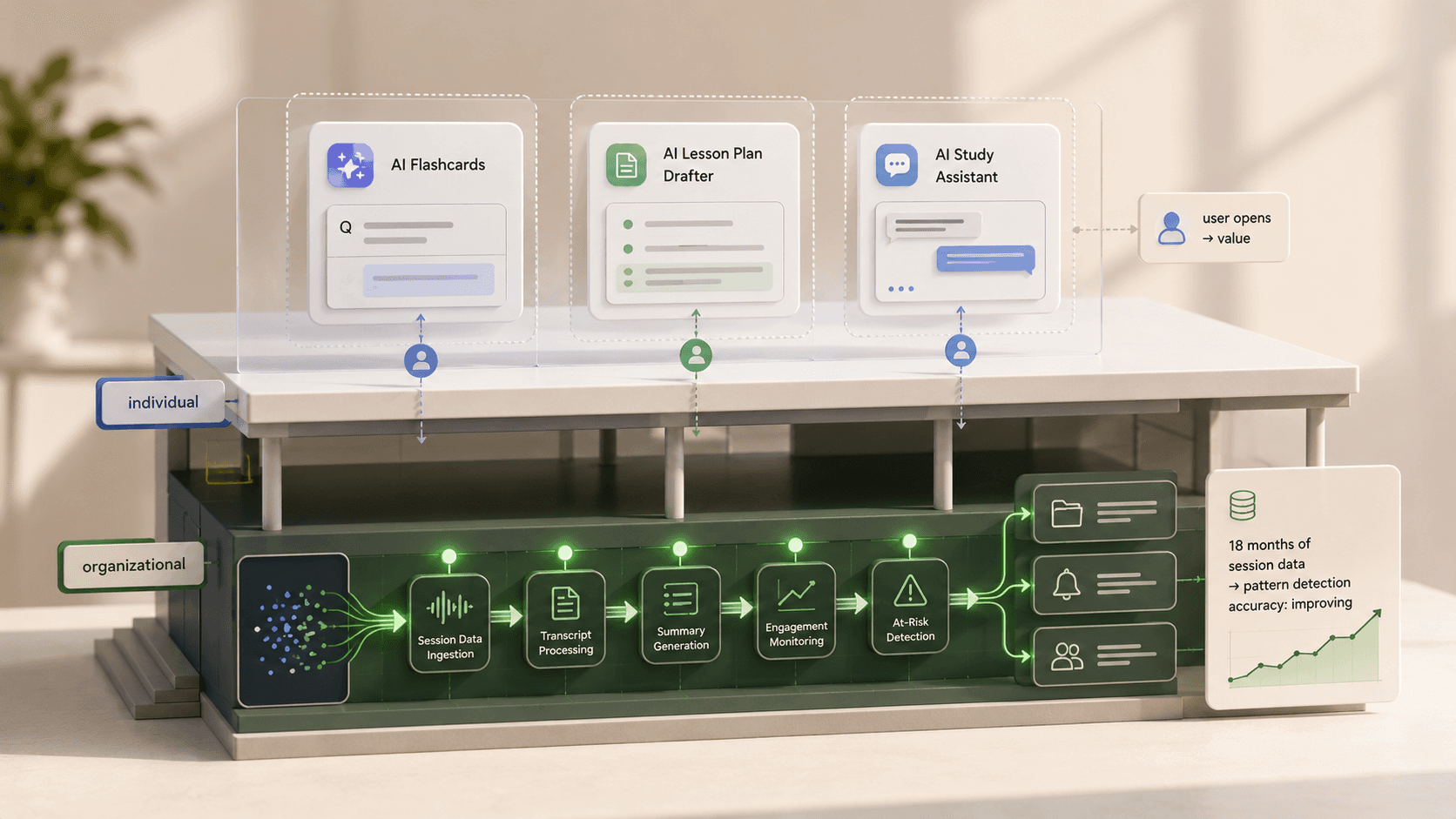
Two types of AI are operating in education right now. They're both called "AI in education," they're both growing, and they're solving fundamentally different problems for fundamentally different audiences.
The first type is consumer AI: study assistants, tutoring bots, question generators, essay helpers, flashcard creators. These tools are built for students and individual educators. They're accessible through a browser or an app, require no institutional adoption, and produce value in proportion to how consistently the individual user employs them. A student who uses a study assistant to explain a concept they didn't understand in class gets value from it. A student who forgets to open the app gets nothing.
The second type is infrastructure AI: the layer of AI embedded inside education platforms that processes session data, generates documentation, monitors student populations, triggers communication workflows, and produces organizational intelligence. This AI isn't visible to students through an interface they can open. It runs continuously, for every session, because it's built into how the platform operates. The value it produces is organizational rather than individual.
Understanding which type of AI does what -- and which type your organization actually needs -- is the starting point for making AI investments that produce consistent returns rather than interesting experiments.
Consumer AI Tools
Consumer AI tools in education are designed for individual use. Their value is direct and immediate: a student asks a question, the AI explains the concept. A teacher needs a lesson plan outline, the AI drafts one. A student wants to practice a specific skill, the AI generates exercises.
The market for consumer AI study tools is large and growing. Students who previously needed to wait for office hours to get a question answered can now get an explanation instantly. Teachers who spent thirty minutes drafting quiz questions can now produce them in two minutes with AI assistance. The productivity gains at the individual level are real.
Consumer AI tools have a consistent limitation: they require activation. Every valuable output requires a user who decided to open the tool, constructed a useful prompt, and reviewed the output. The coverage that results is uneven in proportion to user habits. Students who consistently use AI study tools benefit. Students who use them occasionally benefit occasionally. Students who forget they have access to them benefit not at all.
For individual educators, this isn't necessarily a problem. A teacher who regularly uses AI for lesson planning gets consistent value from it. The organizational question is different: can an institution or education organization depend on consumer AI tools to produce outcomes across all students, all sessions, and all educators, consistently?
The answer is no -- not by design. Consumer AI tools are individual productivity tools. They amplify individual capability when individuals choose to use them. They produce no organizational value when individuals don't.
Infrastructure AI
Infrastructure AI in education operates differently in three fundamental ways: it doesn't wait for user activation, it produces data as well as outputs, and it improves the organization's operational capability rather than just individual users' efficiency.
Activation is the most important distinction. Infrastructure AI runs because the platform runs. When a session ends, the transcript is processed, the summary is generated, and the documentation workflow is triggered -- not because the instructor remembered to click a button, but because session end is a system event that the AI workflow responds to. Coverage is complete because the workflow runs for every session. The instructor's behavior on any given day doesn't affect whether the workflow runs.
Data production is the second distinction. Consumer AI tools produce outputs -- explanations, lesson plans, practice problems. Infrastructure AI produces outputs and data. Session summaries are outputs. The structured session records that summaries create are data: attendance, engagement signals, comprehension check results, curriculum coverage, student responses. That data accumulates across sessions and becomes the foundation for organizational analytics, at-risk monitoring, progress reporting, and the longitudinal pattern detection that produces organizational intelligence.
Consumer AI tools consume data when users provide it through prompts. Infrastructure AI generates data as a byproduct of operation. An organization that has been running sessions through AI-embedded infrastructure for a year has a rich, structured dataset. An organization that has been using consumer AI tools for a year has better lesson plans and potentially better student comprehension -- but no accumulated organizational dataset.
Organizational capability improvement is the third distinction. A teacher who uses a study tool more effectively becomes a more effective teacher. The organization is unchanged. Infrastructure AI that monitors all students continuously, surfaces at-risk signals, maintains documentation coverage, and produces consistent parent communication changes what the organization can do -- not just what individual educators can do.
Workflow Integration
The difference between AI as a tool and AI as infrastructure becomes most concrete in workflow integration.
Consumer AI tools exist outside workflows. An educator uses a tool to produce something, then moves that output into their workflow manually. The lesson plan drafted with AI has to be copied into the scheduling system or the LMS. The session notes summarized with AI have to be sent to the parent through a communication tool. The AI produced a useful output; the workflow integration is the educator's responsibility.
Infrastructure AI is built into workflows. When an AI system generates a session summary from a transcript, the summary is already in the platform's documentation system -- not in a separate AI tool that the instructor has to export from. When the instructor approves the summary, the approval triggers the parent notification workflow. The parent receives the communication because the workflow ran, not because the instructor also remembered to open a communication tool and initiate a send.
This integration difference is what makes infrastructure AI produce consistent organizational outcomes rather than occasional individual outcomes. The workflows that parent communication, documentation coverage, and operational monitoring require are systematic only when the AI that supports them is part of the system rather than adjacent to it.
For education organizations at scale, workflow integration is the decisive property. At fifty students, an educator can manually move AI-generated content from a tool into a workflow and the coverage will be acceptable. At five hundred students, that manual integration breaks down -- not because any individual educator is less capable, but because the volume requires systematic execution that manual integration can't provide.
Operational Intelligence
Operational intelligence is the organizational capability that infrastructure AI creates and consumer AI tools cannot.
Operational intelligence is the organization's ability to know what's happening across the full operation -- all students, all sessions, all instructors -- in time to act on what it learns. This requires continuous monitoring of a complete, consistently structured dataset. It requires pattern detection across that dataset that surfaces exceptions for human attention. And it requires routing those exceptions to the people who can respond to them.
Consumer AI tools cannot produce this capability because they don't have access to the full operation's data. A lesson planning tool knows about the lesson plan the teacher asked for. It doesn't know about the student's attendance pattern across the last eight sessions, or the engagement trend across the last five, or the comprehension check accuracy trajectory across the last three months. The data that enables organizational intelligence doesn't exist in consumer AI tools because those tools don't generate it.
Infrastructure AI that is embedded in the session platform, processing every session's data continuously, generates the dataset that organizational intelligence requires. An at-risk student whose engagement has declined across six sessions shows a pattern in the data. Infrastructure AI detects the pattern and surfaces the flag. The operations coordinator receives the flag and intervenes. Consumer AI tools could help that student if the student remembered to use them. Infrastructure AI catches the pattern before the student's behavior reveals the problem.
The organizational intelligence gap between organizations with infrastructure AI and those using consumer AI tools is significant and grows with organization size. At small scale, personal relationships and direct observation can substitute for systematic monitoring. At large scale, there is no substitute -- either the monitoring is systematic and AI-powered, or it's incomplete.
Institutional Value
Institutional value is the accumulated capability that infrastructure AI creates over time as it processes more session data, refines its pattern detection, and produces a richer organizational dataset.
Consumer AI tools don't accumulate institutional value because they don't accumulate institutional data. A teacher who has used a study tool to generate lesson plans for two years has a personal efficiency advantage. The organization has no accumulated dataset, no refined pattern detection, no organizational intelligence built from two years of usage.
Infrastructure AI accumulates institutional value because every session adds to the dataset the AI processes. An organization that has been running sessions through AI-embedded infrastructure for two years has a dataset that enables pattern detection calibrated to its specific student population and curriculum. The at-risk detection is more accurate because it's been refined against two years of actual outcomes. The summary generation is more useful because it reflects the organization's specific documentation format and educational context. The organizational intelligence is richer because it's built from two years of complete session data.
This compounding value is what makes infrastructure AI a strategic investment rather than just an operational tool. Consumer AI tools provide value as long as individuals use them well. Infrastructure AI provides increasing value as the organization accumulates the dataset that makes its capabilities more accurate and more relevant.
For education organizations choosing where to invest in AI, the institutional value distinction is decisive. Consumer AI tools produce individual efficiency gains that don't persist beyond individual users. Infrastructure AI produces organizational capabilities that improve over time and persist beyond any individual employee.
Where Education Is Heading
The direction of AI in education is toward deeper integration of infrastructure AI and more sophisticated consumer AI -- not as competing approaches, but as distinct layers that serve different functions.
Consumer AI for students and educators will continue to improve in capability and accessibility. The study assistants will become better at diagnosing specific misconceptions and providing targeted explanations. The content generation tools will become better calibrated to specific curriculum standards and student learning profiles. The individual-facing AI layer will become increasingly capable.
Infrastructure AI for education organizations will become more sophisticated in its operational intelligence capabilities. Pattern detection will become more predictive -- identifying disengagement risk earlier, with more precision. Progress monitoring will become more longitudinal -- tracking capability development over years rather than months. Organizational intelligence will become more specific to each organization's educational context as the dataset grows.
The convergence point -- where infrastructure AI makes consumer AI more useful -- is where the most interesting development is happening. An AI study assistant that knows the student's session history, has access to the concepts they've been struggling with, and understands their current curriculum position can provide more targeted support than one that works from a student's prompt alone. Infrastructure AI generates the context that makes consumer AI more effective.
HiLink is designed as AI learning infrastructure: the session data layer, documentation workflows, engagement monitoring, at-risk detection, and organizational intelligence that education organizations need the AI to handle systematically -- built into the platform rather than available as a tool organizations have to connect to it. The infrastructure creates the foundation that makes every subsequent AI investment more valuable.
The distinction between AI study tools and AI learning infrastructure is not a preference. It's a structural difference in what each type can do, for whom, and with what persistence. Organizations that understand it make better AI investments. Those that don't often spend on consumer tools that improve individual productivity while missing the infrastructure layer that would improve the whole operation.