How Modern Education Platforms Are Built
Most people who use an education platform see the interface. A session room. A progress dashboard. A notification from their instructor. The experience feels simple, or at least self-contained.
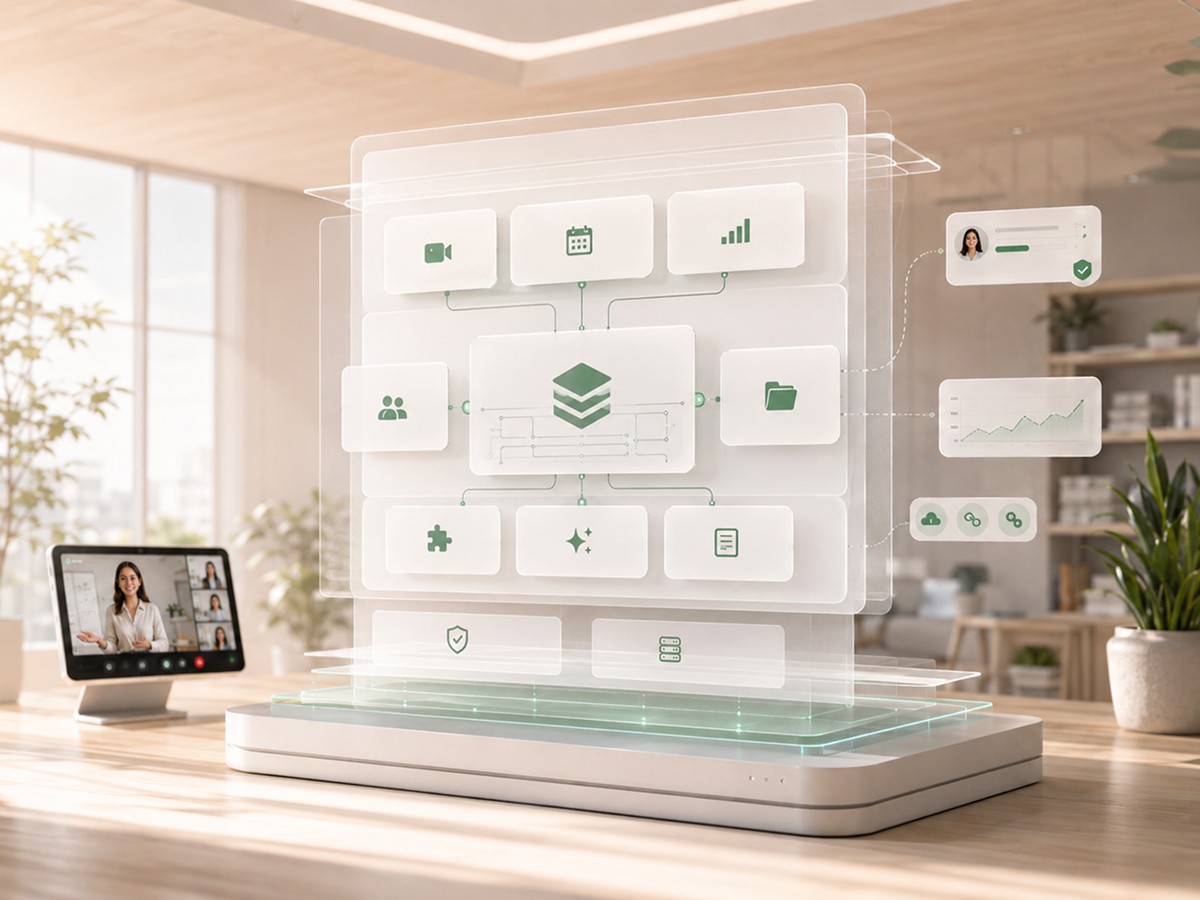
What makes that experience possible is considerably more complex: a layered architecture of infrastructure, communication systems, operational workflows, APIs, analytics, and AI that have to work together reliably for the product to function as intended.
Understanding how modern education platforms are built matters for two audiences. For EdTech founders and product teams, it clarifies the build-versus-buy decisions that shape development timelines and technical debt. For education operators evaluating platforms, it provides a framework for understanding which platforms are built for the operational complexity of real-world education and which are built for a simpler model that doesn't hold up under load.
This article examines the architecture layer by layer -- not to be exhaustive, but to give a clear picture of what each layer does and why it exists.
The Foundation of Modern Education Systems
The foundation of any modern education platform is reliable infrastructure: the systems that handle data storage, user management, authentication, and the core services that every other layer depends on.
At this layer, the decisions that matter most are architectural rather than functional. How is data structured? How are different components of the system isolated so that a failure in one doesn't cascade into others? How does the system handle geographic distribution for a student population spread across regions with different latency characteristics? How is the infrastructure designed to scale -- incrementally, predictably, without requiring manual intervention at each new threshold?
These decisions are invisible to end users until they go wrong. A student in a session doesn't think about database architecture. They notice when the session drops, when recordings fail, when the platform is slow in their region.
The foundation layer is also where security and compliance decisions live. Authentication, authorization, data encryption, access control, audit logging. For education platforms serving minors or operating under specific regulatory frameworks, these aren't optional considerations -- they're requirements that have to be built in rather than added on.
What distinguishes modern education platforms from legacy ones at this layer is not the presence of these capabilities but the architectural approach: cloud-native design that scales dynamically rather than fixed infrastructure that has to be manually sized, microservices that can be updated independently rather than monolithic systems where any change affects everything, and API-first design that makes every platform capability accessible programmatically rather than only through the platform's own UI.
That API-first principle is what enables the extensibility that modern education products require. A platform designed around the assumption that all interactions will happen through its own interface will always limit what organizations can build on top of it.
Real-Time Communication Layers
The real-time communication layer handles the live session experience: video, audio, screen sharing, chat, and the interactive tools that make a session more than a video call.
This is technically one of the more demanding layers to build well. Real-time communication requires low-latency data transmission, adaptive bitrate management as network conditions change, routing infrastructure that minimizes the distance data travels between participants, and graceful handling of the failure modes that are inevitable in consumer and enterprise network environments.
The decisions that differentiate platforms at this layer:
Latency and reliability under realistic conditions. A session that works well when all participants have excellent connectivity and works poorly when one participant has a variable mobile connection is a session built for demos rather than real-world use. Modern education platforms handle variable connectivity through adaptive quality mechanisms that degrade audio and video gracefully rather than dropping entirely, and through reconnection logic that handles participant drops without disrupting the session for everyone else.
Interactive tool integration at the session layer. The whiteboard, annotation, polling, and breakout functionality that make a session educationally substantive are not separate products attached to the video -- in well-built education platforms, they're components of the session layer that share state with the video infrastructure. An annotation persists across video quality changes. A poll result is available in the session data alongside attendance. The engagement tools and the communication tools function as a unified system rather than as separate features that happen to coexist.
Accessibility infrastructure. Live captions, generated from real-time transcription, are part of the communication layer in modern education platforms -- not a third-party integration that sometimes works. This matters for accessibility compliance, for international students, and as infrastructure: the transcript generated for live captions is the same transcript that feeds AI summaries, progress tracking, and session records. Captions aren't just an accessibility feature. They're the entry point for the AI layer.
Operational Workflow Systems
The operational workflow layer is where modern education platforms diverge most sharply from generic communication tools.
Operational workflows are the automated sequences that manage everything surrounding a session: the scheduling logic that books rooms and assigns instructors, the provisioning that configures session environments, the notification sequences that ensure participants show up, the post-session processes that document what happened and communicate it to the right people, and the exception handling that activates when something goes wrong.
Building this layer well requires a different design orientation than building a communication tool. A video conferencing product is optimized around the session experience. An education platform's operational workflow layer has to be optimized around the operational experience of an education business: running sessions reliably, at scale, with consistent quality and without requiring a coordinator to manually manage every event.
The components of a well-built operational workflow system:
Scheduling and coordination logic. Not just calendar management, but the business rules that govern session assignment: instructor qualification matching, availability constraint enforcement, time zone handling, conflict detection, and the automated follow-through that creates session environments, distributes credentials, and confirms participants without manual steps.
Session lifecycle management. Automated triggering of the right actions at each stage: session creation, participant notification, session start, recording initiation, engagement data capture, session close, transcript generation, summary production, post-session communication, and record update. Each step should execute reliably without requiring human initiation.
Exception handling workflows. When a session doesn't happen as planned -- an instructor no-shows, a participant can't join, a recording fails -- the platform should detect the exception, route it to the right person, and initiate the appropriate response. Exception handling that requires someone to be watching a dashboard and manually triggering follow-up actions isn't a workflow system. It's a manual process with a digital notification attached.
The depth of the operational workflow layer is often what separates platforms that work for serious education organizations from platforms that work for occasional use cases. At small scale, gaps in this layer can be filled by human coordination. At large scale, they compound into operational breakdowns that consume management attention and erode service quality.
APIs and Integrations
The API layer is what determines how a modern education platform fits into the broader system landscape of an education organization or product.
Most education organizations and EdTech products don't run on a single platform. There's a CRM that manages student relationships. A scheduling system that handles booking. A billing platform that processes payments. A student information system that maintains records. A communication tool that handles parent outreach. The education platform has to coexist with all of these, and ideally has to integrate with them in ways that eliminate manual data transfers and create coherent operational workflows.
API design quality determines how well this integration works in practice.
Well-designed APIs in education platforms are documented clearly enough for external developers to implement without sustained support from the platform vendor. They expose the full functionality of the platform programmatically, not just a subset of features available for integration. They maintain stable versioning with clear deprecation processes so integrations don't break without warning. They support webhooks for key session events, enabling downstream systems to react to session data in real time rather than through polling.
For EdTech product builders, the API layer has additional significance. A platform with a genuinely API-first architecture is one that can be embedded into a custom product experience without the user encountering the platform vendor's UI at all. The session management, recording, engagement tools, and data capture are available as infrastructure components. The product builder provides the interface. This is the model that allows EdTech companies to deliver a fully branded, custom experience built on reliable infrastructure rather than building that infrastructure layer themselves or inheriting someone else's product design.
Integration flexibility at the API layer is what allows modern education platforms to serve both the education operator who needs to connect session data to their CRM, and the EdTech founder who needs to embed a full session experience into a custom product. The same API surface serves both use cases because it was designed for composition rather than for a single fixed use pattern.
Analytics and Visibility
The analytics layer converts the raw data generated by sessions, participants, and workflows into organizational visibility -- the view that operations teams, instructors, and education leaders need to manage quality at scale.
Session data generated at the real-time communication and workflow layers is rich but unstructured in its raw form. A transcript is text. Engagement signals are event streams. Attendance records are timestamped joins and departures. For that data to be useful to an operations team, it has to be processed, aggregated, and surfaced in forms that answer specific operational questions.
The analytics layer does that processing. Individual session records become student progress profiles. Engagement event streams become session-level engagement scores. Attendance patterns across sessions become risk signals. Instructor session data across many sessions becomes quality patterns. The raw data generated by individual sessions becomes organizational intelligence when aggregated and analyzed at the right level.
The design decisions that determine how useful the analytics layer is:
Data completeness. Analytics are only as useful as the underlying data is complete. If session documentation is inconsistent -- because it depends on instructor effort rather than automated capture -- the analytics built on it are also inconsistent. Modern education platforms capture session data as a default output of every session, not as an opt-in feature.
Accessibility. Analytics that live inside a platform dashboard are useful for direct observation. Analytics that are accessible through APIs can be consumed by external reporting systems, integrated into custom dashboards, or used as inputs for AI models that the organization builds or integrates. The second category enables organizational intelligence; the first enables organizational reporting.
Actionable surfacing. Analytics are most valuable when they direct attention rather than just providing data. Exception-based alerts -- a student whose engagement has declined significantly, a session that had recording issues, an instructor whose documentation completion rate has dropped -- are more operationally useful than dashboards that require someone to review everything to find what needs attention.
AI-Powered Infrastructure
AI in modern education platforms is most useful when it's integrated into the infrastructure layer rather than positioned as a standalone feature.
The distinction matters because AI's value in education depends on the quality and completeness of the data it operates on. AI summaries are useful when they're generated from accurate, complete transcripts -- which requires reliable transcription infrastructure built into every session. AI engagement analysis is useful when it's built on systematic engagement data capture -- which requires that the engagement layer records structured data from every session activity. AI progress monitoring is useful when it has consistent session documentation to analyze -- which requires that documentation is produced reliably.
Infrastructure-integrated AI is AI that has access to the data it needs because that data is generated systematically as part of how the platform operates, not because someone configured each session to produce it.
The practical AI capabilities in modern education platforms:
Automated session documentation. Transcripts processed into structured summaries, reviewed by instructors, and distributed automatically -- a workflow that makes consistent session documentation achievable without the manual burden that previously prevented it.
Engagement and progress pattern detection. Longitudinal analysis across session data that surfaces at-risk students and quality patterns before they become serious problems -- not by replacing instructor judgment, but by ensuring the signals reach instructors and operations teams in time to act on them.
Operational workflow automation. AI-assisted scheduling, exception detection, and communication triggering that reduces the coordination overhead per session without removing the human oversight that edge cases require.
Pre-session briefing generation. Structured context surfaced for instructors before each session -- what was covered last time, where the student struggled, what the plan is today -- generated from session history without requiring the instructor to search for it.
Taken together, the AI layer in a well-built modern education platform is not a feature set. It's the intelligence layer that makes the rest of the platform's data and workflows increasingly useful over time -- improving with every session because it's operating on a growing, consistently structured dataset.
HiLink is built with this layered architecture as a foundational design principle. As API-first virtual classroom and education infrastructure, HiLink integrates real-time session delivery, operational workflow systems, engagement data capture, open API access, and AI-powered operational intelligence as a unified platform -- designed for the product teams and education operators who need infrastructure that performs under the full complexity of modern online education, not just in demonstration conditions.
Understanding how the layers fit together is what separates organizations that make good platform decisions from those that discover the gaps only after they're running inside them.