How AI Reduces Teacher Admin Work
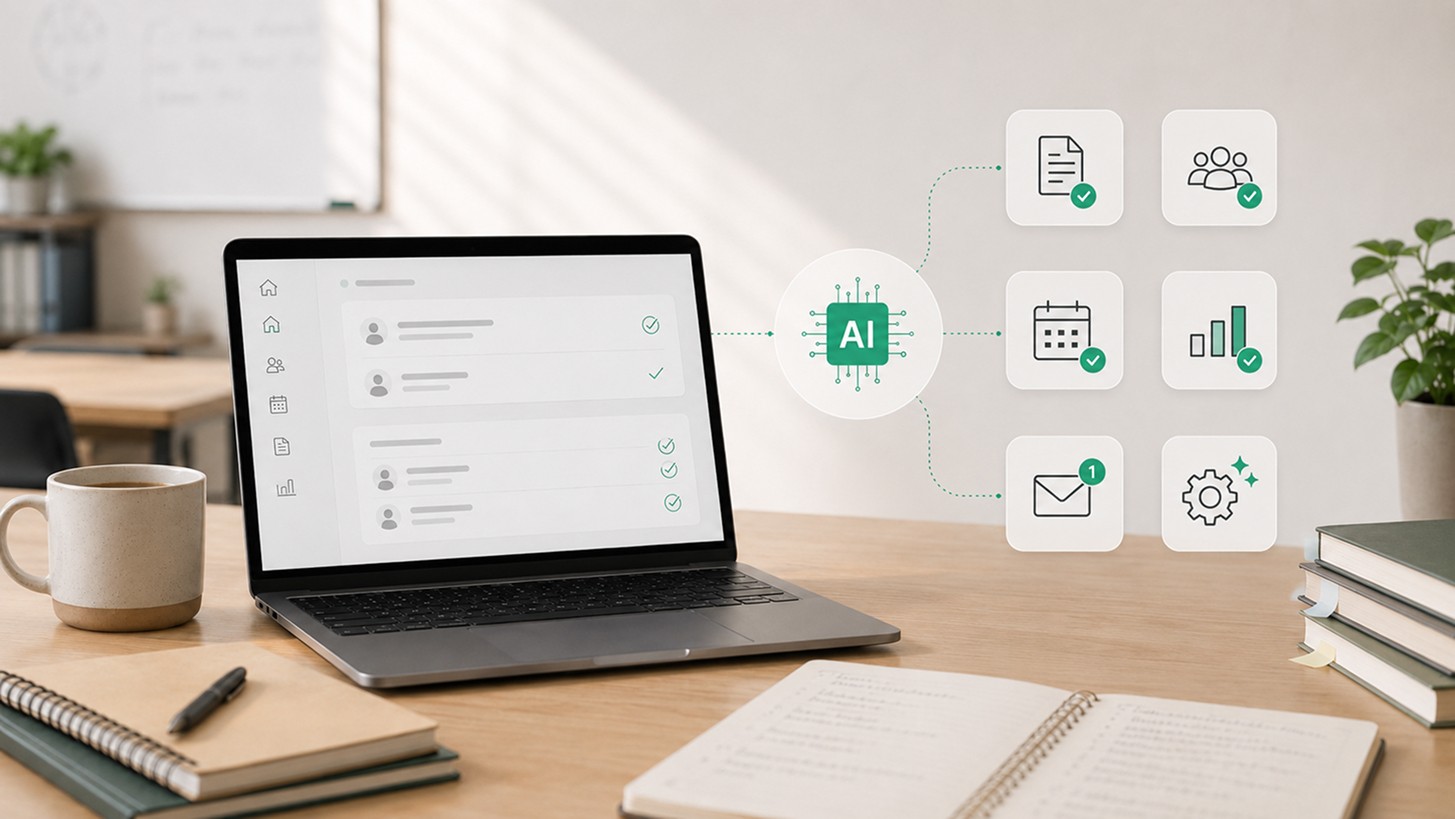
Ask almost any teacher or tutor what gets in the way of good teaching, and the answer is rarely the teaching itself. It's everything around it.
Writing up session notes after back-to-back lessons. Sending parent updates that require pulling information from three different places. Filling in attendance records. Logging curriculum coverage. Preparing the same kind of report for the fifth student this week. These tasks are necessary. They're also not what anyone went into education to do.
The conversation about AI in education tends to go one of two directions. Either AI is going to transform how students learn -- personalized, adaptive, revolutionary. Or it's going to replace teachers, which makes teachers reasonably defensive. Both framings miss the most practical and immediate application: AI reduces teacher admin work, quietly and without drama, in ways that return real time to the people who need it.
That's the version worth understanding.
Where Teachers Lose Time
The administrative load on instructors in online education is larger than it looks from the outside.
In a physical school, many administrative functions are handled by someone other than the classroom teacher: a receptionist takes attendance, an administrator sends parent communications, a department head manages curriculum logs. In online tutoring and virtual learning environments, much of that work falls on the instructor directly -- especially in smaller organizations that can't afford specialized administrative roles.
A typical online tutor running four or five sessions a day might spend thirty to sixty minutes on post-session administration alone. Notes about what was covered. Notes about how the student performed. A follow-up message to a parent. Updating a progress tracker. Logging the session against a curriculum plan. Each individual task is short. Together, they can consume a meaningful fraction of the working day.
There's also the pre-session preparation that gets overlooked. Reviewing what happened in the last session. Checking whether homework was submitted. Pulling together materials for the planned content. An instructor who sees fifteen different students across a week carries fifteen separate mental files of context that have to be refreshed before each session.
None of this is optional. The notes matter for continuity. The parent communication matters for trust and retention. The curriculum logging matters for accountability. The pre-session review matters for teaching quality. The issue is not that these tasks shouldn't exist -- it's that they currently require full human attention for work that doesn't necessarily need it.
Repetitive Operational Tasks
The administrative tasks that consume instructor time have something in common: they're structured, predictable, and pattern-based.
A session note follows a predictable structure. What was the topic? What did the student do well? Where did they struggle? What should happen next? The content varies by student, but the shape is consistent. An attendance record is pure data entry. A curriculum coverage log is a mapping exercise. A session reminder to a student or parent is a triggered communication based on a scheduled event.
These are exactly the kinds of tasks that AI handles well. Not because AI understands the teaching -- it doesn't -- but because processing structured information, recognizing patterns, and producing formatted outputs based on source material is what current AI systems are genuinely good at.
The distinction that matters here is between tasks that require judgment and tasks that require processing. Deciding what a struggling student needs is a judgment call. Writing a structured summary of what happened in a session is a processing task. Deciding how to handle a difficult parent conversation requires relationship intelligence. Sending a routine post-session update requires taking information from one place and communicating it in another.
AI should handle the processing tasks. Instructors should handle the judgment calls. When that division is implemented well, the instructor's time and attention shift toward the work that actually requires them.
AI-Generated Reports and Summaries
The most direct way AI reduces teacher admin work is through automated session summaries and reports.
Here's what typically happens without AI: a session ends, the instructor sits down to write notes, they're mentally tired from back-to-back teaching, the notes come out thin or delayed, and the parent gets an update that's either late or vague. When it happens once, it's forgivable. When it's the pattern, it erodes the professional appearance of the service and creates gaps in the student's record that matter later.
With AI-powered session summaries, the workflow changes substantially. The session is transcribed in real time. When it ends, a structured summary is generated automatically: topics covered, key moments, student responses, recommended next steps. The instructor reviews it -- correcting anything the transcript missed, adjusting the tone, adding context that wasn't captured -- and approves it. That review typically takes under a minute.
What changed? The instructor's role shifted from author to editor. The output is still reviewed and approved by a person. The quality is still governed by the instructor's judgment. But the blank page problem is gone, and so is most of the time.
Progress reports follow the same logic. Generating a monthly progress report for a student traditionally means pulling together notes from multiple sessions, synthesizing performance patterns, writing a coherent narrative, and formatting it in a way that's readable for a parent. That's an hour of work, per student, per month. AI can draft the report from session data automatically -- the instructor reviews and refines. The process goes from an hour to ten minutes.
The quality of AI summaries depends directly on the quality of the underlying transcription. For organizations building on AI-powered virtual classroom infrastructure, the transcription layer isn't a separate add-on -- it's built into every session, which means the input AI needs to generate useful summaries is already there.
Parent Communication Workflows
Parent communication is one of the highest-value and highest-burden aspects of running an online education service.
High value because it directly affects trust, retention, and the parent's perception of whether their investment is working. High burden because it requires consistent, personalized, timely output -- and at any meaningful scale, delivering that consistently through manual effort alone is unsustainable.
The pattern that breaks down first: routine post-session updates. The intent is to send every parent a message after every session. The reality is that instructors running multiple sessions a day don't have time to write those messages individually, so they get skipped or templated so heavily they feel impersonal. Parents notice both.
AI-assisted communication workflows address this by automating the routine and standardizing the structured. Post-session messages can be generated from the session summary and sent automatically -- or held for a thirty-second instructor review before going out. Absence notifications can be triggered the moment an attendance record flags a no-show, without requiring anyone to monitor a dashboard and manually send a message. Progress update reminders can be generated from session data and queued for approval at predictable intervals.
The key design principle is the same one that applies to summaries: AI drafts, humans approve. Parents are not receiving machine-generated communications without human oversight. They're receiving timely, consistent communications that a human has reviewed -- which is better than the alternative of inconsistent communications that no one had time to write.
For tutoring businesses and online schools, this consistency is a direct retention driver. A parent who hears from you after every session, with a coherent summary of what happened, is a parent who stays. The service quality is the same. The perception of quality is higher because the communication reflects it consistently.
AI-Assisted Progress Tracking
Tracking student progress in online education is operationally awkward. The data exists -- across session notes, comprehension check results, attendance records, homework submissions -- but it's fragmented. Assembling a coherent view of a student's progress requires pulling from multiple sources, recognizing patterns across time, and making judgments about what those patterns mean.
At the individual instructor level, this is manageable for students they see regularly. For students they see once a week, or for organizations where students work with multiple instructors, the picture becomes much harder to hold together.
AI assists here not by replacing the instructor's assessment, but by surfacing the patterns in data that the instructor then interprets. A dashboard that shows a student's engagement trend across the last ten sessions, their comprehension check scores by topic area, and their attendance pattern gives an instructor a useful starting point for the pre-session review that would otherwise require manually digging through notes.
At the organizational level, AI-assisted progress tracking gives operations teams visibility they can act on. A flag that a student's engagement has declined over the last month is information. What to do with it -- whether to reach out, adjust the instructor, change the curriculum approach -- is a human decision. But the flag only exists if someone or something was monitoring the patterns systematically.
This is where the infrastructure argument and the admin-relief argument converge. AI reduces the burden on individual instructors by processing data they would otherwise have to compile manually. It also makes organizational quality management possible at a scale where manual monitoring would be impractical.
What Should Remain Human
The case for AI reducing teacher admin work is straightforward. The risk worth naming is that it can become an argument for eroding the human elements of education that are actually its most important parts.
Relationship is not an administrative task. The rapport between an instructor and a student -- built over many sessions, through moments of patience, humor, encouragement, and honest feedback -- is not something AI assists with. It's the core of what makes teaching effective, and it requires undivided human presence.
Judgment about a student's wellbeing is not an administrative task. An instructor who notices that a usually engaged student has gone quiet, and suspects something is going on outside of academics, is exercising a form of professional judgment that no AI system can replicate. The right response requires knowing the student, reading the situation, and making a human call.
Curriculum adaptation in the moment is not an administrative task. Recognizing that the planned approach isn't landing and pivoting to a different explanation, a different example, a different angle -- that's teaching. AI cannot do it because teaching responsiveness requires understanding, and AI summaries and tracking tools don't understand anything. They process.
The division of labor that works: AI handles what's routine, structured, and pattern-based. Humans handle what's relational, contextual, and judgment-dependent. When that division is respected, AI is genuinely useful in education. When it's not -- when AI is positioned as capable of the relational and contextual -- it fails, and it makes the teaching worse.
Platforms that build AI tools for education with that division in mind are building something worth using. Platforms like HiLink integrate AI into the operational layer -- session summaries, engagement signals, progress tracking -- while keeping the teaching layer entirely in the instructor's hands. That's the right architecture, and it's the one that actually delivers the administrative relief instructors need without compromising the human work that matters most.