Embedded Virtual Classrooms Explained
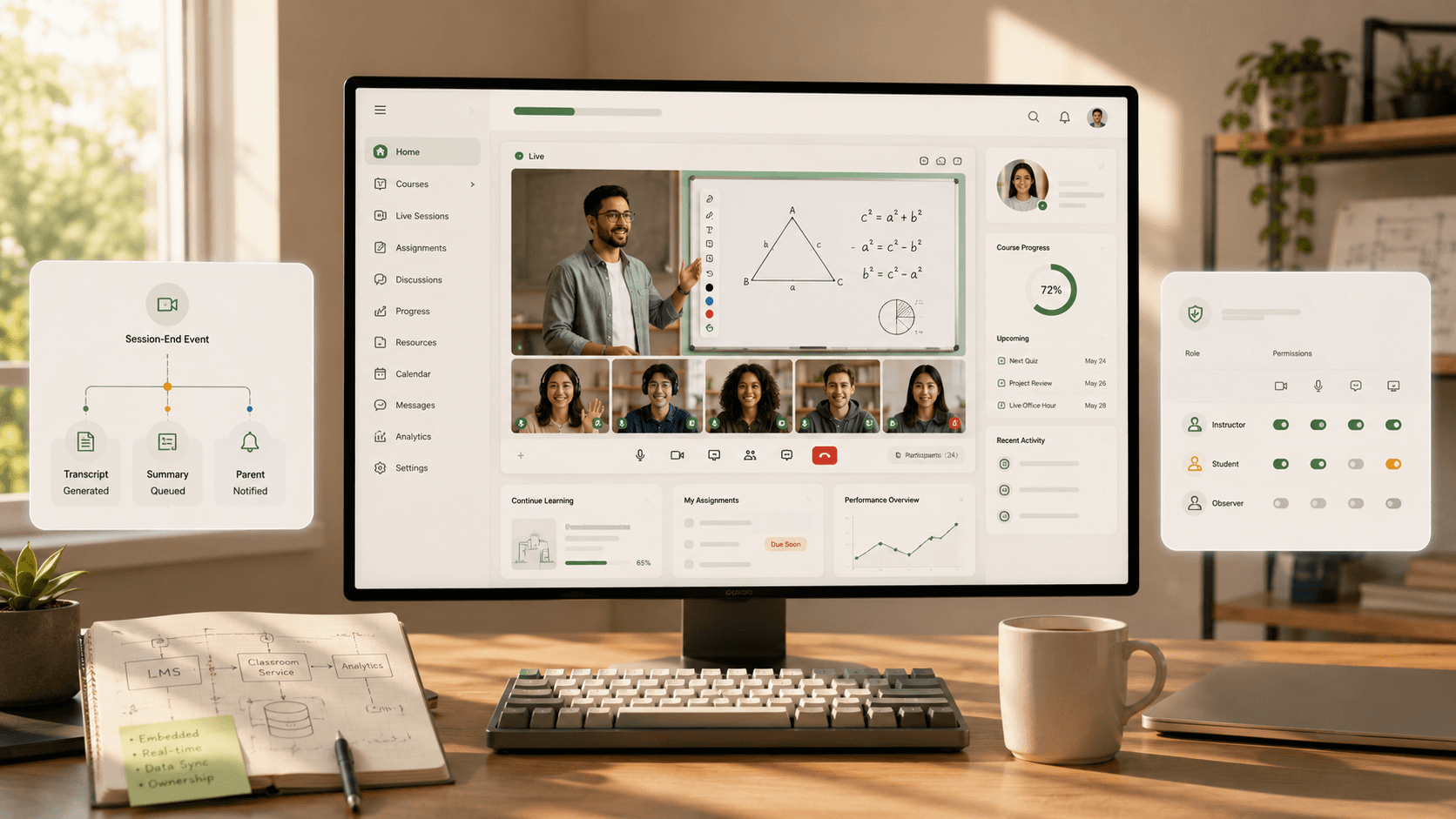
There's a moment in most EdTech product journeys when the question comes up: do we send users to a separate platform for live sessions, or do we bring the live session into our product?
The first option is simpler to implement. Point users to a video conferencing link, handle the coordination on your side, and accept that the live session happens in someone else's product. The tradeoff is that the session is outside your control: the branding is wrong, the data doesn't come back to you, the user experience is fragmented, and the learner's experience of your product has a gap in the middle where the core value delivery actually happens.
The second option is harder to implement. It requires either building the session infrastructure from scratch or integrating with a platform that exposes the right API surface for embedding. But it produces a fundamentally different product: one where the session is part of the experience, not an interruption in it.
An embedded virtual classroom is the mechanism that makes the second option achievable without the engineering cost of building session infrastructure from scratch. For platform builders and education operators who need live learning as part of their product rather than adjacent to it, embedded classrooms are increasingly the right architectural choice.
What Embedded Classrooms Are
An embedded virtual classroom is a live learning environment that is integrated into a host product rather than operating as a standalone platform.
The distinction is architectural. A standalone virtual classroom is a product that users navigate to. It has its own URL, its own interface, its own brand, its own session management logic. Users leave the host product, complete their session in the virtual classroom, and return. The session data, if it comes back to the host at all, has to be explicitly fetched or integrated.
An embedded virtual classroom is a component within the host product. The session interface renders inside the host application. Users never leave the product. The host application controls what participants see, what tools are available, and how the session is configured. Session data -- attendance, engagement signals, transcripts, recordings -- flows back to the host application automatically because the session is happening within the host product's infrastructure.
The embedding can take different forms depending on how much control the builder needs.
At the lightest end, an iFrame or web component approach embeds the virtual classroom provider's session UI into the host product. The session looks like the provider's product running inside a frame. Implementation is fast. Customization is limited.
At the middle level, SDK-based embedding uses the provider's session management and media infrastructure while allowing the host product to render its own session interface. The video, audio, and session state are managed by the provider. The visual layer is the host product's own design.
At the fullest end, a headless API integration handles all session management, data, and infrastructure through API calls while the host product renders everything the user sees. Maximum flexibility, maximum implementation investment, maximum long-term control.
The right approach depends on how much the host product needs to differentiate the session experience and how much engineering investment is available. All three approaches produce an embedded classroom -- one that lives inside the product rather than next to it.
Why Organizations Embed Learning Experiences
The decision to embed a virtual classroom into a product rather than using a standalone platform reflects priorities that are worth understanding clearly, because they determine what the embedding has to accomplish.
Product coherence is the most common motivation. When the live session is the core value delivery in an education product, having that session happen outside the product creates a fundamental incoherence. The student logs into the tutoring platform, clicks a link, opens a video call in a separate window, completes the session, closes the call, and logs back into the platform. At each transition, there's friction, a branding mismatch, and a moment where the product experience breaks. For a product whose primary function is delivering live learning, that break is a product quality issue.
Data ownership is the second major motivation. When sessions happen in a standalone platform, the session data -- attendance, engagement, transcripts, recordings -- belongs to that platform unless the host product explicitly integrates to retrieve it. For EdTech products that need to offer analytics, progress tracking, parent communication, or personalization, not owning the session data is an architectural problem. Embedding means the session data is generated within the host product's infrastructure and available immediately.
Differentiation is the third motivation. A standalone virtual classroom is a commodity experience. Every organization using the same platform produces a session that looks and feels the same. An embedded classroom, customized to the host product's interface and workflow, is a differentiated experience that becomes part of the product's competitive identity.
Regulatory and compliance considerations drive embedding decisions for some organizations. If session data needs to be stored in specific regions, processed by specific infrastructure, or logged according to specific formats, controlling where the session happens is necessary. Embedding with an API-first infrastructure provider that supports these requirements is more controllable than depending on a standalone platform's compliance posture.
Reducing Platform Fragmentation
Embedding a virtual classroom into a product addresses one of the most persistent sources of friction in online education: platform fragmentation.
Platform fragmentation in online learning is the condition where different parts of the educational experience happen in different systems that don't connect. The curriculum is in the LMS. The session happens in the video platform. The progress notes are in the instructor's notes app. The parent communication goes through an email tool. The billing is in the payment processor. Each system does its job. No system has a complete view of the student's experience.
For the student and parent, fragmentation means navigating between products. For the instructor, it means switching contexts constantly. For the operations team, it means manually moving data between systems. For product builders, it means that the experience they've designed exists only in their system -- the moments that matter most (the live sessions) happen somewhere else.
Embedding the virtual classroom into the host product eliminates the largest fragmentation gap in most education products. The session happens in the same system as everything before and after it. Session data -- what was covered, who attended, how students engaged -- is immediately available in the host product's data layer, not locked in a separate platform that requires integration work to access.
This has downstream consequences for every product feature that depends on session data. Progress tracking that previously required pulling data from a standalone platform can now operate on locally available session data. AI-powered summaries that previously required a separate tool can operate on transcripts generated by the embedded session infrastructure. Parent communication that previously required the operations team to check a separate platform for session outcomes can trigger automatically from the embedded session's data.
Reducing fragmentation through embedding doesn't just improve the user experience. It improves the operational coherence of the entire product, because the session data that was previously missing or delayed is now available where and when the product needs it.
API-First Infrastructure Considerations
Building on the right API-first infrastructure is the decision that determines how much the embedded classroom can do and how maintainable it will be over time.
An embedded virtual classroom built on API-first infrastructure can expose any capability that the infrastructure provides through its API. Session configuration, participant management, recording, transcription, engagement tools, session data -- all of these are available programmatically, which means the host product can control them, extend them, and connect them to its own workflows.
An embedded virtual classroom built on infrastructure that doesn't have a genuine API-first design -- where the API is an afterthought to a product built for direct use -- has capability limited to what the vendor has chosen to expose. Customization options are bounded by the vendor's product decisions. Session data may not be available in formats the host product can use. Webhooks for session events may be incomplete or undocumented. The host product is dependent on the vendor's roadmap for features it needs.
The specific API capabilities that matter for embedded classroom infrastructure:
Session lifecycle control. The host product should be able to create, configure, start, and end sessions through API calls, without requiring any manual action in the vendor's own interface. Session rooms should be provisionable programmatically as part of the host product's scheduling workflow.
Participant and permission management. The host product should be able to define participant roles and permissions through the API, configuring different capabilities for instructors, students, and observers without requiring those definitions to exist in the vendor's interface.
Real-time session data access. Session events -- participant joins, engagement tool responses, recording status, session end -- should be available as webhooks that the host product's backend can subscribe to and act on in real time. Post-hoc data access through polling is less useful than real-time event notification.
Media and content access. Recordings, transcripts, and session artifacts should be accessible through the API in formats the host product can store, process, and present in its own interface. The host product should own the data generated in its sessions.
Documentation quality and API stability are evaluation criteria that matter as much as capability. An API with powerful capabilities that's poorly documented or that changes without clear versioning creates a maintenance burden that offsets the embedding benefits. Evaluate documentation clarity and version stability alongside feature set when choosing embedded classroom infrastructure.
Scalability and Customization
Scalability and customization are the two dimensions that determine whether an embedded virtual classroom remains the right choice as the product grows.
Scalability for embedded classrooms has both technical and product dimensions.
Technical scalability means the infrastructure can handle the session volume the product generates without degradation. This requires evaluation at the peak session load the product expects, not just current load. Infrastructure that works at current scale but degrades at target scale creates a migration problem at the worst possible time -- when the product is growing and the user base is most dependent on reliability.
Product scalability means the embedding remains maintainable and extendable as the product adds features. An embedded classroom built with tight coupling to the infrastructure provider's implementation details becomes harder to maintain as both the host product and the infrastructure evolve. An embedding built on clean API abstractions remains decoupled -- changes to the infrastructure provider's implementation don't require changes to the host product's interface layer.
Customization is the dimension that determines how differentiated the embedded experience can become.
Interface customization allows the embedded classroom to match the host product's visual design. Colors, typography, layout, component hierarchy -- how much of this is configurable determines whether the session feels like part of the host product or like a vendor product running inside it.
Functional customization allows the host product to include some session capabilities and exclude others. A tutoring product might want to expose the whiteboard but not screen sharing. A corporate learning product might want to expose session recording but not live captions. An educational platform for younger students might want to restrict participant controls. The infrastructure should support these configurations rather than forcing a fixed feature set.
Behavioral customization allows the host product to define how session events are handled. When a session ends, what happens? When a participant joins late, what's the default behavior? When a recording fails, what's the fallback? An API-first infrastructure provider that supports behavioral configuration through the API enables the host product to define these behaviors programmatically rather than accepting the vendor's defaults.
Future Trends in Embedded Learning
The trajectory of embedded virtual classrooms reflects broader trends in EdTech product design: toward more integration, more data access, and more product differentiation.
The increasing adoption of headless architectures across software generally is reaching EdTech. As more EdTech products choose to build their own interfaces on top of API-first infrastructure rather than embedding pre-built UI components, the demand for infrastructure that is genuinely headless -- where the entire UI layer can be custom without inheriting any of the provider's design assumptions -- will grow.
AI capabilities are increasingly built into embedded classroom infrastructure rather than available only as separate tools. Session transcription that powers both live captions and post-session summaries, engagement analysis that operates on the session's structured data automatically, and pre-session briefing generation that draws on the session history are all AI capabilities that are most useful when they're part of the embedded infrastructure rather than available only through a separate integration.
The business model for embedded virtual classroom infrastructure is also evolving. Usage-based pricing that scales with session volume rather than seat-based pricing that requires predicting user counts is becoming more common, making embedded infrastructure more accessible for products with variable or growing usage patterns.
HiLink is built for this embedded architecture use case. As an API-first virtual classroom and education infrastructure platform, HiLink provides the session management, engagement tooling, real-time data access, AI-powered operational capabilities, and genuine headless flexibility that platform builders need to embed live learning into their products without inheriting another platform's experience. The infrastructure handles what infrastructure should handle. The product builder builds the product.
That's the promise of embedded virtual classroom infrastructure: live learning as a native part of the product, not a detour from it.