Education Platform Infrastructure: Why Online Learning Is an Infrastructure Problem, Not a Communication Problem
Why Video Calls Became the Default
The story of how video conferencing became the infrastructure of online education is not complicated. It is a story about availability and urgency converging at the same moment.
When institutions and education businesses needed to move instruction online, the decision was not made by infrastructure architects weighing long-term requirements against available options. It was made by operations teams and educators who needed something working by Monday. Zoom was already installed. Google Meet required no setup. Microsoft Teams was already deployed across most enterprise organizations. The path of least resistance led directly to communication tools, and an entire industry followed it.
What followed was a period of productive improvisation. Educators adapted. Students adapted. Businesses found workarounds for the limitations that surfaced. The tools were not designed for education but they were good enough to make education happen.
Good enough is not the same as designed for the purpose. And the gap between those two things -- between tools that can support education and infrastructure built for it -- has been widening steadily as the operational requirements of online learning at scale have become clearer.
The organizations that recognize this gap now are the ones building on infrastructure designed for what education actually requires. The ones that do not recognize it are still paying the operational cost of building on a foundation that was never meant to carry this weight.
The Limitations of Communication-First Systems
Communication-first systems -- video conferencing tools designed for meetings, team collaboration, and business calls -- share a set of architectural assumptions that are correct for their intended use case and wrong for education.
The session is the product. In business communication, the meeting is the deliverable. Something was discussed, a decision was made, a relationship was maintained. The value is in the interaction itself. What gets captured afterward -- notes, action items, recordings -- is supplementary. The tool is optimized around the session experience.
In online education, the session is not the product. The session is the production process. The product is learning -- a change in what a student knows or can do, documented, measurable, and connected to the sessions before and after it. A communication-first system optimized around session experience misses this entirely. It delivers the interaction. It does not capture the learning.
Participants are equals. Business communication tools are designed for participants with roughly equal standing. The meeting model assumes that any participant can speak, share, contribute, and influence the outcome. Role differentiation is shallow -- a presenter, a host, a participant -- and the distinctions are operational rather than architectural.
Education requires differentiated roles as a first-class architectural concept. An instructor has different capabilities than a learner. A teaching assistant has different capabilities than both. A learner in a group session has different permissions than a learner in a one-to-one session. An institutional observer has different data access than any participant. These distinctions are not configuration options. They are requirements that need to be built into the platform from the start.
Data is a byproduct. Communication tools capture what is necessary to facilitate the session. Participant identity, connection quality, session duration. The data they produce is operational -- enough to bill for the service, troubleshoot technical issues, and prove the session occurred.
Education platforms need data that is pedagogically structured. What learning objectives were addressed. How individual learners engaged with specific content. Where comprehension was uncertain. How a student's performance has trended across multiple sessions. This data does not exist as a byproduct of a communication session. It has to be designed into the platform from the ground up, captured as structured events, stored in a consistent schema, and made accessible to the systems that need to use it.
Scale is linear. In business communication, scaling from 100 meetings a month to 1,000 is primarily a capacity question. More sessions, more participants, more storage. The operational complexity does not change qualitatively -- it just requires more of the same infrastructure.
In online education, scaling from 100 sessions to 1,000 changes the operational requirements qualitatively. Quality monitoring that was manual at 100 sessions requires systematic instrumentation at 1,000. Parent communication that was personal at 100 sessions requires automated workflows at 1,000. Tutor performance management that relied on direct observation at 100 sessions requires session-data-driven analysis at 1,000. The infrastructure requirements of online education do not scale linearly with volume. They evolve.
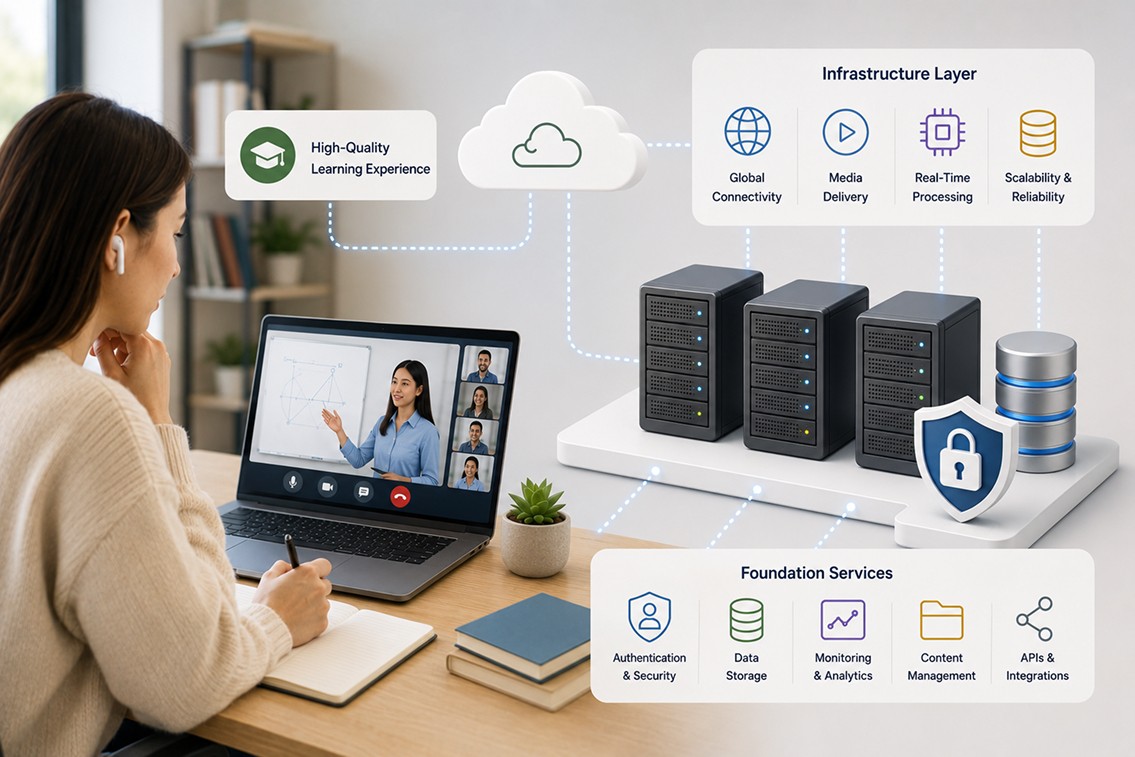
The Infrastructure Requirements of Online Education
Defining what education platform infrastructure actually requires is more useful than cataloging where communication tools fall short. The requirements are specific and they point clearly toward what needs to be built.
Learning event capture as a foundational layer. Every meaningful interaction in a learning session needs to be captured as a structured data event. Hand raises. Poll responses. Assessment submissions. Engagement signals. Whiteboard contributions. Breakout room transitions. Session milestones. These events are the raw material for everything an education platform builds -- analytics, AI outputs, compliance documentation, quality monitoring, learner progress tracking. Without this layer, everything built on top of the session is reconstructed from incomplete information.
Session continuity across time. Learning does not happen in isolated sessions. It happens across many sessions over weeks and months, and the effectiveness of each session depends partly on how well it connects to the ones before and after it. Education platform infrastructure maintains structured records of what was covered, what needs reinforcement, and where individual learners are in their progress -- so each session starts from an informed position and contributes to a cumulative learning record rather than disappearing into an archive of recordings.
Role-differentiated architecture. Instructors, learners, teaching assistants, observers, administrators, institutional clients -- each with different permission scopes, data visibility, and operational capabilities. This is not a feature. It is a load-bearing architectural requirement that shapes everything from session moderation to compliance reporting to multi-tenant data management.
Engagement systems designed for learning. Monitoring engagement in an educational context is different from monitoring attendance in a meeting. Education engagement systems capture participation quality, not just participation presence. They distinguish between a learner who is actively working through a problem and one who left the tab open. They surface these signals in real time, during the session when they can still influence the outcome, rather than as retrospective data that arrives too late to act on.
Operational tooling that scales. Reporting, quality monitoring, parent communication, tutor performance management, compliance documentation -- these are operational functions that grow in complexity with session volume. Education platform infrastructure produces the data and automates the workflows that make these functions tractable at scale, rather than leaving them as manual processes that break down somewhere between 500 and 2,000 sessions a month.
Integration interoperability. LTI, xAPI, SCORM, webhook-driven event streams -- the standards that allow education platforms to compose with the broader ecosystem of learning management systems, assessment tools, student information systems, and institutional data infrastructure. These are not optional integrations. They are the connective tissue that allows education platform infrastructure to function within the institutional and enterprise environments where online learning increasingly operates.
Operational Complexity at Scale
The operational complexity of online education at scale is the clearest argument for purpose-built infrastructure, because it is where the gap between communication tools and education systems becomes most visible and most costly.
A tutoring business running 3,000 sessions a month faces operational requirements that simply do not exist at 300 sessions a month. Quality monitoring requires signal-based flagging rather than manual spot-checks. Tutor performance management requires session-data-driven analysis rather than direct observation. Parent communication requires automated workflows rather than individual tutor initiative. Compliance documentation requires automated record generation rather than manual assembly.
None of these requirements can be met by adding features to a communication tool. They require session data captured consistently, structured in a schema that operational systems can consume, and exposed through interfaces that allow downstream automation. They require infrastructure designed for the operational reality of education at scale, not for the simpler operational model of business communication.
The organizations that build on education platform infrastructure before they need to grow into it scale without the operational crises that characterize the 500-to-5,000 sessions per month transition. The ones that defer the infrastructure investment until the operational pain forces it find that the migration is more expensive, more disruptive, and more constrained by existing commitments than it would have been earlier.
AI and the Future of Learning Infrastructure
AI is entering online education through the data layer, which is why the AI capabilities of an education platform are inseparable from its infrastructure.
Platforms with rich, structured session data produce AI outputs that are operationally meaningful. Live captions built on real-time transcription infrastructure. Lesson summaries that capture pedagogical content -- what was taught, how learners responded, what needs reinforcement -- rather than generic meeting recaps. Engagement detection that reflects learning behavior rather than technical events. Parent communication generated automatically from session records rather than written manually. Tutor performance modeling built from session-level data captured consistently across time.
Platforms with thin session data produce AI outputs that are structurally similar but operationally shallow. The summary exists but describes any session rather than this one. The engagement signal exists but cannot be trusted as a basis for operational decisions. The AI roadmap items stay on the roadmap because the data infrastructure they depend on was never built.
The future of learning infrastructure is AI-native -- not in the sense that AI makes decisions about learning, but in the sense that AI outputs are natural products of how sessions are captured and structured. The platforms that get there are the ones building the data layer now, before the AI capabilities they want to deploy are already on the roadmap.
Why Education-Native Systems Are Emerging
The emergence of education-native virtual learning infrastructure as a distinct market category reflects a growing recognition that online education has outgrown the communication tools it started with.
The recognition is coming from multiple directions simultaneously. EdTech companies building products find that communication tool APIs do not expose the session data their product roadmaps require. Tutoring businesses scaling past a few thousand sessions a month find that their operational model is unsustainable on tools that require manual assembly of everything beyond the session itself. Institutional clients find that the compliance, integration, and data residency requirements they bring to procurement conversations are not met by platforms built on communication infrastructure.
These converging pressures are defining the education platform infrastructure category. Not through a single breakthrough but through the accumulating weight of requirements that communication-first systems cannot meet -- and that purpose-built education infrastructure addresses as a matter of design.
The organizations moving toward education-native infrastructure are not moving away from something that was working. They are moving toward something designed for where they are going.
Where HiLink Fits
HiLink is built as education platform infrastructure from the ground up -- not adapted from communication tools and not a feature-complete application that leaves the infrastructure layer to whoever is building on top of it.
The session environment is designed for online instruction. The data layer captures learning events as structured data across every session, automatically, without manual configuration. The AI layer runs from the infrastructure up -- live captions, lesson summaries, engagement signals, parent recaps -- producing consistent outputs that feed into operational workflows through a clean API. Multi-tenant architecture handles institutional hierarchy natively. Full white-label capability supports brand ownership at the domain and tenant level. LTI, xAPI, and SCORM interoperability satisfies enterprise integration requirements. Compliance infrastructure handles data residency and regulatory requirements as architectural properties.
For EdTech companies building learning products, tutoring businesses scaling past the operational limits of communication tools, and institutional deployments with real compliance and integration requirements, HiLink provides the infrastructure layer that online education at scale actually requires.
The Bottom Line
Online education is not a communication problem with a communication solution. It is an infrastructure problem that requires infrastructure designed for it -- systems that capture learning events, support differentiated roles, maintain session continuity, produce structured operational outputs, and scale without degrading the quality of what is produced.
The tools that brought online education through its first decade of scale were not built for this. They were built for meetings, adapted for classrooms, and made to work through the discipline and workarounds of the people using them. That adaptation has a ceiling, and most organizations building serious online education businesses are approaching it.
Education platform infrastructure exists to raise that ceiling -- not by adding features to communication tools, but by building the foundational layer that online learning at scale actually needs. The organizations that build on it early find that the ceiling they were approaching becomes the floor they are building from.