AI-Powered Session Recaps Explained
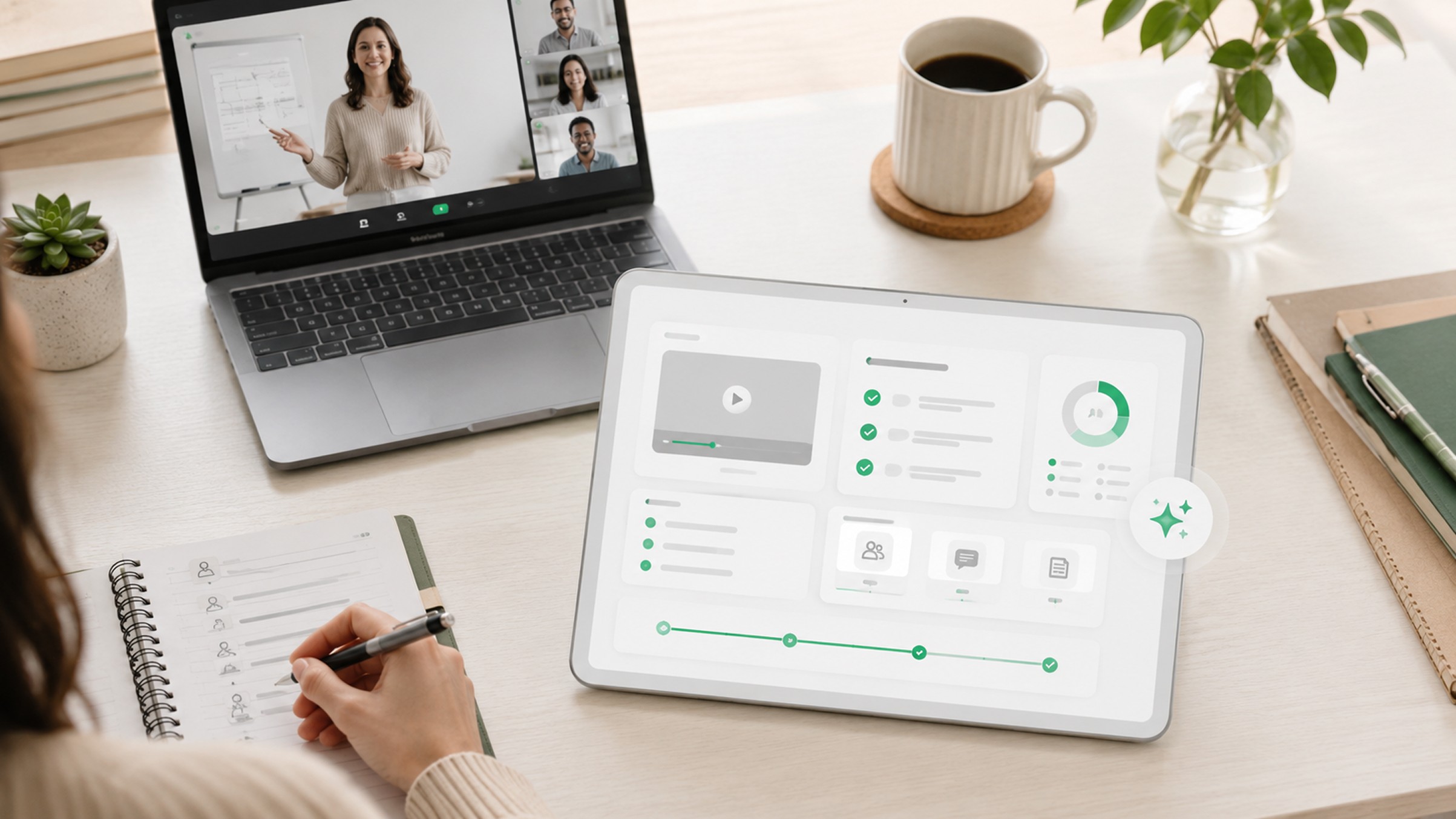
After every lesson ends, something important happens -- or should happen.
Someone documents what was covered. How the student performed. What needs to happen next. That record becomes the thread of continuity that connects one session to the next, that keeps a substitute instructor informed, that gives a parent confidence their investment is producing progress, that lets an operations team catch a struggling student before they disengage.
In practice, that documentation often doesn't happen consistently. It's written quickly and vaguely, or delayed until the details have faded, or skipped entirely when an instructor has back-to-back sessions and no margin to write. The information that was generated in the session -- the comprehension gaps exposed, the concepts that clicked, the topics covered and not covered -- disappears.
AI-powered session recaps exist to close that gap. Not to replace the instructor's judgment, but to make the documentation process reliable enough that it actually happens, every session, without consuming the time that should be going toward teaching.
Why Session Continuity Matters
Continuity is the difference between a series of isolated sessions and a coherent learning journey.
In a physical tutoring or classroom context, continuity is partly maintained by physical proximity. The same room. The recurring weekly slot that becomes a ritual. The informal check-in at the start of class -- "how did last week's homework go?" -- that resets context before instruction begins.
In online education, none of those environmental cues exist. Each session starts from a blank slate unless something actively recreates the context. If no one has recorded what happened last time, the instructor either spends the first ten minutes of a session reconstructing it through conversation, or they proceed without it and risk covering ground already covered, or missing ground that needs revisiting.
This matters more than it might initially appear. Learning is cumulative. What a student understands today depends partly on what they understood last week. When continuity breaks -- because a different instructor stepped in without context, because the regular instructor forgot where they left off, because sessions are infrequent enough that memory isn't reliable -- the student's progress slows even if the individual session is well-delivered.
At the organizational level, continuity is also an accountability structure. Parents who pay for ongoing tutoring or enrollment in an online school expect their child's learning to be tracked and built upon deliberately. A program that can show a student's progression across sessions -- here's what we covered, here's where you were six weeks ago, here's where you are now -- is delivering a fundamentally different service from one where each lesson is opaque.
Session continuity is not a soft benefit. It's an operational and educational foundation that either gets built systematically or doesn't get built reliably at all.
The Limitations of Manual Note-Taking
Manual session notes are better than nothing. But they come with a set of structural limitations that make them insufficient as the primary continuity mechanism for any education operation at scale.
The first limitation is time. Writing a useful post-session note takes ten to fifteen minutes, minimum, if it's done properly. For an instructor running four or five sessions a day, that's an hour of post-session administration before they've checked their messages, prepared for tomorrow, or done anything else. That overhead is not sustainable, and instructors respond to it rationally: they abbreviate, delay, or skip.
The second limitation is accuracy. Notes written from memory immediately after a session are reasonably accurate. Notes written an hour later, or the next morning, lose precision. The specific moment when a student struggled with a concept, the exact question that revealed a gap, the phrasing that finally made something click -- these details have half-lives. By the time an instructor sits down to write, the session has already started to blur.
The third limitation is consistency. Manual notes vary by instructor, by session, by how tired the instructor was, and by whether anything in the session struck them as particularly noteworthy. That variation means notes are useful when they exist and useful to the person who wrote them -- but not reliable as an organizational data source. You can't aggregate inconsistent notes into meaningful progress tracking. You can't compare students across instructors when the documentation format differs person to person.
The fourth limitation is the blank-page problem. Starting a note from nothing requires mental energy that post-session instructors often don't have. The default in low-energy moments is a minimal note that technically exists but communicates very little.
These are not criticisms of instructors. They're descriptions of what happens when a necessary function is left entirely to individual effort and willpower rather than supported by systems.
How AI-Generated Recaps Work
The mechanism behind AI-powered session recaps is simpler than it might sound, and understanding it helps set accurate expectations for what the feature can and can't do.
During a session, the platform transcribes the audio in real time. A virtual classroom with live captioning enabled produces a timestamped text record of everything said -- by the instructor, by the student, by any participant. That transcript is the raw material the AI works from.
When the session ends, the AI processes the transcript and produces a structured output: the topics covered, significant exchanges, moments where comprehension was tested, student responses that reveal understanding or confusion, and a suggested focus for the next session. The structure of the output is configurable -- different organizations need different formats -- but the logic is consistent: take the transcript, identify what's educationally significant, and produce a document a person can act on.
That document goes to the instructor for review. This step is not optional -- it's the design feature that makes AI recaps reliable rather than risky. The instructor reads the summary, corrects anything the transcript missed or mischaracterized, adds context that wasn't captured in speech, and approves it for distribution. That review takes thirty to sixty seconds for a well-produced recap. It's the difference between an AI draft and a human-approved record.
After instructor approval, the recap can trigger downstream actions automatically: a parent notification, an update to the student's progress record, a log of curriculum coverage for the operations team, a brief for whoever teaches the student next.
The whole sequence -- transcription, AI summarization, instructor review, distribution -- can complete within minutes of a session ending. Compared to a manual process that might happen hours later, or not at all, that's a structural change in how session data flows through an organization.
Engagement Visibility and Summaries
Session recaps become significantly more useful when they include engagement data alongside session content.
A transcript tells you what was said. Engagement data tells you something about what was happening beyond the words: which parts of the session produced active student responses, where participation dropped off, how students performed on comprehension checks, whether the session maintained consistent energy or flagged at specific points.
When these two streams are combined in a recap, the result is a document with real diagnostic value. Not just "we covered quadratic equations" but "we covered quadratic equations, the student answered correctly on the initial check but struggled on the application problem at minute 23, and participation dropped in the final fifteen minutes."
That specificity is what makes a session recap actionable for the next instructor rather than just informational. It tells the teacher where to start, what to revisit, and what to watch for. It's the difference between a note that says "covered Ch. 4" and one that gives a clear picture of where the student actually is.
For organizations monitoring quality across many concurrent sessions, engagement-enriched summaries are also the layer that makes proactive intervention possible. A pattern of low engagement in the final portion of sessions might indicate the lesson structure runs too long. A student whose comprehension check scores have declined across five consecutive recaps is a flag that can be acted on before the student or parent raises a concern. These signals only exist if the data is being captured and surfaced -- and AI-powered recaps that include engagement context are the mechanism that surfaces them consistently.
Supporting Teachers Operationally
The operational case for AI-powered session recaps is ultimately about returning time and attention to the work that actually requires a teacher.
Every minute an instructor spends on post-session documentation is a minute they're not preparing for tomorrow's session, thinking about a student's specific challenges, communicating with a concerned parent, or simply resting between sessions. The administrative overhead of online teaching is real, and it accumulates. Instructors who are administratively overloaded teach worse, not because their knowledge or skill has changed, but because their available attention has.
AI recaps reduce that overhead by handling the production work while leaving the judgment work to the instructor. The difference between producing a note and reviewing one is significant in terms of cognitive demand. Reviewing an accurate, well-structured summary requires confirmation and light editing. Producing one from scratch requires active recall, organization, and writing -- after an hour of teaching.
There's also a pre-session benefit that's often overlooked. An instructor preparing for a session with a student they see once a week doesn't have to dig through old notes or rely on memory if the platform surfaces the previous session's recap automatically. The context is there: what was covered, what the student struggled with, what the plan is for today. That pre-session briefing improves the quality of the teaching that follows, reliably.
For tutoring companies and online schools managing many instructors and students, the consistency that AI recaps enable is itself an organizational asset. When documentation is produced systematically rather than depending on individual instructor habits, the organization has a reliable data layer to manage from. Quality control becomes data-driven rather than anecdote-driven. Parent communication is timely rather than dependent on whether the instructor remembered to send a note.
The Future of Learning Continuity
Session recaps are one component of a broader shift in how serious online education organizations think about learning continuity.
The shift is from treating each session as a standalone event to treating the full learning relationship -- across sessions, instructors, and time -- as the unit of value. Documentation, progress tracking, curriculum coverage, and communication are not administrative overhead. They're the infrastructure that makes a sustained learning relationship possible and legible to everyone involved.
AI accelerates this shift by making the systematic capture and use of session data practical at scale. Organizations that previously couldn't afford the administrative time to document every session consistently can now do so with minimal instructor overhead. Organizations that previously had no practical way to monitor engagement trends across hundreds of concurrent student relationships now have a data layer that makes it possible.
What doesn't change is what the documentation is ultimately for: supporting instructors in teaching better and students in learning more. The recap is not the product. The insight the recap enables -- the instructor who walks into tomorrow's session knowing exactly where to start, the operations team that catches a struggling student two weeks earlier than they otherwise would have -- that's the product.
Platforms like HiLink integrate AI-powered session recaps as part of the core virtual classroom infrastructure, not as a bolt-on feature. The transcription, summarization, engagement data, and automated workflows are built into the session layer -- which means every session automatically generates the continuity record that the next session depends on. For education operators building learning programs that need to work reliably at scale, that integration is what makes the difference between a documentation feature and actual learning infrastructure.
The goal is simple, even if the systems behind it aren't: every instructor walks into every session informed, and every student's progress is visible, continuous, and acted on. AI-powered recaps are one of the clearest paths to getting there.