AI in Live Learning Environments
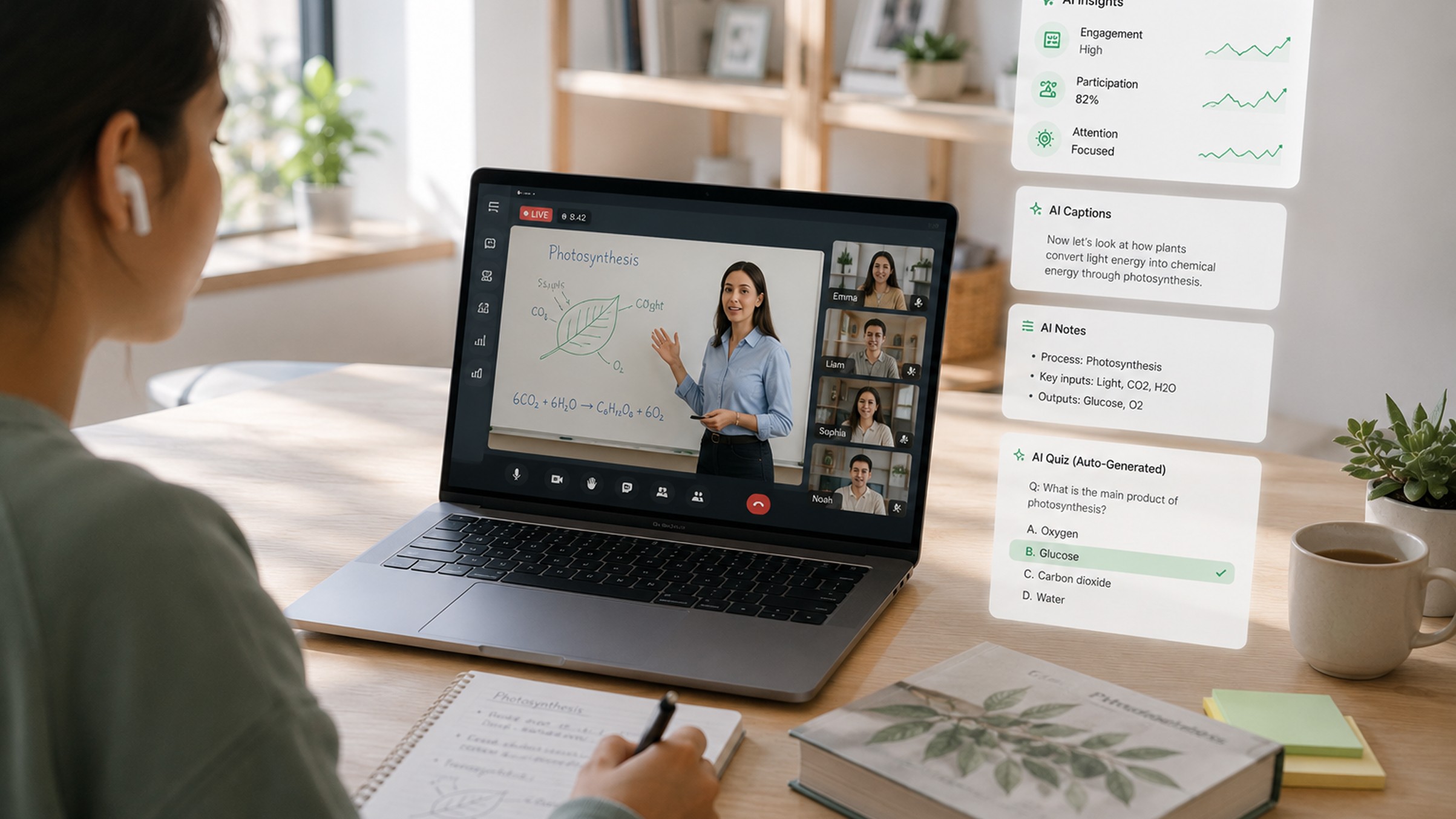
There's a version of the AI in education story that sounds like science fiction. Adaptive systems that know what each student needs before the student does. Intelligent tutors that replace instructors. Algorithms that predict outcomes with accuracy that human judgment can't match.
That version doesn't reflect what AI in live learning currently does, or what it should do.
The practical reality is less dramatic and more useful. AI in live learning environments addresses specific operational problems that organizations running online education at any scale genuinely face: session documentation that doesn't get done consistently, engagement patterns that are hard to monitor across hundreds of concurrent sessions, captions and transcripts that would require significant human labor to produce manually, and administrative overhead that pulls instructor attention away from teaching.
None of this is transformational in the science-fiction sense. All of it matters in the operational sense. And understanding the difference between those two framings is what separates AI implementation that helps from AI implementation that disappoints.
The Operational Complexity of Live Learning
Before examining what AI does in live learning environments, it's worth understanding the operational context it's working in.
Running live online education at scale is a coordination problem as much as a technology problem. Every session requires a correctly matched instructor, a prepared student, a working technical environment, and a surrounding set of workflows that manage what happens before the session starts and after it ends. As session volume grows, the number of things that have to go right simultaneously grows faster than headcount can scale to manage manually.
The specific operational gaps that accumulate in scaling live learning organizations:
Documentation doesn't happen reliably. Post-session notes, progress records, and curriculum coverage logs have genuine operational value -- they maintain continuity, inform parent communication, and enable quality monitoring. But producing them manually for every session is time-consuming, and instructors running back-to-back sessions don't have the time or energy to do it consistently.
Engagement is hard to monitor at scale. An operations team responsible for hundreds of active students cannot personally track whether each student is engaged, progressing, or at risk. Without systematic data capture and pattern detection, at-risk students tend to surface when they disengage or cancel -- too late to intervene effectively.
Communication is inconsistent. Parents expect timely updates about their child's sessions. Instructors expect pre-session context about the student they're about to teach. These communication flows have to happen reliably across every session, which is impractical through manual effort at volume.
These are the gaps AI in live learning is positioned to fill. Not by replacing teaching, but by automating the operational support that teaching depends on.
AI-Supported Engagement Visibility
In a physical classroom, engagement is partially visible through ambient signals. Body language, proximity, eye contact, the quality of silence after a question -- experienced teachers read these signals continuously and adjust their teaching based on what they observe.
In an online environment, most of those signals disappear. A grid of video thumbnails doesn't communicate what a room full of students does. The instructor can't tell, from a standard video interface, which students are actively processing and which have mentally checked out.
AI-supported engagement visibility reconstructs some of this ambient awareness through structured signals. Participation rates on polls and comprehension checks surface understanding in a form the instructor can see and respond to. Hand-raise patterns across a session indicate which students are engaged and which are quiet. Periods of inactivity in interactive tools can flag students who have disengaged. Post-session engagement summaries tell instructors which parts of the lesson produced active response and which parts didn't.
The key distinction is that these are structured signals, not surveillance. AI isn't monitoring students through their cameras or inferring emotional states from facial expressions. It's processing the interaction data that students generate by participating in session activities -- responses to polls, whiteboard contributions, chat activity, comprehension check results -- and making that data available to instructors in a useful form.
For organizations monitoring quality across many sessions simultaneously, AI-supported engagement data enables exception-based management. Rather than requiring an operations team to review every session individually, the system surfaces the students and sessions that fall outside normal engagement parameters. That exception-based model is the only scalable approach to quality monitoring in live learning at volume.
The operational value is clear: problems that would previously surface when a parent called to report their child had become disengaged can now surface two or three weeks earlier, when the pattern first appears in the data. Earlier detection means earlier intervention means better outcomes.
AI-Generated Summaries and Recaps
Of all the AI applications in live learning, automated session summaries have the most direct impact on the operational workflows that make education programs run.
The problem they address is structural, not incidental. Session documentation is necessary for continuity, for parent communication, for quality monitoring, and for the pre-session briefing that helps the next instructor pick up where the last one left off. Producing that documentation manually for every session is time-consuming. At scale, it either doesn't happen consistently, happens too late to be useful, or is abbreviated to the point of being useless.
AI-generated summaries change this by shifting the instructor's role from author to editor. When a session is transcribed in real time, an AI system can produce a structured recap from the transcript automatically: topics covered, student responses, comprehension gaps identified, recommended focus for the next session. The instructor reviews this draft, corrects inaccuracies, adds context that speech didn't capture, and approves it -- a process that takes thirty to sixty seconds rather than ten to fifteen minutes.
The human approval step is not cosmetic. It's the design feature that keeps AI summaries accurate and appropriate. Transcripts capture what was said, not always what was meant. An instructor reviewing the AI draft catches the moments where the transcript mischaracterized a student's response, missed a critical exchange, or didn't capture the context that makes a recommendation sensible. The output reflects AI efficiency and human judgment -- which is the right combination.
For education organizations, the downstream effects of consistent documentation compound quickly. Parent communication becomes timely and informative when post-session summaries are available within minutes of a session ending rather than days. Instructor continuity improves when the pre-session brief contains an accurate, structured recap of the previous session rather than notes written hastily from memory. Quality monitoring becomes data-driven when session records are complete and consistent rather than variable.
Accessibility and Captions
Live captions are one of the clearest and most straightforward applications of AI in live learning environments -- and one of the most practically important.
For students with hearing difficulties, live captions aren't an enhancement. They're a prerequisite for participation. Without them, a live session is inaccessible in the most basic sense. With them, the educational experience is available on equal terms.
For students learning in a second language, captions reduce the cognitive burden of processing unfamiliar pronunciation while simultaneously processing new content. That's a real and significant accessibility benefit, not a marginal one. Language learners in particular -- a substantial population in many online learning contexts -- benefit from having the audio signal reinforced by a text equivalent.
For any participant dealing with intermittent audio issues, background noise, or bandwidth constraints, captions provide a continuity guarantee. The session remains comprehensible even when the audio layer is imperfect.
Modern AI captioning is accurate enough to be genuinely useful across most languages and accent variations. Technical vocabulary, proper nouns, and very fast speakers still produce errors, but the error rate is low enough that captions add accessibility value rather than confusion for the majority of sessions.
The secondary benefit is infrastructure: captions generate transcripts, and transcripts are the raw material for everything else AI can do in a live learning environment. AI summaries, progress tracking, engagement analysis, curriculum coverage logging -- all of these become possible when session content exists as a searchable, processable text record. Live captioning is the mechanism that creates that record in real time. For organizations building AI capabilities into their learning infrastructure, live captioning is foundational, not optional.
AI Workflow Support for Educators
Beyond engagement visibility and session documentation, AI provides operational support to educators through the workflows that surround live sessions.
Pre-session briefings are one underutilized application. An instructor teaching their eighth session of the day, seeing a student they work with once a week, shouldn't have to reconstruct context from memory or search through old notes. A pre-session summary surfaced automatically -- here's what you covered last time, here's what the student struggled with, here's what was planned for today -- takes thirty seconds to read and meaningfully improves session quality.
Post-session workflow triggering is another. When a session ends and a summary is approved, AI can initiate a sequence of downstream actions automatically: sending a parent notification with the session recap, updating the student's progress record, logging curriculum coverage, flagging the next session's focus areas for the instructor. These workflows would otherwise require manual coordination across multiple systems. AI handles the routine orchestration; humans handle the exceptions.
Progress monitoring across time is a third application. A single session's data is informative for the instructor in that session. Data across twenty sessions for the same student reveals a learning trajectory. Data across all students with a particular instructor reveals something about session quality. AI can surface these longitudinal patterns -- flagging the student whose comprehension scores have declined over five sessions, or the instructor whose sessions consistently run short -- that would be invisible without systematic analysis of accumulated session data.
The common thread is operational intelligence: AI processes the data that live learning generates and surfaces the patterns and signals that help instructors teach better and organizations manage quality more proactively. It doesn't make decisions. It makes the people making decisions better informed.
What AI Should Not Replace
The case for AI in live learning is strong on operational grounds. The limit is equally clear.
AI should not replace the instructor's relationship with the student. The trust that makes a student willing to ask a question they think is stupid, or admit they're lost, or try again after failing -- that's built through human interaction over time. No engagement signal or AI summary contributes to it. What AI can do is give instructors more time and attention to invest in those relationships by reducing the administrative overhead that competes for the same attention.
AI should not replace professional judgment about what a student needs. An AI system can flag that a student's engagement has declined across six sessions. It cannot determine whether the right response is a different teaching approach, a conversation about what's happening outside of academics, a change in session timing, or simply patience while the student works through a difficult period. That determination requires knowing the student as a person -- which is a human capability.
AI should not monitor students in ways that feel punitive or surveillance-like. Engagement signals are useful when they give instructors better ambient awareness and help organizations catch at-risk students earlier. They become counterproductive when students perceive them as a mechanism for catching inattentiveness or punishing distraction. The frame matters: AI is there to help students succeed, not to produce evidence against them.
The division of labor that makes AI useful in live learning is consistent across all of these applications: AI handles the processable, the pattern-based, and the administrative. Instructors handle the relational, the contextual, and the judgment-dependent. When that division is respected, AI in live learning delivers real operational value without eroding the human qualities that make education worth receiving.
Platforms like HiLink implement AI with this division in mind -- building engagement visibility, automated session summaries, accessibility tools, and workflow support into the operational layer of live classroom infrastructure. The AI handles what the platform should handle so instructors can focus on what only they can do.
That's the version of AI in live learning that's worth building. And it's available now, without waiting for the science-fiction version to arrive.